London’s Millennium Bridge
The sleek Millennium Bridge was London’s first new crossing over the River Thames in 100 years. Famous for the wobble that spoiled its opening, the footbridge cuts an impressive route between St Paul’s Cathedral and Tate Modern.
Bankside & Peter’s Hill
10 June 2000 (reopened February 2002)
Who designed the Millennium Bridge?
The design was a collaboration between the architects Foster and Associates, the engineering firm Ove Arup and the sculptor Anthony Caro.
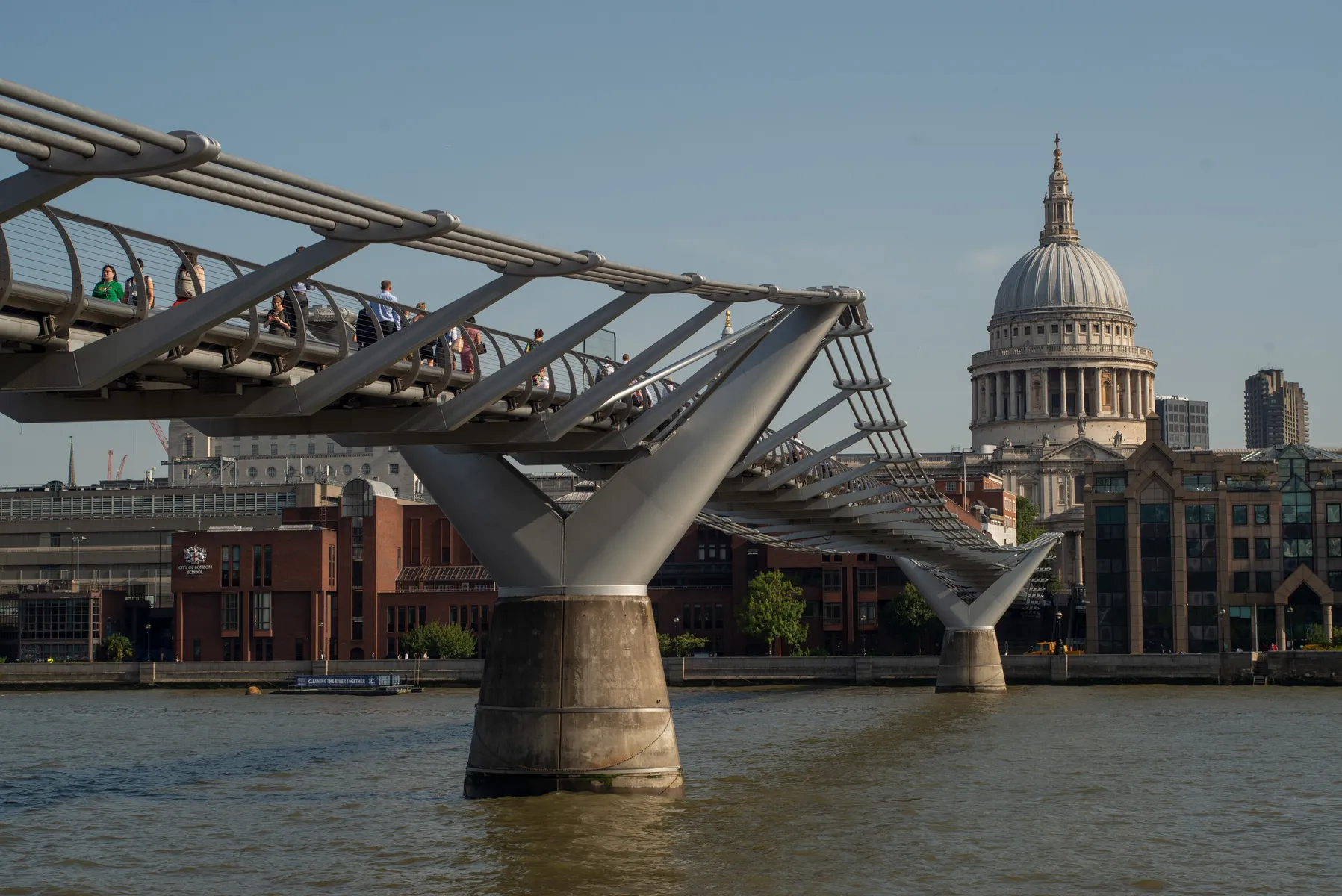
Their 325-metre-long creation is a distinctively minimal structure. A four-metre-wide walkway rests on a slim skeleton of supports, strung between two Y-shaped pylons bedded into the river on piers.
This design was a bold twist on the typical suspension bridge. You’d usually see tall towers supporting the structure’s weight, as we have on Albert Bridge and Hammersmith Bridge further west along the Thames.
Instead, the Millennium Bridge gives pedestrians uninterrupted views all around. Without prominent structures holding you up, it can feel like levitating above the churning river, fully exposed to the elements.
St Paul’s dome looms at one end, Tate’s vast chimney at the other. The task, said architect Norman Foster, was “to create a bridge so sleek that it does not fight for attention with the historical monuments for which it provides a link.”
Why was it built?
As the year 2000 approached, a number of construction projects were started to mark the new millennium. London was transformed by landmarks like the London Eye and the Millennium Dome.
The Tate Modern gallery also opened in the year 2000, occupying a vast disused power station at Bankside, on the south bank of the River Thames.
That project injected momentum into an existing idea for a pedestrian bridge to connect Southwark and the City of London. A bridge to St Paul’s was proposed as early as 1851. Parliament gave their backing in 1911, before the First World War (1914–1918) put the project on hold.
In 1996, a competition seeking designs was launched by Southwark Council, the Royal Institute of British Architects and the Financial Times newspaper. There were over 200 submissions, but Foster, Ove Arup and Caro provided the winning design.
-
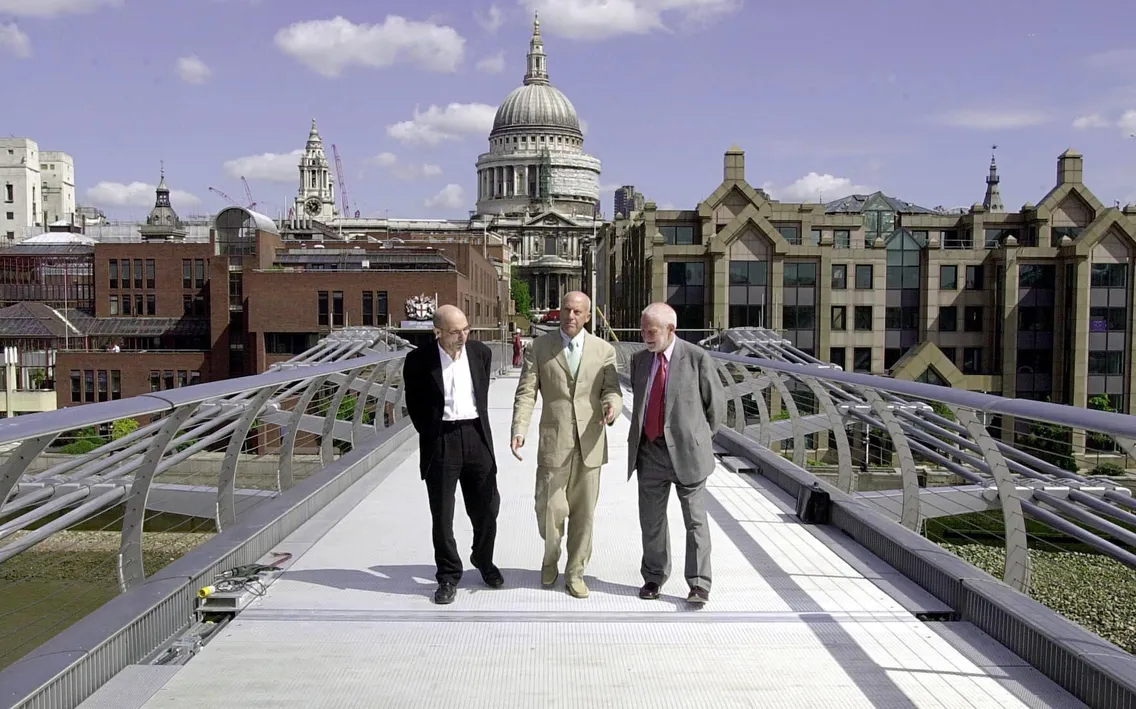
Tony Fitzpatrick of Arup with Norman Foster and Anthony Caro on the bridge in May 2000.
-
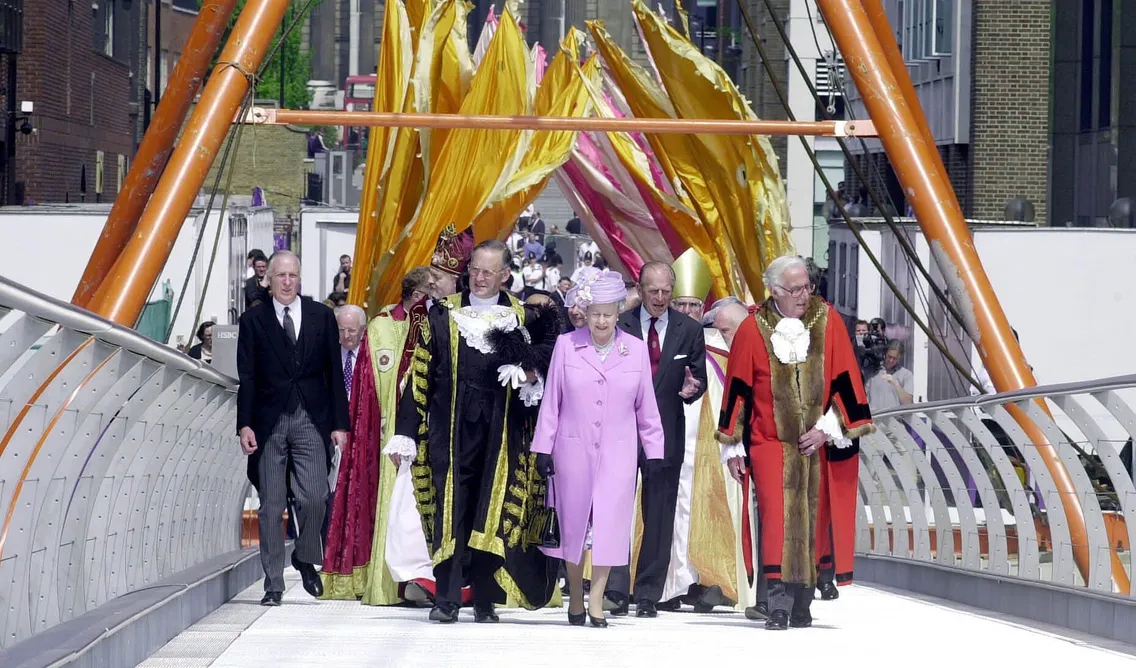
Queen Elizabeth II, the mayor of Southwark and the Lord Mayor of London opened the bridge in June 2000.
When did the Millennium Bridge open?
Construction began in November 1998, and the bridge was opened by Queen Elizabeth II on 10 June 2000. It was the first new crossing over the River Thames to be built in London since Tower Bridge opened in 1894. About 90,000 people crossed the bridge on its opening day.
However, the bridge was closed just days after opening following reports that it was wobbling.
Why did the bridge wobble?
The bridge was a victim of its own success. The footsteps of thousands of people crossing at once caused vibrations, making it sway. As people stepped to steady themselves, it amplified the swaying motion. It was an embarrassing failure for such a large and symbolic project. The wobbling gained international media attention.
The solution was to install giant shock absorbers, like suspension on a car or bike. These helped to reduce the movement of the structure.
It took over a year and a half to fix. The bridge reopened in February 2002.
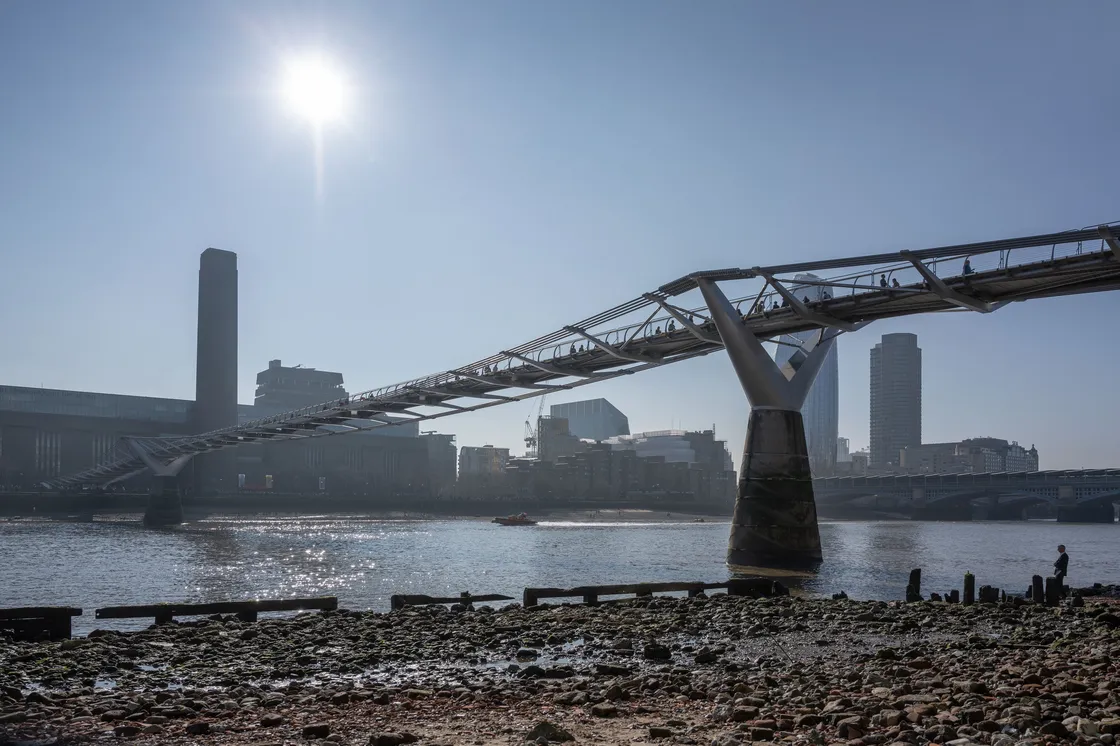
Tate Modern is at the bridge’s southern end.
Connections
A walk across the Millennium Bridge is a tourist’s dream, taking you between London’s past and its future.
Look north and you’ll see St Paul’s Cathedral, an emblem of the City of London and its deep history. Look south and you’ll see Tate Modern, an art gallery that symbolises London’s creativity and embrace of avant-garde ideas.
The southern tip of the bridge touches down at Bankside in Southwark. In the 16th and 17th centuries, this was London’s entertainment district, a place beyond the rules of the City for theatres, bear-baiting and brothels. In the 20th century, when the power station now home to Tate Modern was in operation, oil barges once moored here.
The northern end of the bridge drops you at Peter’s Hill in the City of London, with Upper Thames Street and Castle Baynard Street running beneath your feet.
The nearest bridge to the east is Southwark Bridge. To the west, it’s Blackfriars Railway Bridge.