Albert Bridge
A hybrid of three construction styles, Albert Bridge is one of the most unusual bridges in London. It’s also one of the most resilient, remaining standing despite recurring structural issues and closures.
Battersea and Chelsea
Since 1873
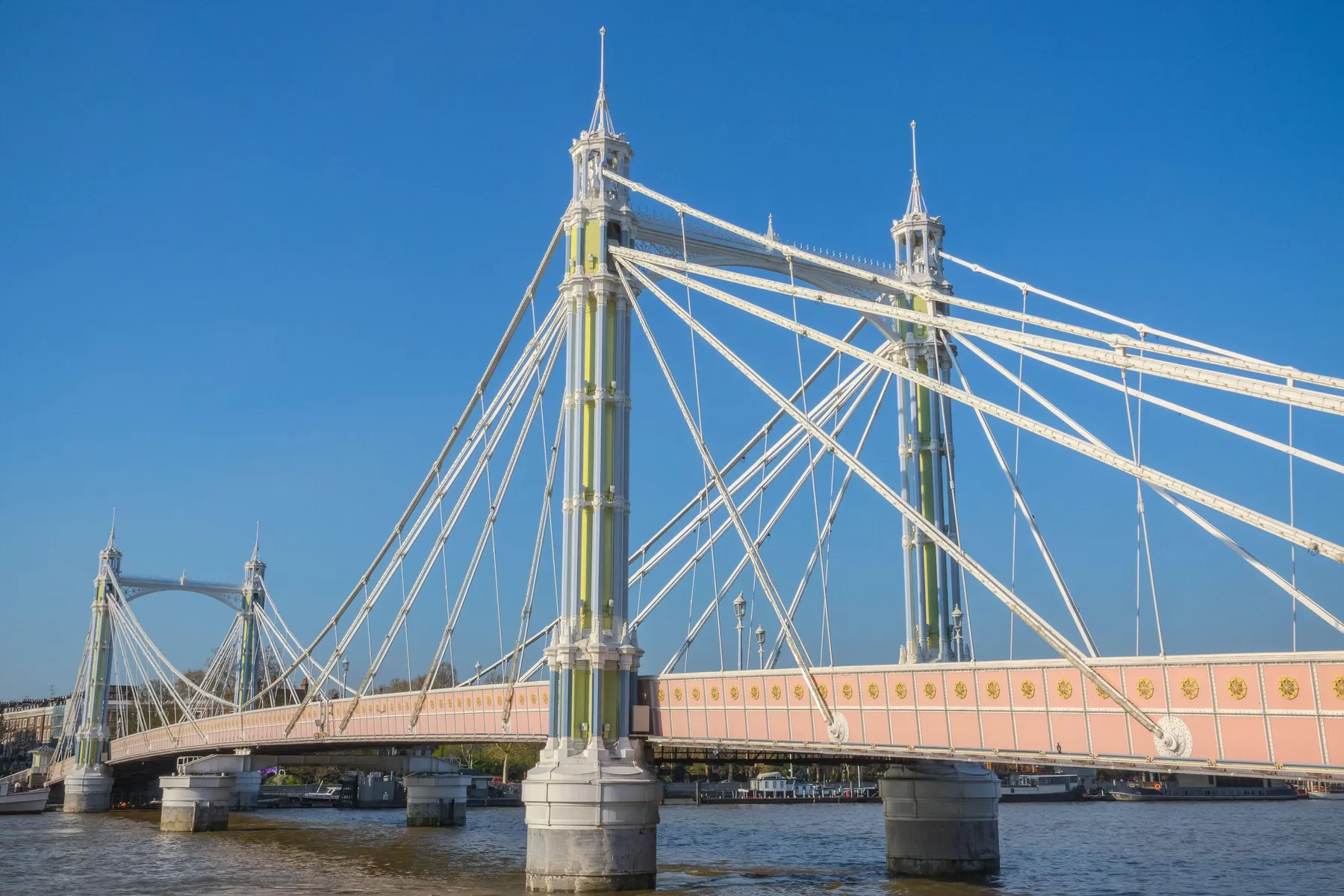
The bridge has a unique design
Albert Bridge was opened in 1873 and named after Prince Albert, the husband of Queen Victoria. It was originally a toll bridge, although crossing charges were abolished just six years later. The toll-booths, two on each side at either end, remain the only surviving examples of bridge toll-booths in London.
Albert Bridge, originally designed by engineer Roland Mason Ordish, is a hybrid of multiple construction styles. It features both cable-stayed and suspension elements, including straight wrought-iron bars supporting each half of the bridge and vertical steel suspenders.
The bridge’s cast-iron towers were, at the time, the largest such structures ever cast. This was done at a nearby Battersea metalworks so that they could be floated down the River Thames to be put into position.
Extensive strengthening work carried out between 1972 and 1973 gave Albert Bridge elements of a beam bridge, where a horizontal steel beam supports the middle section.
London’s original wobbly bridge?
More than a century before the Millennium Bridge opened with a wobble, Albert Bridge was shaking. It was nicknamed ‘The Trembling Lady’ as the bridge would vibrate when a large number of people crossed it. The vibrations were such an issue that signs were erected ordering troops from nearby Chelsea Barracks to ‘break step’ when crossing. You can still see these signs on the toll-booths today.
Structural issues have plagued Albert Bridge from the outset. Between 1884 and 1887, it was strengthened by Joseph Balzagette, the man behind our modern sewage system and several other London bridge designs. He replaced the rusting steel cables with steel link chains.
A two-tonne weight limit was introduced in 1973 to help the bridge cope with the demands of modern traffic. Since 2012, the restriction has been three tonnes. Penalty fines have been enforced from 2024 in an effort to protect the historic structure.
“shining with electric lights, grey and airy against the London sky, it is one of the beauties of the London river”
John Betjeman
-
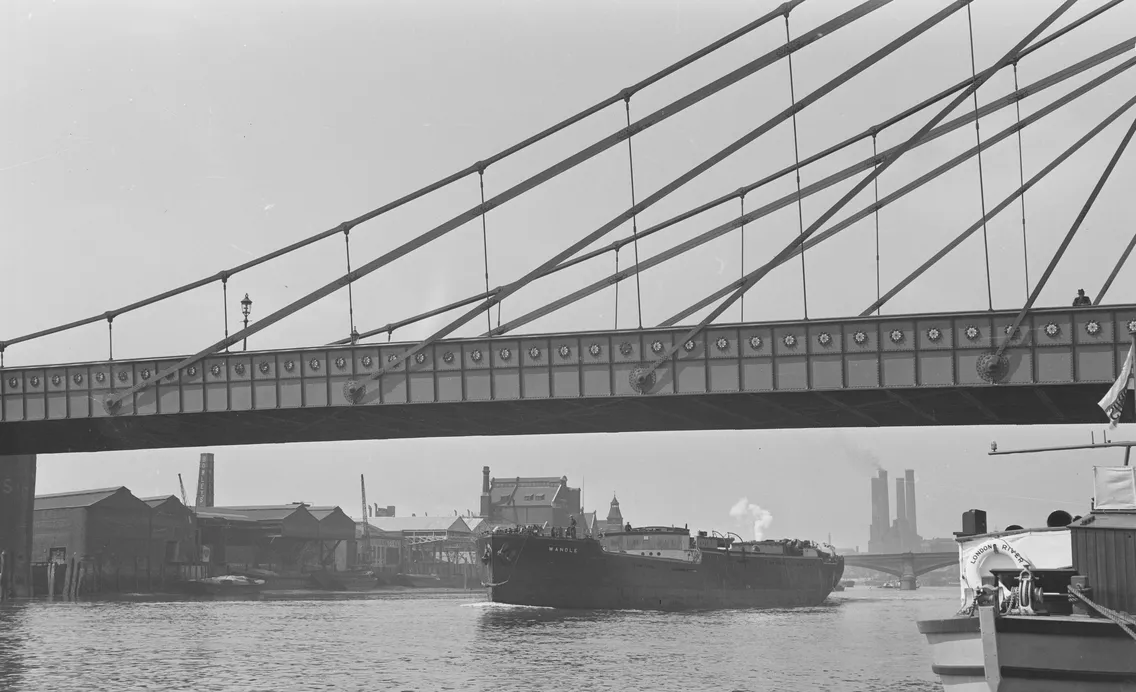
A ship passing under Albert Bridge in 1934.
A true survivor
Despite these persistent structural problems and several attempts at demolition, Albert Bridge has stood strong.
A 1957 plan to demolish the bridge was thwarted by a spirited campaign led by the poet John Betjeman. He described Albert Bridge as “shining with electric lights, grey and airy against the London sky, it is one of the beauties of the London river”.
A 1973 proposal to close the bridge and transform it into a public park was unsuccessful. It’s not dissimilar to the Garden Bridge project, which also failed due to spiralling costs. This was an idea developed by Heatherwick Studio and Joanna Lumley, to create an elevated park on a new pedestrian bridge across the Thames.
Albert Bridge was closed between 2010 and 2011 for repair. Nodding to the bridge’s royal namesake, two dogs from Battersea Dogs Home, Prince and Albert, were the first to walk across the restored bridge. There were further closures in 2026 following the discovery of a crack in the cast iron and changes in movement of the bridge.
Along with Tower Bridge, the Grade II-listed Albert Bridge is one of only two London bridges to have never been replaced.
-
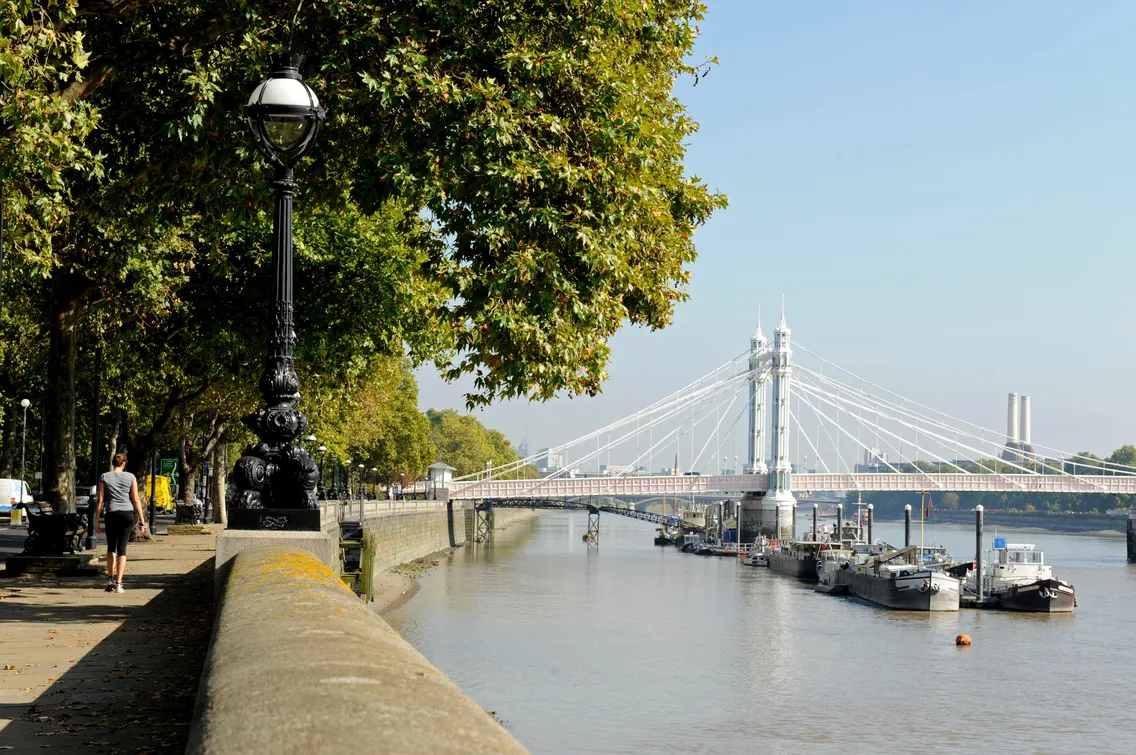
Albert Bridge as seen from Chelsea Embankment.
Colour and lights
Albert Bridge has had various paint jobs over the years. It was pastel green from 1905 to 1981, before being repainted yellow. The current pastel pink, green and blue colour scheme was introduced in 1992 to help make the bridge more visible in foggy weather.
It’s also illuminated at night. The original lights, added for the Festival of Britain in 1951, have since been replaced with 4,000 LEDs.
Connections: Battersea and Chelsea
Albert Bridge connects Battersea on the south side of the river with Chelsea on the north. It’s the third bridge in the area, with Battersea Bridge (opened in 1771) to the west and Chelsea Bridge (opened in 1858) to the east.
The bridge meets the north-west corner of Battersea Park on its south side. Across the river is storied street Cheyne Walk. Its residents have included members of the Rolling Stones, George Eliot, JMW Turner, Bertrand Russell, TS Eliot, David Lloyd George, Bram Stoker and Ian Fleming. Chelsea Physic Garden, London’s oldest botanical garden, is also close to the Chelsea end of the bridge.
Tags
-
Paintings, Prints & Drawings
 Paintings, Prints & Drawings
Battersea Bridge from the Albert Bridge (oil on canvas)
Cast, Jesse Dale
1951-1960
-