Roman — Roman; mid-1st-mid-2nd century
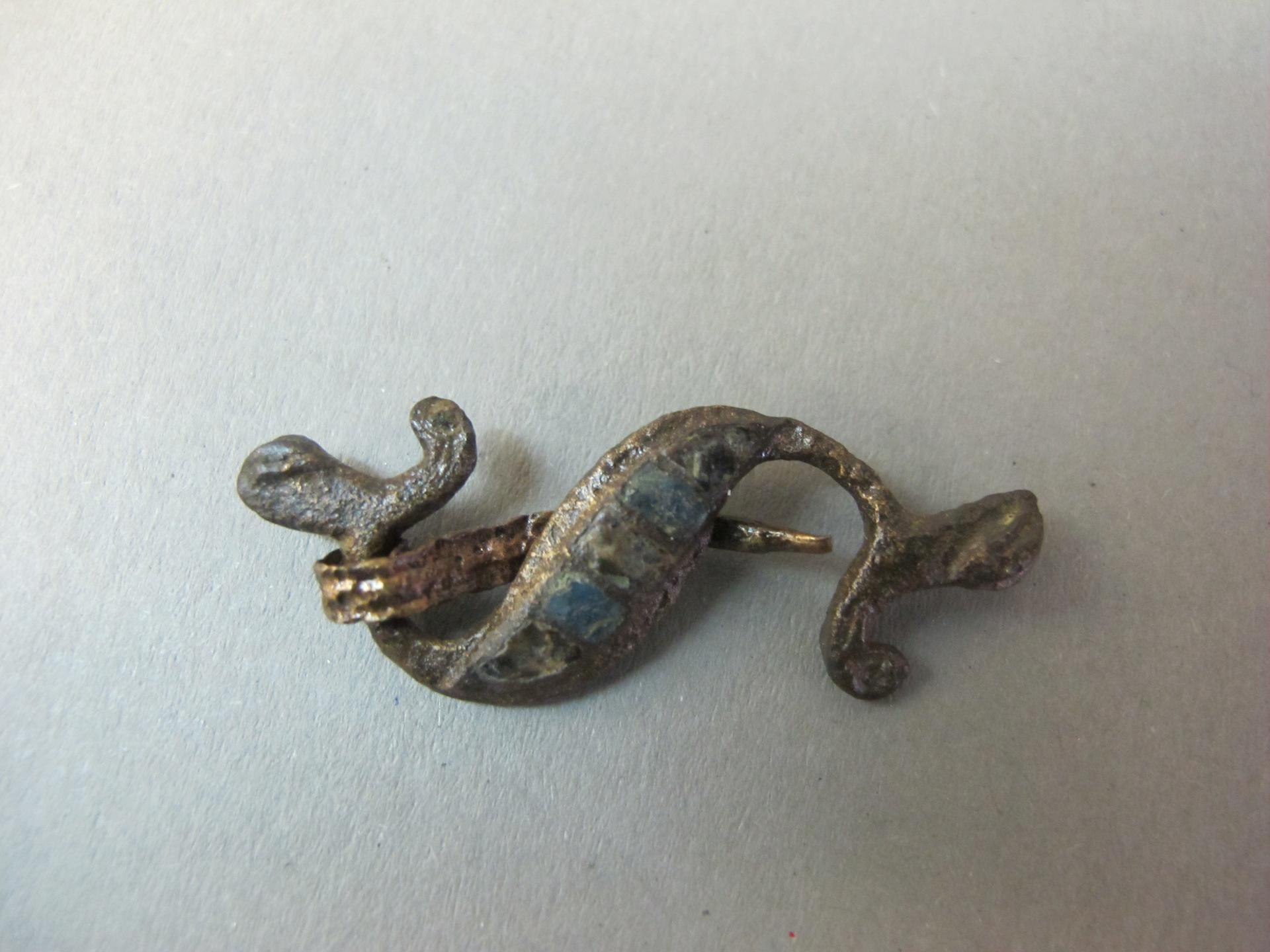
Brooch, dragonesque brooch
Plate brooch, copper alloy. The flat S-shaped surface is divided into segments filled with blue enamel (champleve). Large pin is ancient replacement. Brooches of this form are known as 'dragonesque' and are native to Britain, probably manufactured in the North. It seems that the form was originally based upon a Celtic abstract motif, that of two cornucopias (horns of plenty) joined mouth to mouth at the centre. Later, smaller stylised trumpets were added to the ends of the cornucopias, forming the 'heads' which with the later addition of a decorative 'eye', completed the brooches' zoomorphic appearance. Hence the modern name (Hatatt 1982, 152-3). Note the example from Lamberton Moor, Berwickshire (Robertson 1970, 218, fig 10), and a much simpler form recovered from the Thames foreshore, Billingsgate (Hatatt 1987, 166 no 1025).
The type dates from the mid 1st century to the mid 2nd century.
Tokenhouse Yard EC2. Murdoch, 1991, 338, Souvenirs and Novelties; Guildhall Museum 1908, no 81. (Dragonesque)
- Category:
- Roman
- Object ID:
- 81
- Object name:
- brooch, dragonesque brooch
- Object type:
- Artist/Maker:
- —
- Related people:
- Related events:
- Related places:
- Production date:
- Roman; mid-1st-mid-2nd century
- Material:
copper alloy, enamel
- Measurements/duration:
- L 41 mm, W 15 mm
- Part of:
- —
- On display:
- —
- Record quality:
- 40%
- Part of this object:
- —
- Owner Status & Credit:
Permanent collection
- Copyright holder:
digital image © London Museum
- Image credit:
- —
- Creative commons usage:
- CC BY-NC 4.0
- License this image:
To license this image for commercial use, please contact the London Museum Picture Library.
Download image file
You are welcome to download and use this image for free under Creative Commons Licence CC BY-NC 4.0.
Credit: London Museum
To licence this image for commercial use please contact the London Museum Picture Library