A history of Regent’s Park & Primrose Hill
Once Henry VIII's hunting grounds, Regent's Park and Primrose Hill are now part of central London’s 'green lung'. Both parks are a testament to London's evolving relationship with nature and public space.
City of Westminster & Camden
Since 1539
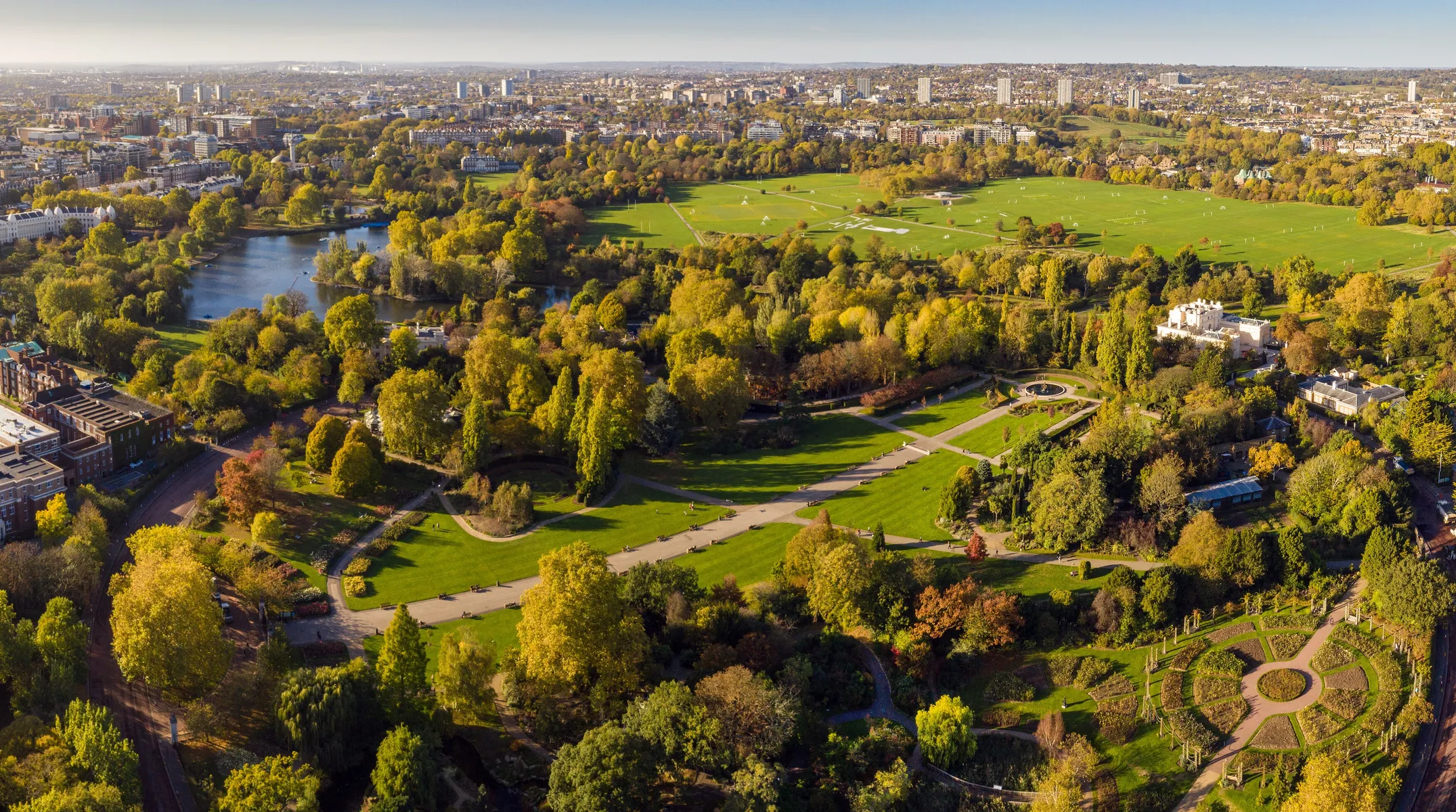
An aerial view of Regent’s Park.
Sweeping views and roses in bloom
Spreading from Westminster into Camden, the adjacent parks of Regent’s Park and Primrose Hill are among London’s horticultural crown jewels.
Like many of the other royal parks, these two were King Henry VIII’s royal hunting grounds in the 1500s. About 250 years later, the areas surrounding them have become some of London’s most sought-after neighbourhoods.
Regent’s Park and its surrounding terraces were designed by one of the Georgian era’s most prominent architects, John Nash, in the early 1800s. It’s home to London’s oldest scientific zoo, oldest outdoor theatre and biggest rose garden, Queen Mary’s Garden.
On a clear day, it’s not uncommon to find Londoners thronging at the Primrose Hill summit, just enjoying the view. The park’s views of St Paul’s Cathedral and the Palace of Westminster are protected by law.
-
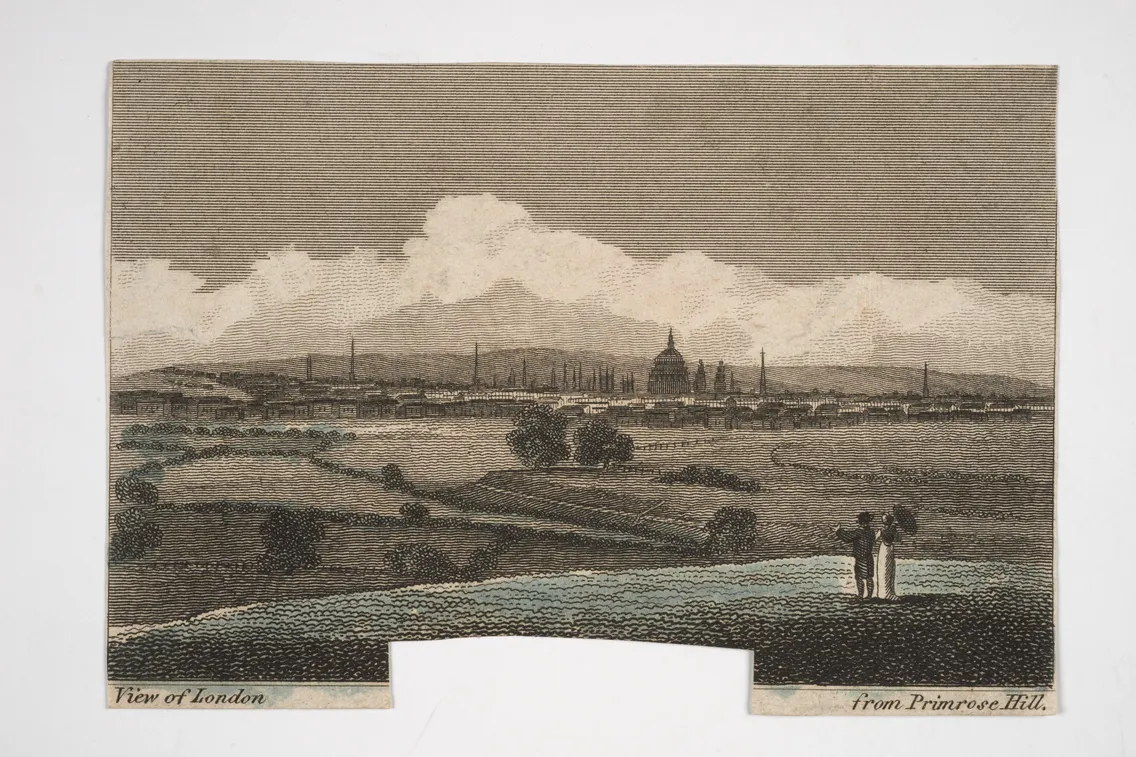
View of London from Primrose Hill, around 1820.
A Tudor beginning
Before becoming public parks, this area was known as Marylebone Park, part of the vast forest of Middlesex. In 1539, King Henry VIII seized a large section of this land to add to his royal collection of hunting grounds.
The delightful name ‘Primrose Hill' is said to have originated in the second half of the 17th century, when golden primroses reportedly carpeted the hillside.
Regent’s Park & John Nash’s grand vision
In the early 1800s, the prince regent (later King George IV) commissioned renowned architect John Nash to redesign the area. The 1827 map in our collection below shows the ambitious scope of the redevelopment. The grand, rounded park is encircled by terraces and the newly built Regent’s Canal. Inside the park, there’s fancy villas, a lake and the menagerie of the Zoological Society of London, which became London Zoo.
-
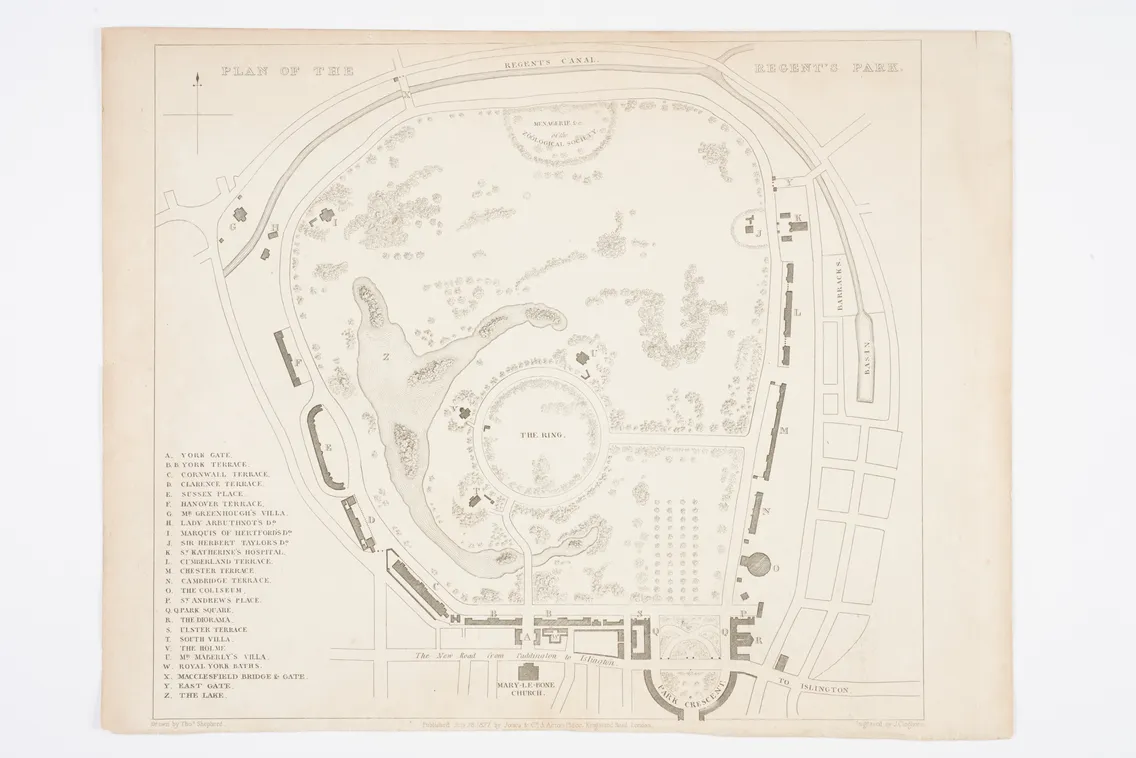
The artist Thomas Hosmer Shepherd included this map in his 1827 book Metropolitan Improvements.
The park and surrounding terraced crescent brought together residential, functional and green spaces in a way that raised the bar for landscape design and town planning. Nash created a picturesque and very desirable postcode, linked to the new Regent’s Canal and redesigned Regent Street that he created for the prince.
Innovation in the 19th-century parks
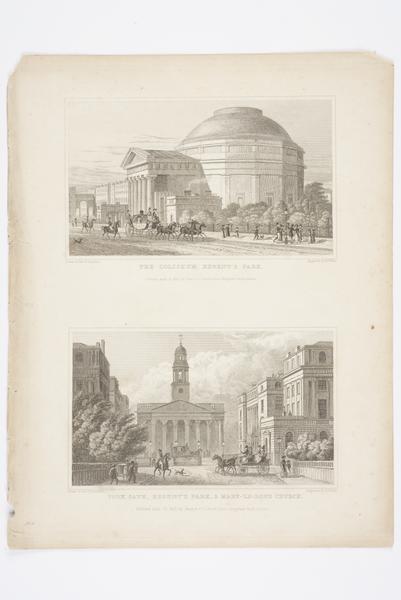
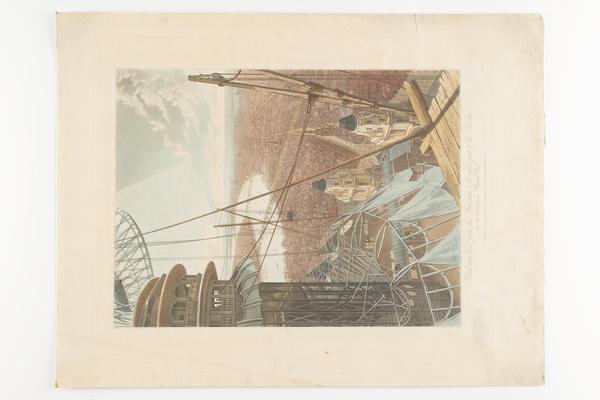
The parks were also witness to 19th-century engineering. It’s said that Britain’s first steam-driven hydraulic lifts, known as ‘ascending rooms’, were constructed here in the Colosseum in the 1820s. The Colosseum was originally built to display works of art, most notably London’s largest panorama by Thomas Hornor. The lift was later fitted to give paying people an unparalleled view of London. By 1875, it had fallen into disrepair and was demolished.
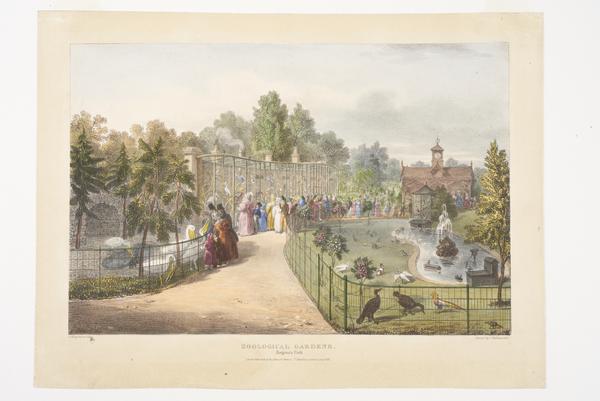
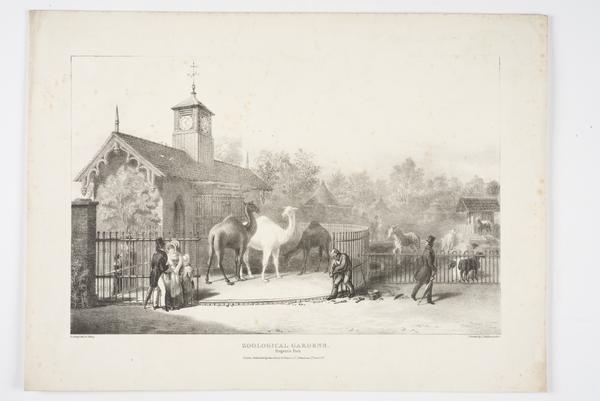
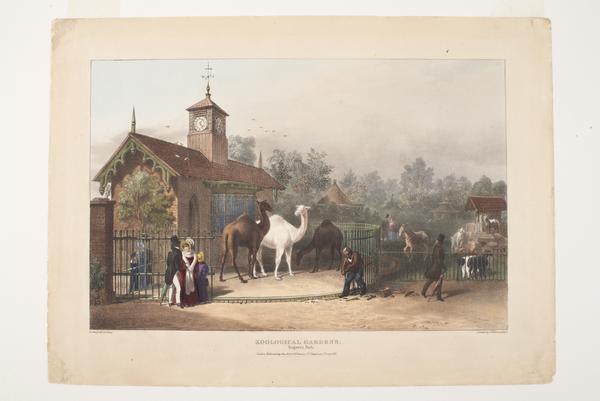
In 1828, the world’s oldest scientific zoo, the London Zoo, opened its gates in one corner of Regent’s Park. This was for the members of the Zoological Society of London. The zoo was opened to the public in 1847.
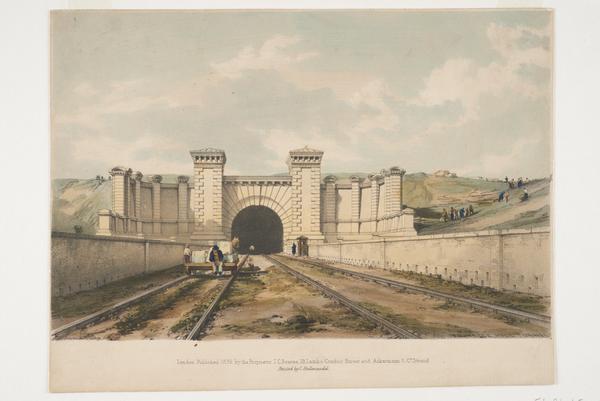
In the meantime, in 1837, the Primrose Hill Tunnel – now Grade II* listed – was opened to the north of the hill. It was the first railway tunnel in London and became a popular tourist attraction.
-
Paintings, Prints & Drawings
 Paintings, Prints & Drawings
Zoological Gardens, Regent's Park (coloured lithograph)
Scharf, George, Hullmandel, Charles, Hullmandel, Charles
1835
-
Paintings, Prints & Drawings
 Paintings, Prints & Drawings
The Coliseum, Regent's Park / York Gate, Regent's Park, & Mary-le-bone Church (engraving)
Shepherd, Thomas Hosmer, Jones & Co.
1827-04-21
-
Paintings, Prints & Drawings
 Paintings, Prints & Drawings
Primrose Hill Tunnel, 1839 (coloured lithograph)
Hullmandel, Charles
1839
-
Paintings, Prints & Drawings
 Paintings, Prints & Drawings
Bird's Eye View from the Staircase & the Upper Part of the Pavilion in the Colosseum, Regent's Park (coloured aquatint)
Ackermann, Rudolph
1829-06
-
Paintings, Prints & Drawings
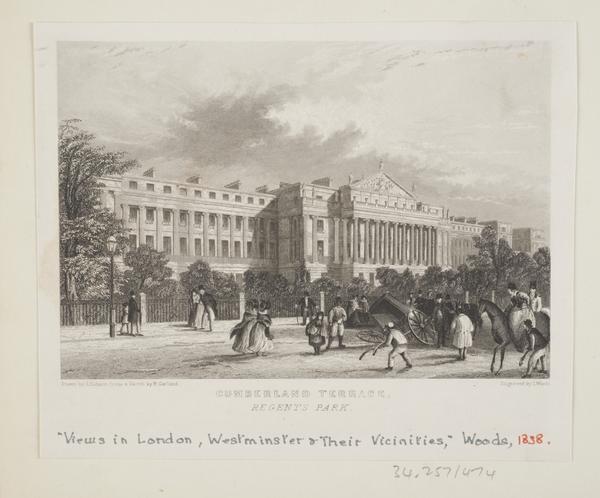 Paintings, Prints & Drawings
Cumberland Terrace, Regent's Park (engraving)
Garland, R., Salmon, J., Woods, J.
1838
The spectacular views from Primrose Hill
The grassy summit of Primrose Hill has long been famous for its views across the city. It became a public park in 1842 after the land was bought from the prestigious boys' school Eton College. Before then, the areas of Primrose Hill and neighbouring Chalk Farm were notoriously secluded spots for duels.
The trees have been deliberately kept low to preserve the two sightlines towards St Paul’s Cathedral and Westminster – it’s one of London’s six protected viewpoints. The summit sits 63 metres above sea level and has inspired painters to capture the London skyline from there.
Wars and resilience
The First World War (1914–1918) left both the parks relatively unscathed. A post office building was erected in Regent’s Park, and one of the mansions served as a home for blind servicemen.
The Second World War (1939–1945) proved far more destructive. An anti-aircraft battery was placed at Primrose Hill, and the area was used for training troops.
During the Blitz, bombs destroyed several of the Nash terraces, as seen in this painting by Angela Latham. They also grievously damaged the market area to the east. Slow rehabilitation work from the 1950s to the 1970s restored them to their former glory.
-
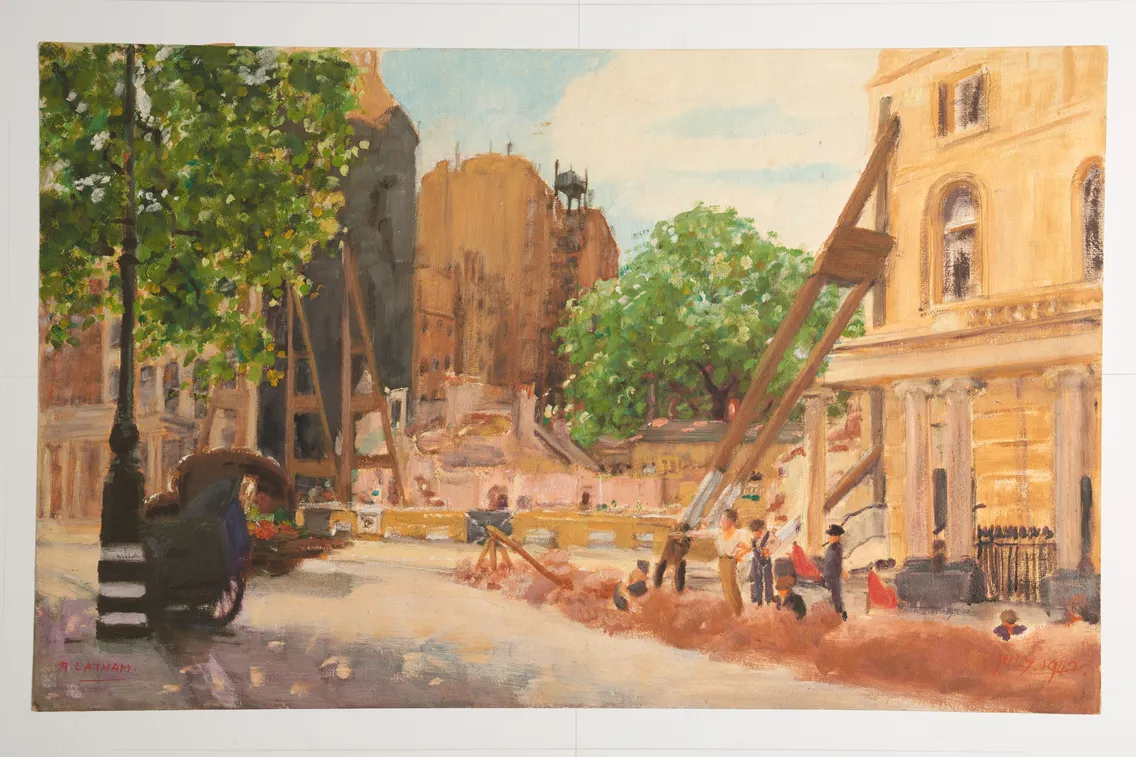
A painting by Angela Latham showing the impact of the Second World War on an area of Regent's Park.
-
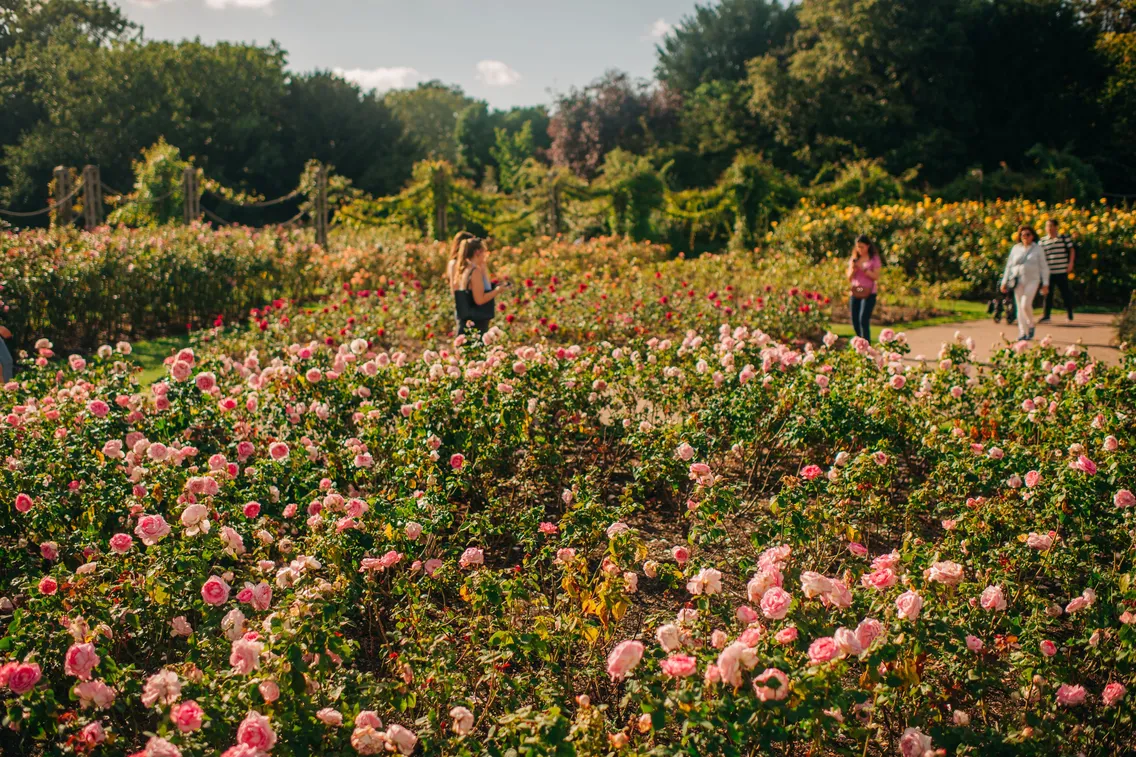
Thousands of roses bloom together in Queen Mary’s Gardens.
On 20 July 1982, the Regent's Park bandstand was targeted by the Irish Republican Army (IRA). This IRA attack killed seven bandsmen and injured 24 others during a military concert.
Today, a memorial plaque commemorates those who lost their lives, and annual services honour their memory.
“Queen Mary’s Gardens is the jewel in Regent’s Park’s crown”
The parks today
Queen Mary’s Gardens, London’s largest rose garden, is the jewel in Regent’s Park’s crown. It was opened in 1932 and named after the wife of the ruling King George V. The thousands of roses create a spectacular display when they bloom simultaneously in early June.
London’s oldest and one of its largest outdoor theatres was also opened in Regent’s Park in 1932. The Regent’s Park Open Air Theatre, which has over a thousand seats, has won several awards over the years.
Wildlife thrives in Regent’s Park. Birdwatchers can spot at least 120 species, while the parks host central London’s only breeding population of hedgehogs.
Tags
-
Paintings, Prints & Drawings
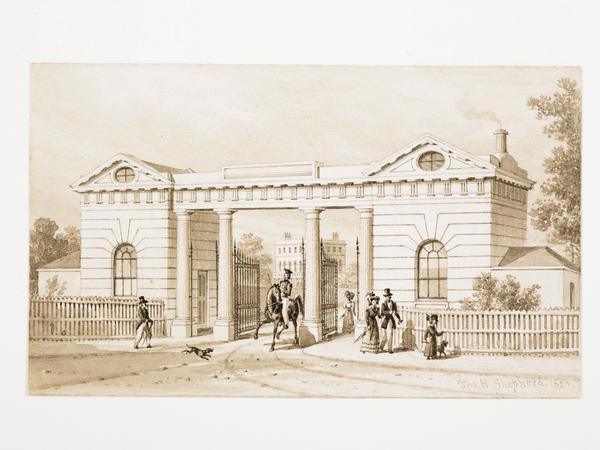 Paintings, Prints & Drawings
East Gate Park, Regent's Park (watercolour)
Shepherd, Thomas Hosmer
1827
-
Paintings, Prints & Drawings
 Paintings, Prints & Drawings
Zoological Gardens, Regent's Park (lithograph)
Scharf, George, Hullmandel, Charles, Hullmandel, Charles
1835
-
Paintings, Prints & Drawings
 Paintings, Prints & Drawings
Zoological Gardens, Regent's Park (coloured lithograph)
Scharf, George, Hullmandel, Charles, Hullmandel, Charles
1835