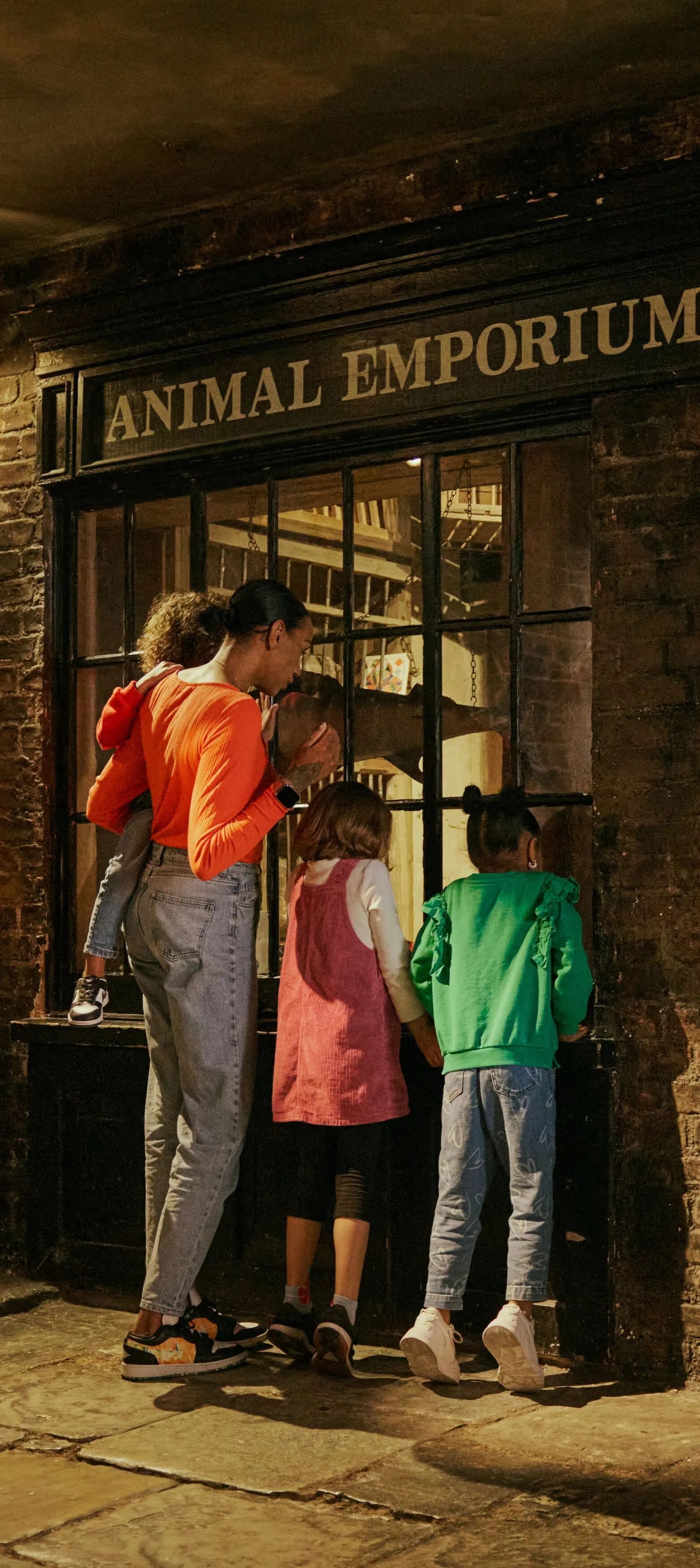
Portobello Market: London’s largest antiques market
Once a humble country lane, Portobello Road is home to one of London's most popular markets. Its bohemian vibe and stalls overflowing with antiques have been shaped by communities, celebrities and cultural movements over 150 years.
Notting Hill, Kensington & Chelsea
Since 1870
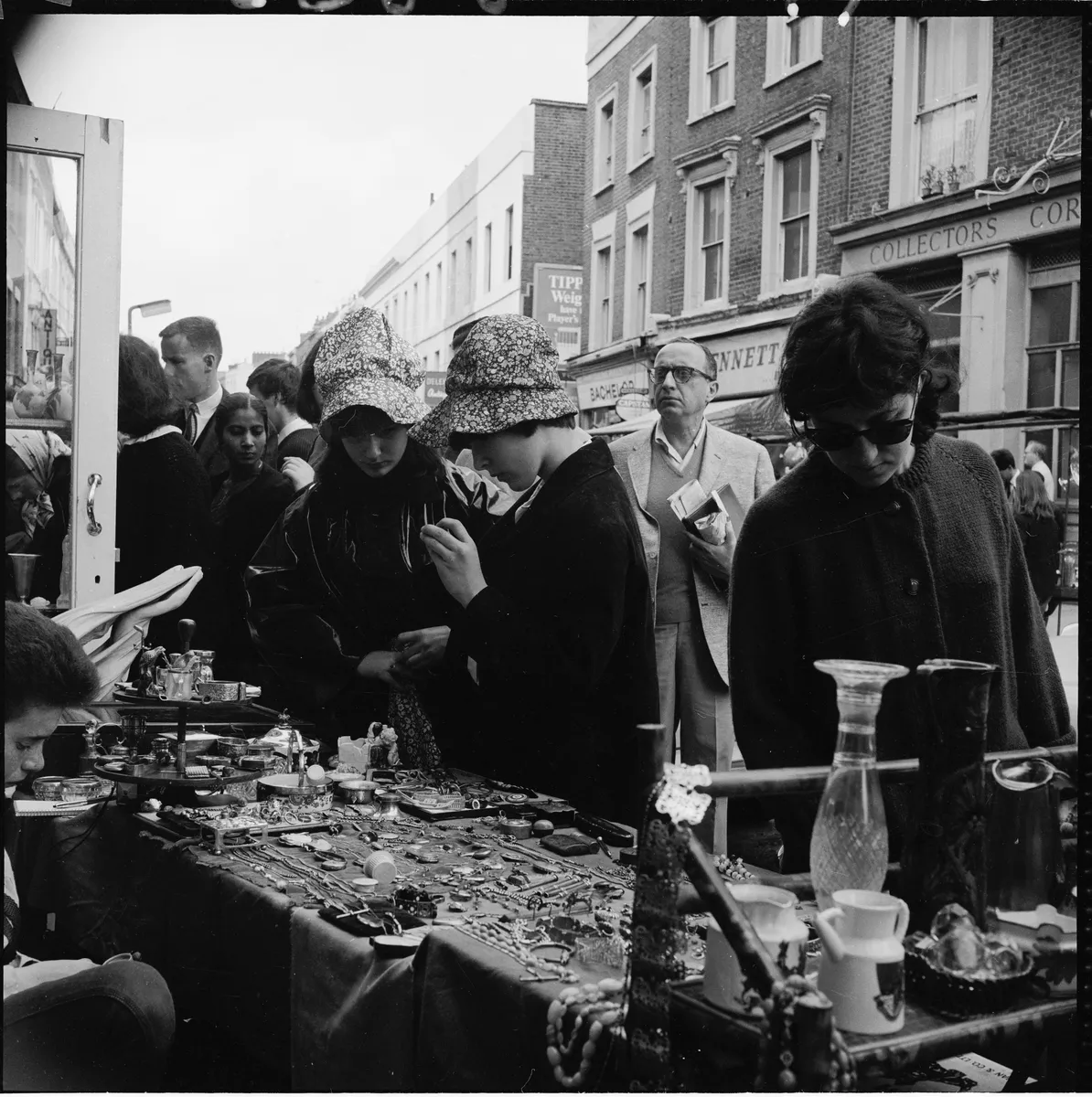
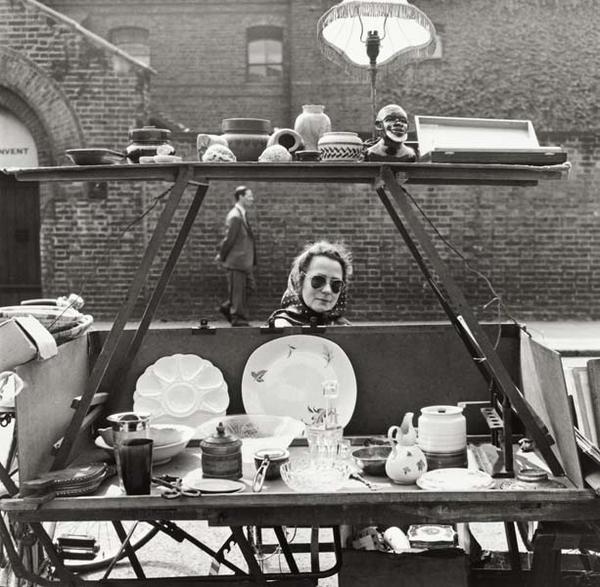
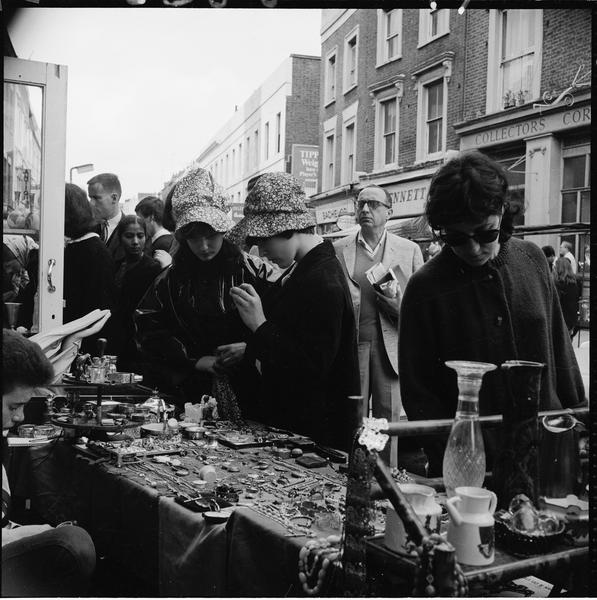
A stall at Portobello Road Market, 1965.
Where the riches of ages are stowed
Portobello Market, in the borough of Kensington and Chelsea, was established by 1870. At first, traders primarily sold fresh food and essentials. But since the 1940s, Portobello has evolved into one of the UK’s largest antiques markets.
The market’s 1,000 vendors stretch along Portobello Road and Golborne Road and are split into five sections: second-hand goods, fashion, household essentials, fruits and vegetables, and the main draw – antiques. Saturday is the main day when all five mini markets are open.
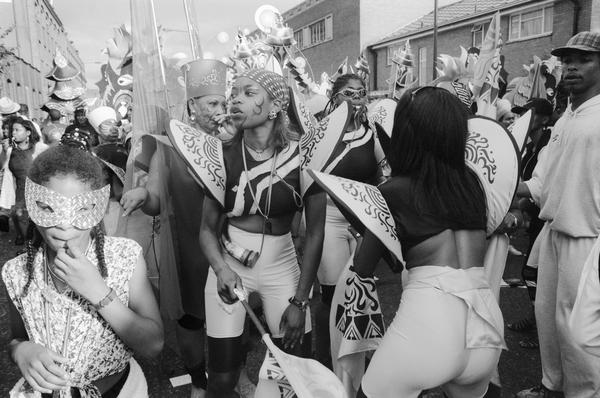
The incredible popularity of the market today can partly be traced back to the Swinging Sixties, when a fashionable, creative crowd began living and shopping in the area. Since 1966, Portobello Road has also played host to a world-famous celebration of Caribbean culture, the Notting Hill Carnival. Films such as Notting Hill and Paddington Bear have only added to the area’s fame.
Portobello Road took its name from a farm
In the 1700s, what we now call Portobello Road was a country lane winding through farmland. Farmers sold their produce along the lane, planting the seed for the market.
The lane’s name came because it led to Portobello Farm, itself named after the British navy’s victory at Porto Bello in Panama in 1739. Just off Portobello Road, you’ll find Vernon Yard, honouring the admiral, Edward Vernon, who commanded the British ships.
-
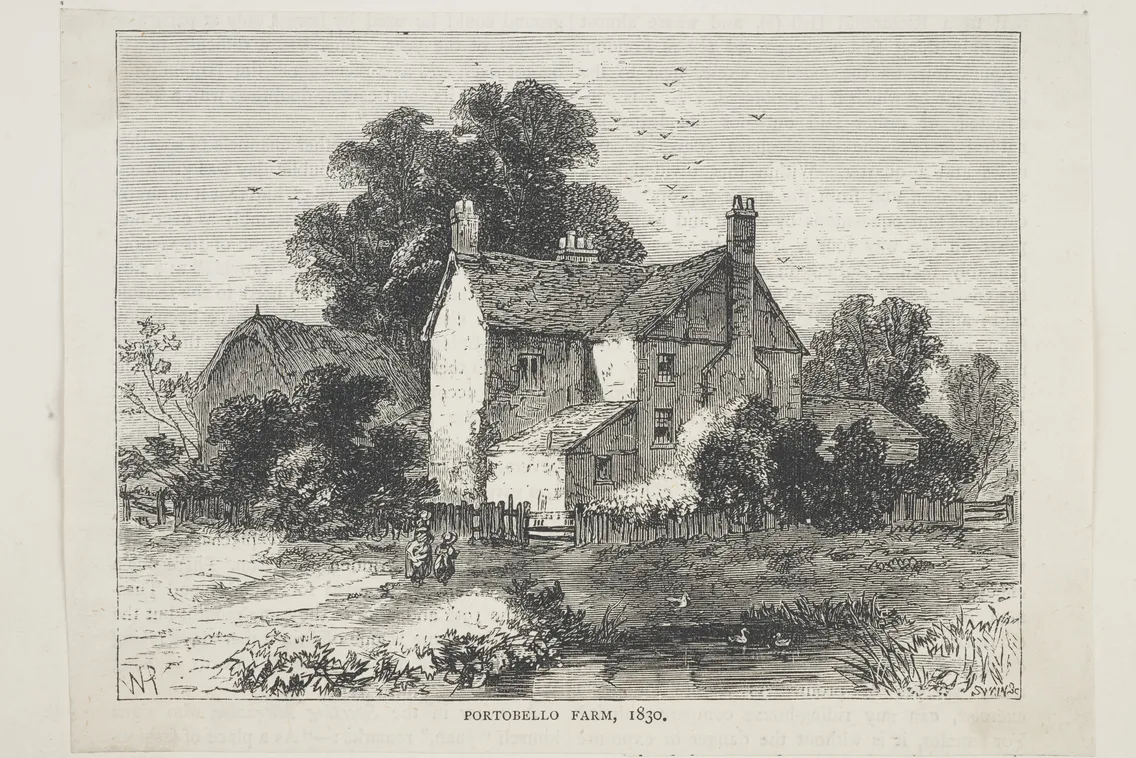
A print showing Portobello Farm, 1830.
The urbanisation of Portobello Road
The mid-1800s brought a wave of urban expansion to the area. As neighbouring Paddington and Bayswater developed, shops and grocers opened up on Portobello Road to meet the growing demand.
The rising middle classes moved into the area. Elegant crescents and terraces were built, as was working-class housing for servants and labourers, most of whom worked locally. In 1864, the Hammersmith and City Railway line was completed, and Ladbroke Grove station opened.
The market formed to serve this expanding local population, and was probably established by 1870.
-
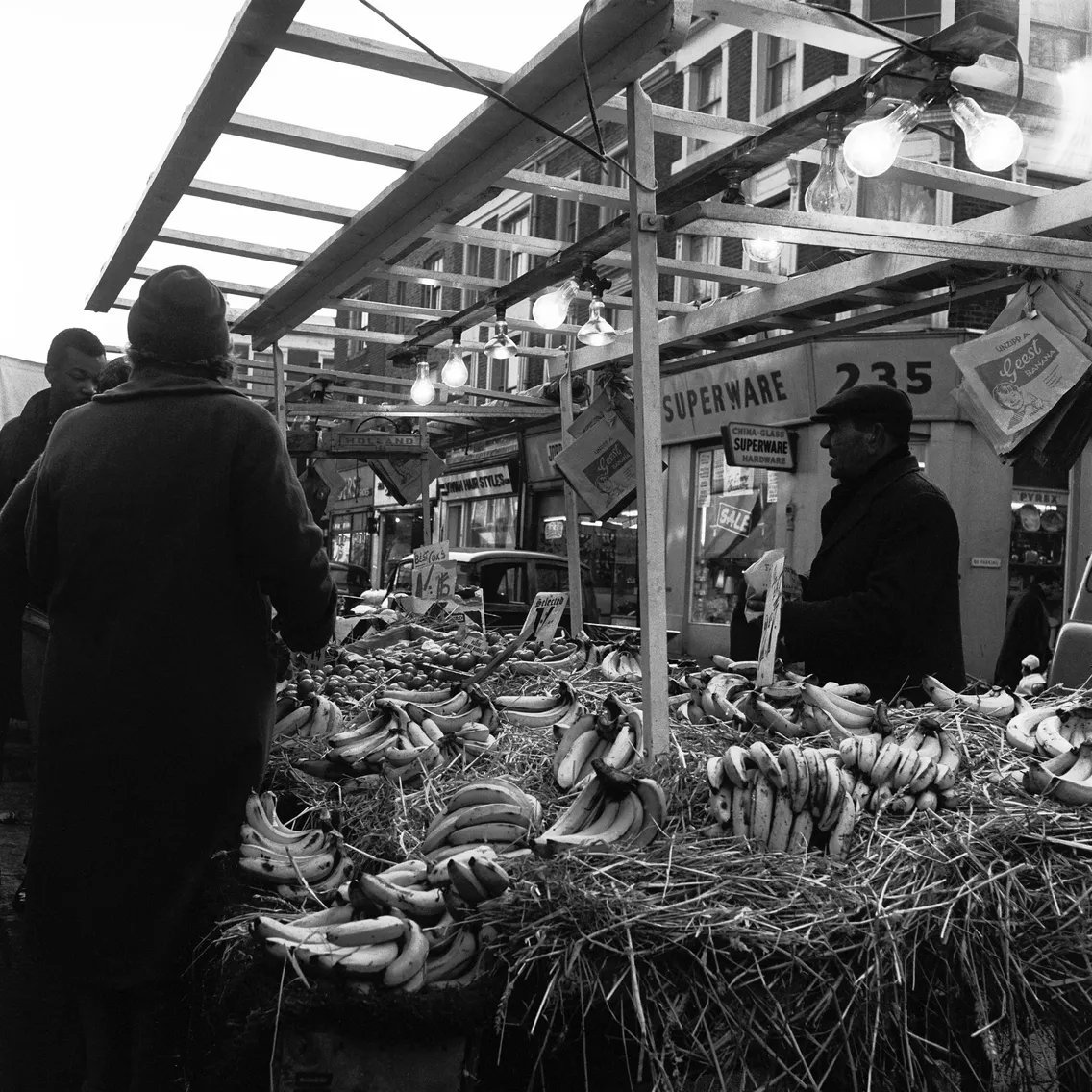
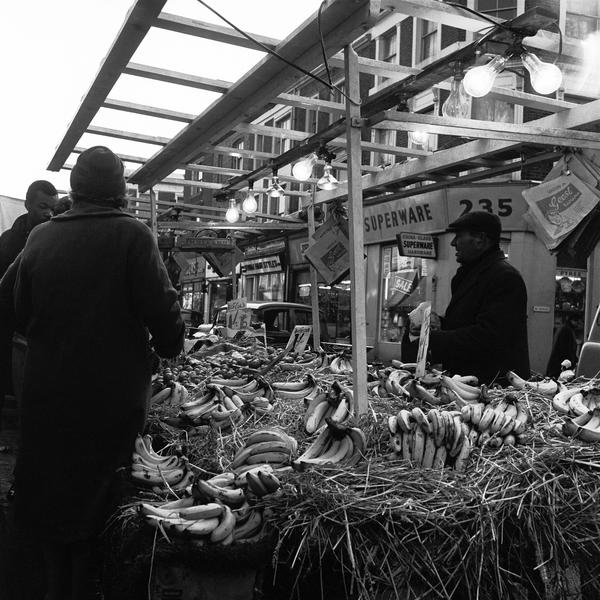
A fruit and vegetable market stall, from between 1960 and 1971.
-
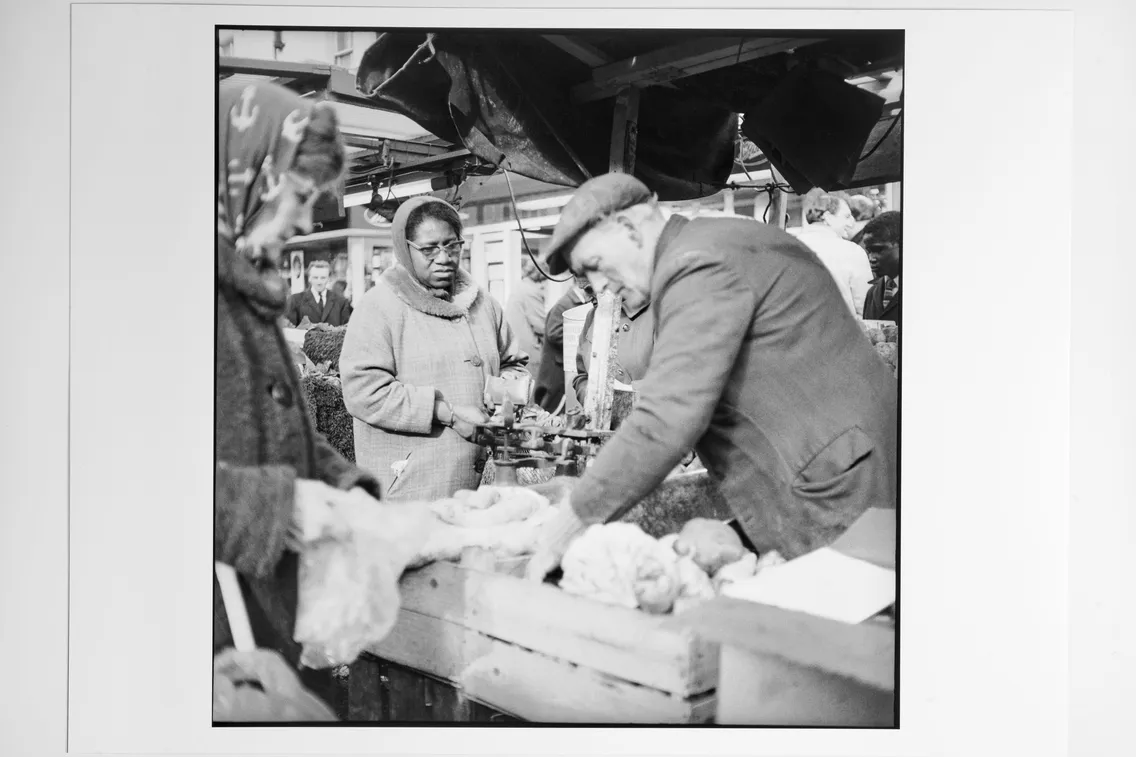
Shoppers and traders around 1960.
Spanish refugees in Notting Hill
After the Spanish Civil War began in 1936, Spanish refugees and political exiles settled around Portobello Road and Notting Hill. Our collection has a trade card for R. Garcia and Sons, a Spanish delicatessen that’s been trading since 1957. They sold meat, fish, cheese, olive oil and wine to meet the needs of the growing Spanish and Portuguese communities.
Second-hand goods and antiques
The antiques arrived after the Second World War (1939 –1945), largely thanks to the closure of Islington’s notorious Caledonian Market. The Caledonian Market was flush with stolen goods, general junk and antique dealers. When it closed, some of these dealers moved to the New Caledonian Market on Bermondsey Street and others to Portobello Market. The bargain hunters followed.
Antiques quickly became what Portobello was famous for. This inspired the song Portobello Road in Disney’s 1971 children’s musical Bedknobs and Broomsticks. It was set during the Second World War, but wrongly presented Portobello as being a long-established hub for antiques – “Portobello Road, Portobello Road… street where the riches of ages are stowed”.
Second-hand clothes and bric-a-brac were also sold at the market. These were collected by ‘rag and bone men’ who travelled the streets gathering people’s unwanted items.
-

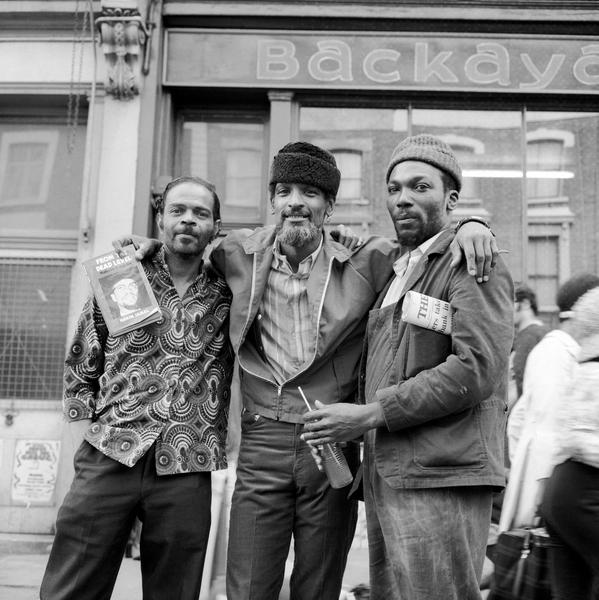
Notting Hill and Portobello Road have welcomed many new communities since the 19th century.
-
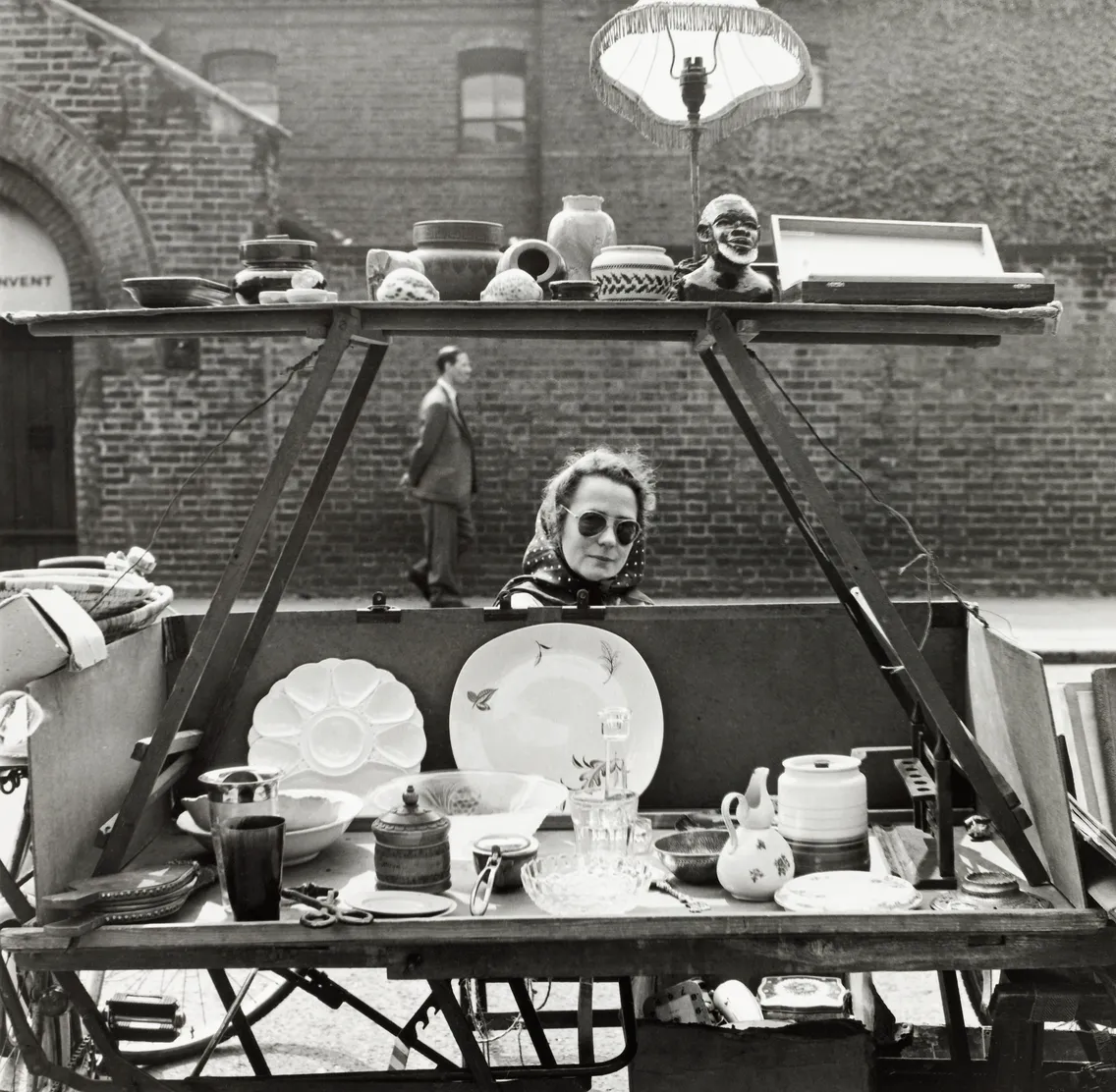
A typical bric-brac stall.
The Swinging Sixties transformed Portobello
In the 1950s and 1960s, Caribbean people who’d answered Britain’s call for workers made Notting Hill their home. Portobello Market adapted in response, with yams, sweet potatoes and green bananas becoming staples alongside British produce.
At the time, Notting Hill had terrible housing. The Caribbean community had to bear this in addition to racist attacks.
But as the 1960s went on, Portobello Road and the surrounding area took on a cool, bohemian edge. Cheap rents in the area attracted artists, musicians, fashion designers and artisans. Some set up the Notting Hill festival, which later evolved into Notting Hill Carnival. Many of Portobello Road’s Victorian terraces were painted in bright, cheerful colours, a look that lasted.
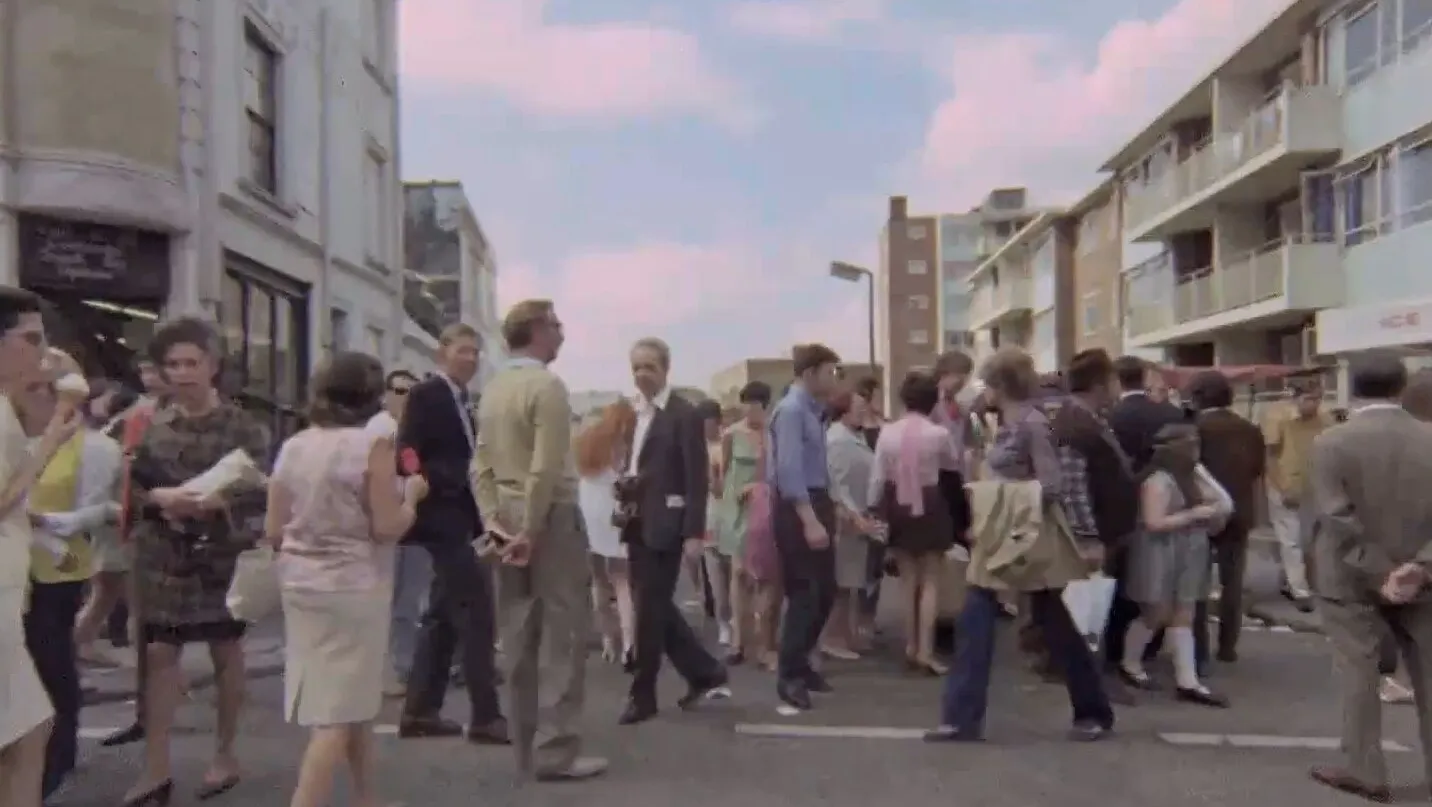
Portobello was associated with ‘swinging London’. It was a place to buy the latest fashions, but also a spot for the coolest Londoners to hang out and show their creative street style. This influenced leading designers of the period.
Vivienne Westwood designed and sold her jewellery in a stall here. Shops like I Was Lord Kitchener's Valet, famous for selling vintage military uniforms, attracted clients such as John Lennon, Jimi Hendrix and Mick Jagger.
“It felt like the whole world was wandering up and down”
Paul Simonon
In the 1970s, Notting Hill Carnival grew as it embraced reggae and dub. And local white musicians began taking influence from the Caribbean sound that was so popular locally.
That included punks like Paul Simonon, bassist for the Clash. He worked on a Portobello stall as a kid and developed his look by buying second-hand clothes there. He told Big Issue magazine: “It felt like the whole world was wandering up and down. So I grew up with broad horizons. It was exciting, enlightening, and made a deep impact on me.”
By the late 1980s, Portobello Road had transformed from a run-down working-class district into one of London's most affluent and desirable areas. That came at a cost. Several long-term independent traders were priced out of the market, and chain shops, cafes and expensive restaurants opened up. As well as diluting the focus on antiques, many of these cater to tourists, rather than the local community.
Portobello Market is a major tourist attraction
Today, the mile-long Portobello Market gets more than 100,000 visitors on Fridays and Saturdays. Antiques and second-hand clothes are the main draw.
Portobello consists of five mini markets. Second-hand goods run from Golborne Road to the Westway. Vintage fashion and household essentials from the Westway to Talbot Road. Fresh produce from Talbot Road to Elgin Crescent. And famous antiques go from there to Chepstow Villas.
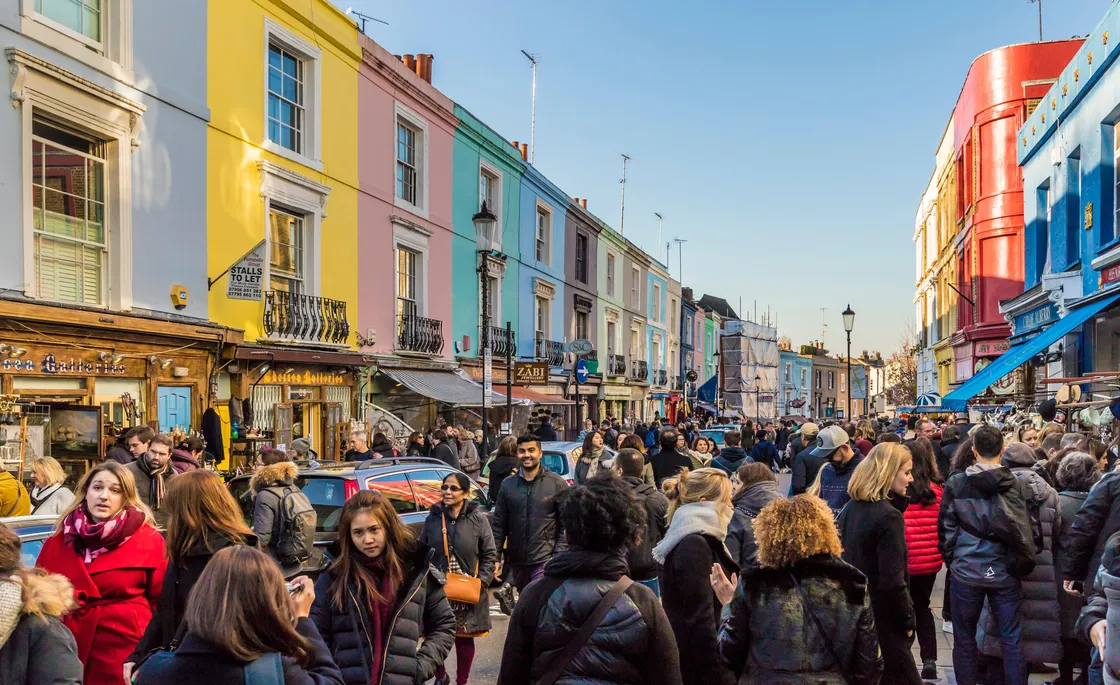
Modern Portobello Market, with the distinctive coloured buildings on either side.
Portobello on film
Portobello Road became even more famous when it appeared in the 1999 rom-com Notting Hill. It starred Hugh Grant, whose character lived on Portobello Road and ran a fictional book shop there. For many tourists, this became the reason to visit Portobello Road.
The street has another cinema connection. The Electric Cinema opened there in 1911. It’s one of London's oldest working cinemas, and became the UK’s first Black-owned cinema in 1993.
Tags
-
Photography
-
-
-
Photography
-
-
-
Photography
-