Kensington Gardens: Royal history meets magical adventure
Kensington Gardens emerged from Henry VIII's hunting grounds to become a beloved public park, home to a royal palace, Peter Pan and a leading art gallery.
Westminster & Kensington & Chelsea
Since 1689
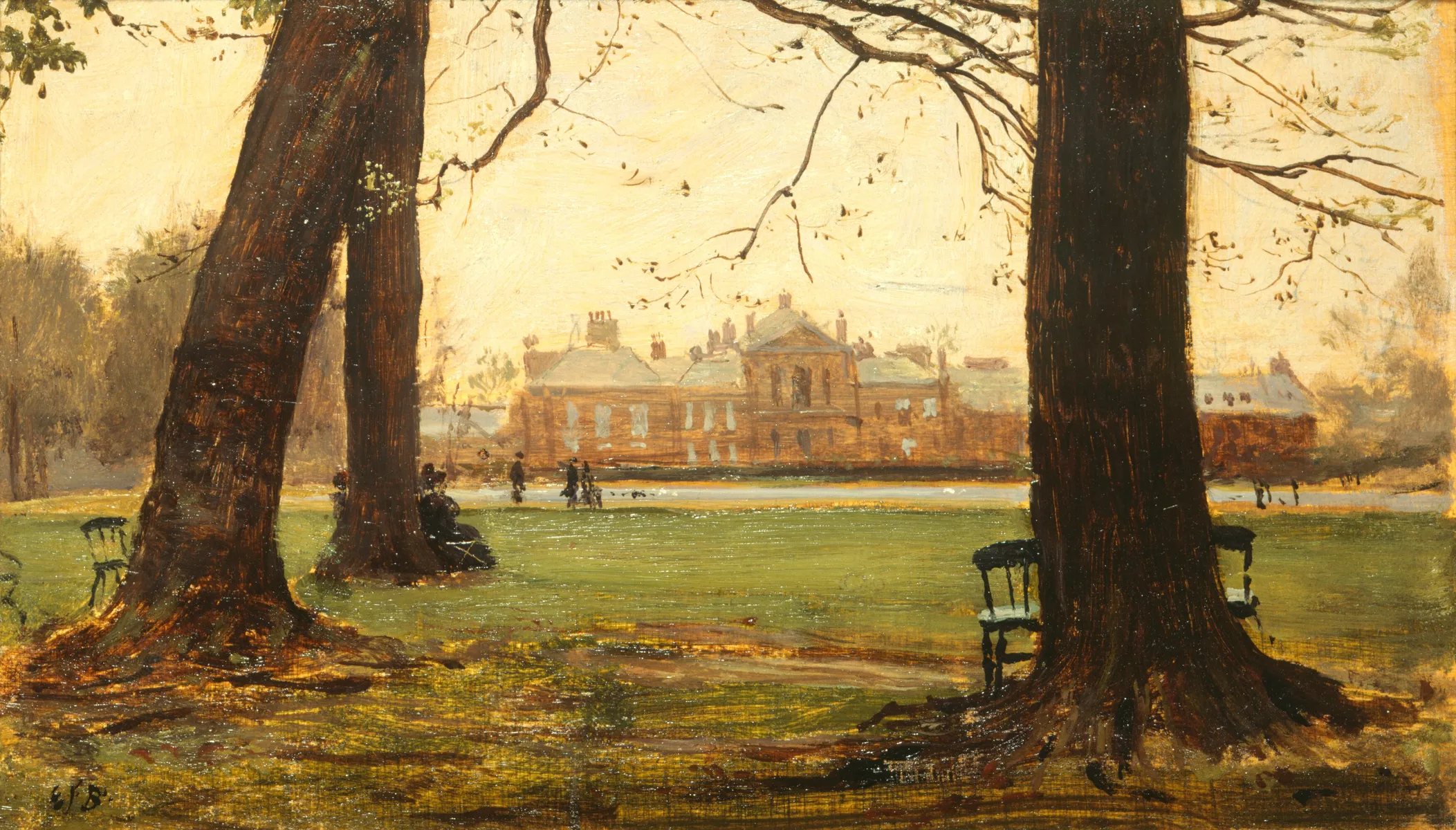
Edward Frederick Brewtnall’s painting of Kensington Gardens and Kensington Palace from between 1891 and 1910.
Gardens fit for a queen
Kensington Gardens were formed at the end of the 17th century, when King William III and Queen Mary II sectioned off a chunk of Hyde Park as a private garden for Kensington Palace. The bulk of it can be found in the borough of Westminster, with the small western section containing Kensington Palace over the border in the borough of Kensington and Chelsea.
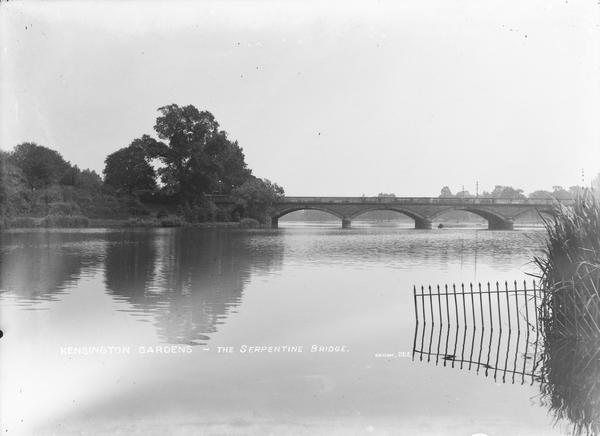
Royals shaped much of the park we see today, repeatedly updating its design and adding spectacular features. Queen Caroline designed the Serpentine lake in the 1700s. Queen Victoria, who spent her childhood in Kensington Palace, added the elegant Italian Gardens and the awe-inspiring Albert Memorial.
By the mid-19th century the park was open to the public. It’s been cherished by Londoners ever since. As well as its flowers, trees and water features, many come to see the statue of Peter Pan, secretly installed in 1912. Others flock to the Serpentine Galleries, opened in 1970.
How was Kensington Gardens created?
Kensington Gardens was originally part of Hyde Park, a piece of land which King Henry VIII had used as hunting grounds in the 1500s.
The western end was split off to become Kensington Gardens by King William III and Queen Mary II. In 1689, the joint monarchs were building Kensington Palace, converting the old Nottingham House which stood on the site.
The couple wanted a private garden, and so Kensington Gardens was born. Mary commissioned elegant Dutch-style formal flower beds and box hedges for the palace grounds.
-
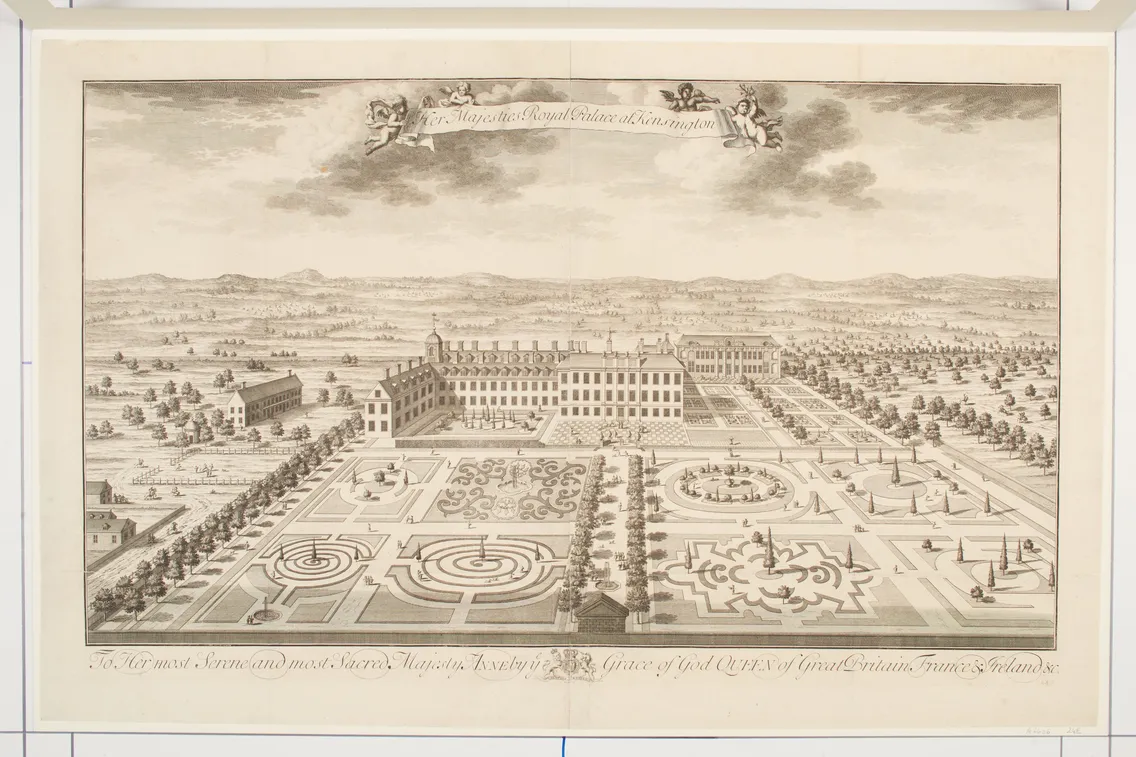
Kensington Palace and its gardens are shown in this print made between 1702 and 1714, when Queen Anne ruled.
-
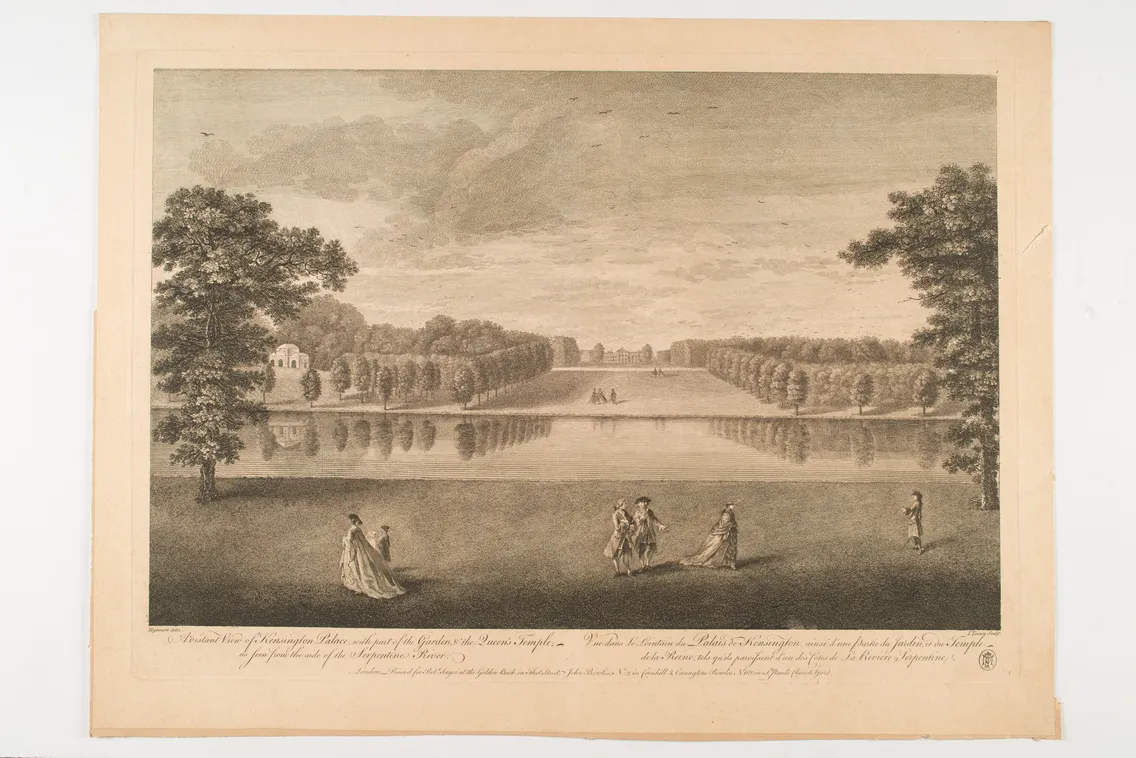
This print from the 1700s looks across the Serpentine towards the palace, with Queen Caroline’s temple visible on the left.
Queen Caroline had a major influence on the park
Queen Caroline was the wife of King George II. In 1728, she worked with the innovative garden designer Charles Bridgeman to create the winding Serpentine lake and the Long Water at the eastern end of the park. Mimicking a natural body of water was a groundbreaking move.
Caroline and Bridgeman were also responsible for a long ditch in the east of Kensington Gardens which acted as its border with Hyde Park. It was known as a ‘ha-ha’ because of the surprise it supposedly caused people who came across it.
Using a sunken barrier, rather than a raised wall or fence, gave you an uninterrupted view of the park. The idea caught on, and was copied at other grand houses.
The Queen's Temple, built in the east of the park in 1735, was another of Caroline’s additions. This type of decorative garden building is known as a folly, and it still stands today.
The total cost of the garden reportedly came to £20,000, roughly £3.8 million today.
-
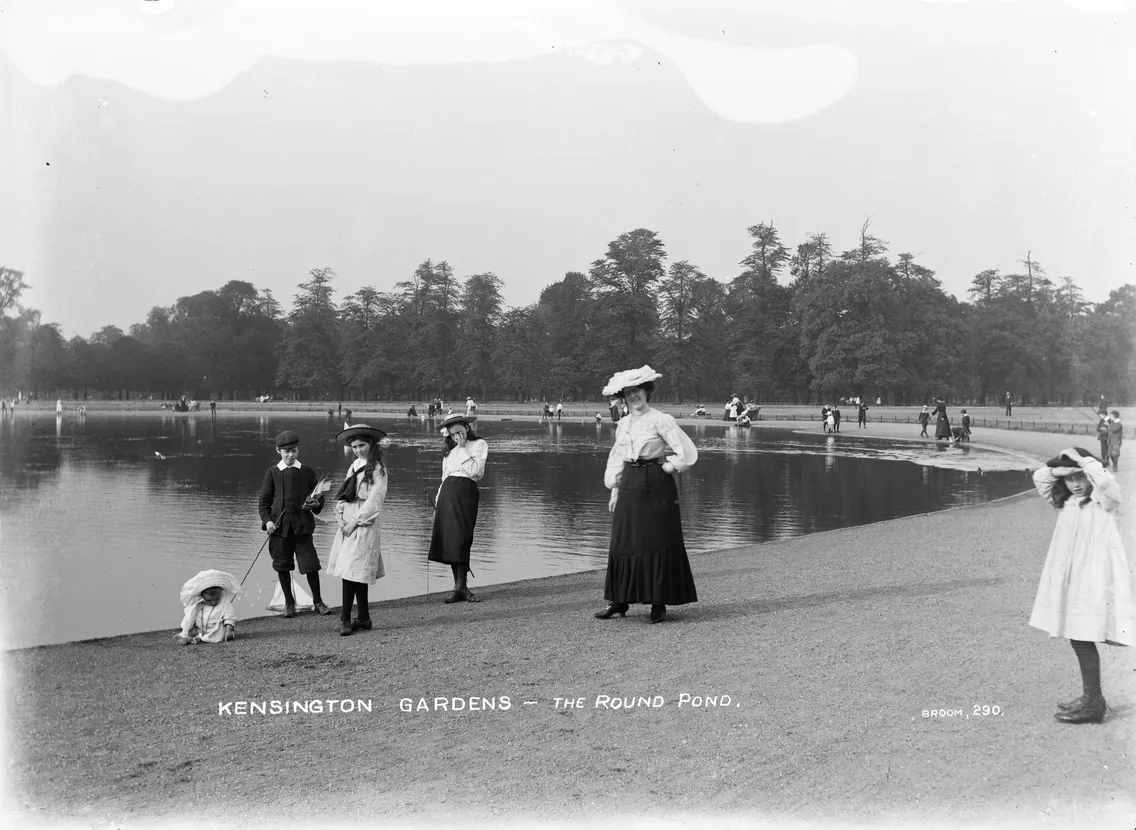
The Round Pond, photographed here around 1905, was added by George II in 1730.
-
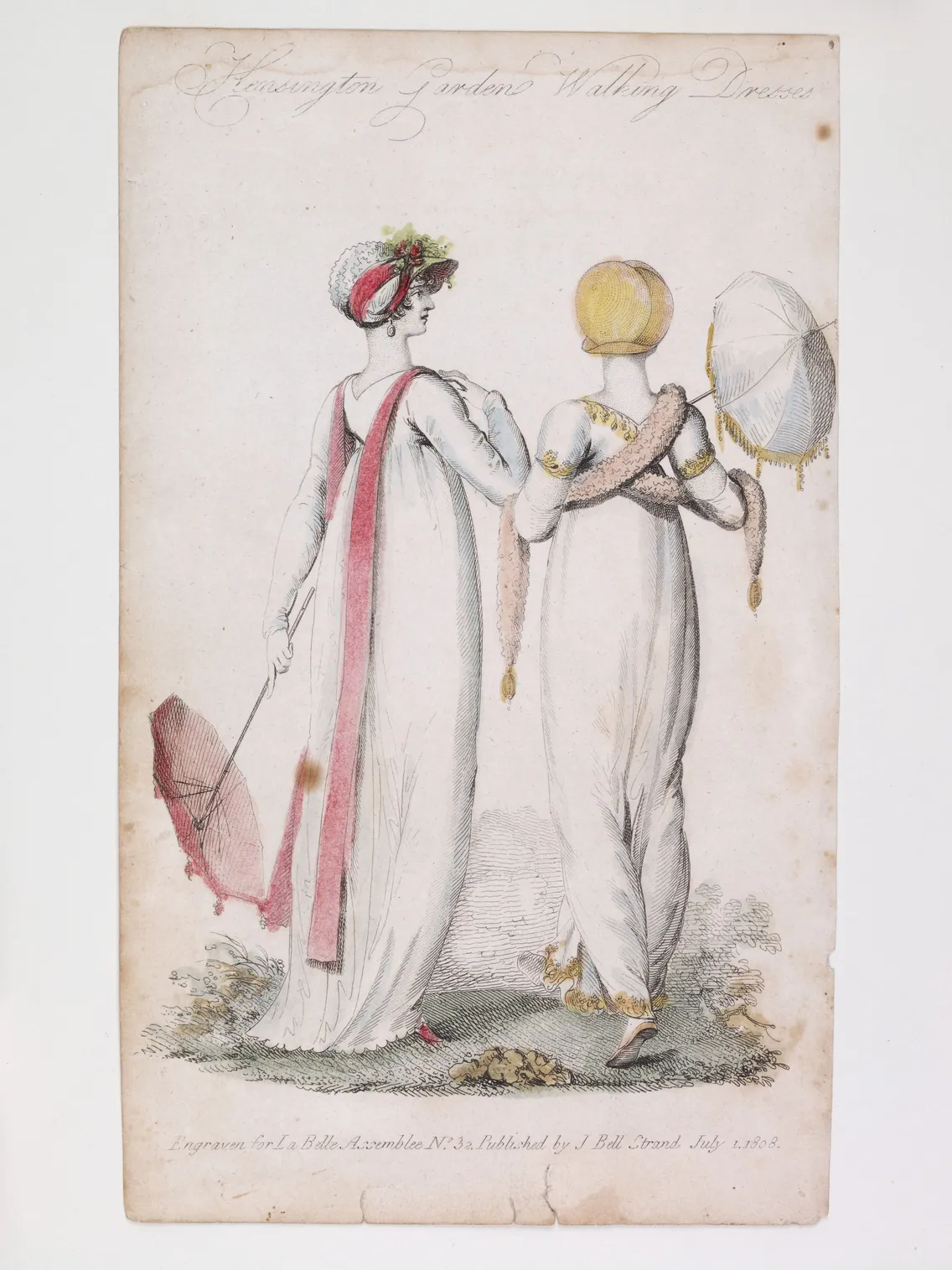
Outfits you might have seen at Kensington Gardens in the early 19th century.
A royal robbery and promenading in the park
King George II enjoyed walking alone in his new gardens. But during one walk, he’s said to have been robbed by a man who’d jumped the wall.
The thief took the king’s watch and shoe buckles, but remained respectful. The pair struck a deal. The thief would return a seal from the king’s watch-chain, which would have been of little value. In exchange, the king would say nothing about the robbery. Supposedly, the thief honoured the deal, returning to the exact spot the next day to return the seal.
Wealthy Londoners were often invited to access the park in the 18th and early 19th century without having to jump the wall. This was a fashionable place to be and it mattered how you dressed. A series of hand-coloured engravings in our collection captured the styles you might see there in the early 19th century.
Victorian splendour and a royal tribute
Queen Victoria was born and raised at Kensington Palace, and she left her mark on its surroundings. In the north-eastern corner of Kensington Gardens, at the tip of the Long Water, are the Grade II-listed Italian Gardens. Combining water fountains and carved marble, the gardens were a gift to the queen by her husband, Prince Albert.
After her husband, Prince Albert, died in 1861, Victoria commissioned the Albert Memorial – a towering gothic masterpiece by Sir George Gilbert Scott in the south-east of the park. This ornate monument shows Albert holding the catalogue from the 1851 Great Exhibition, surrounded by 187 exquisitely carved figures representing arts, sciences and the continents.
-
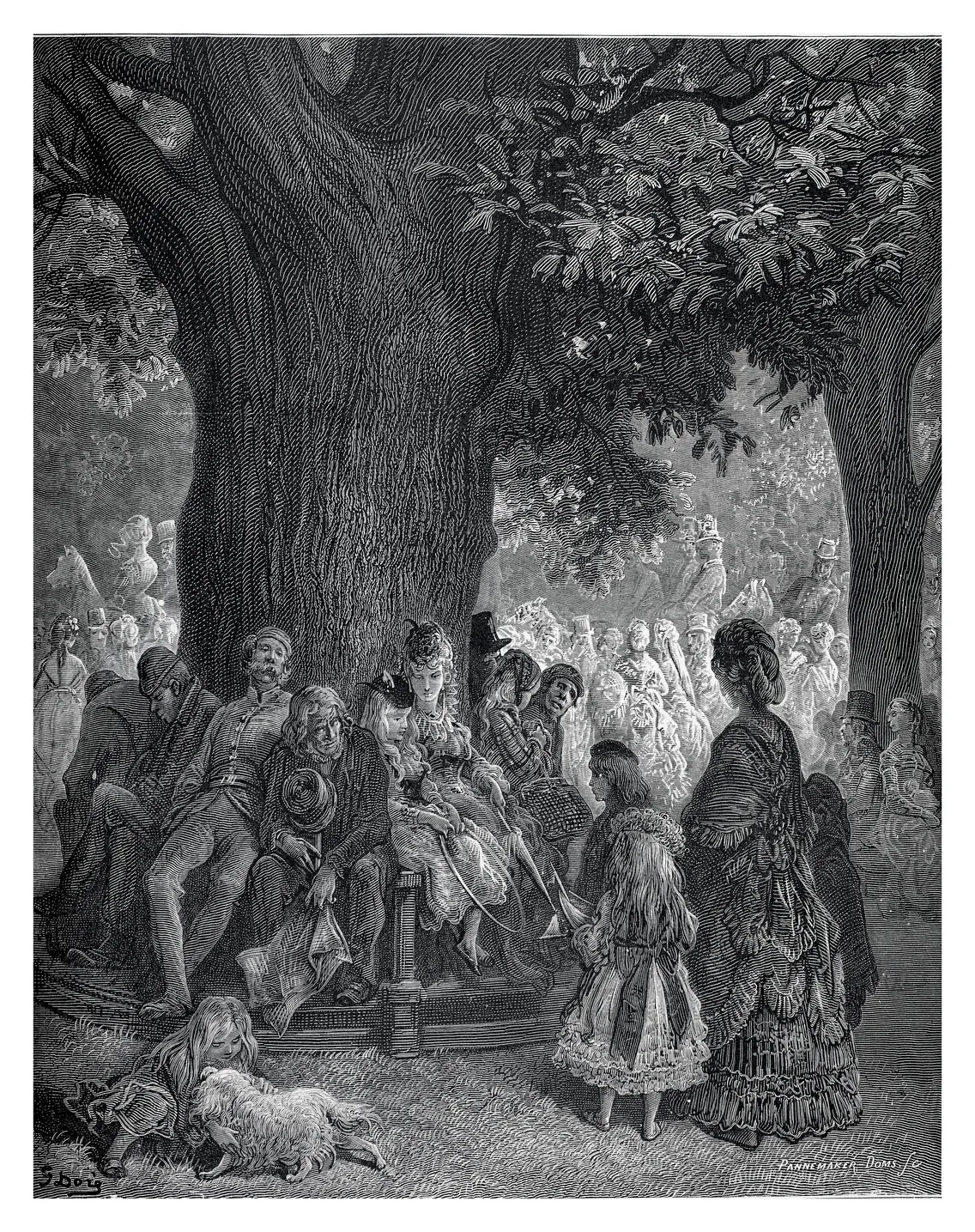
Gustav Doré’s illustration of people in the park is from 1872, after it had been opened to the public.
-
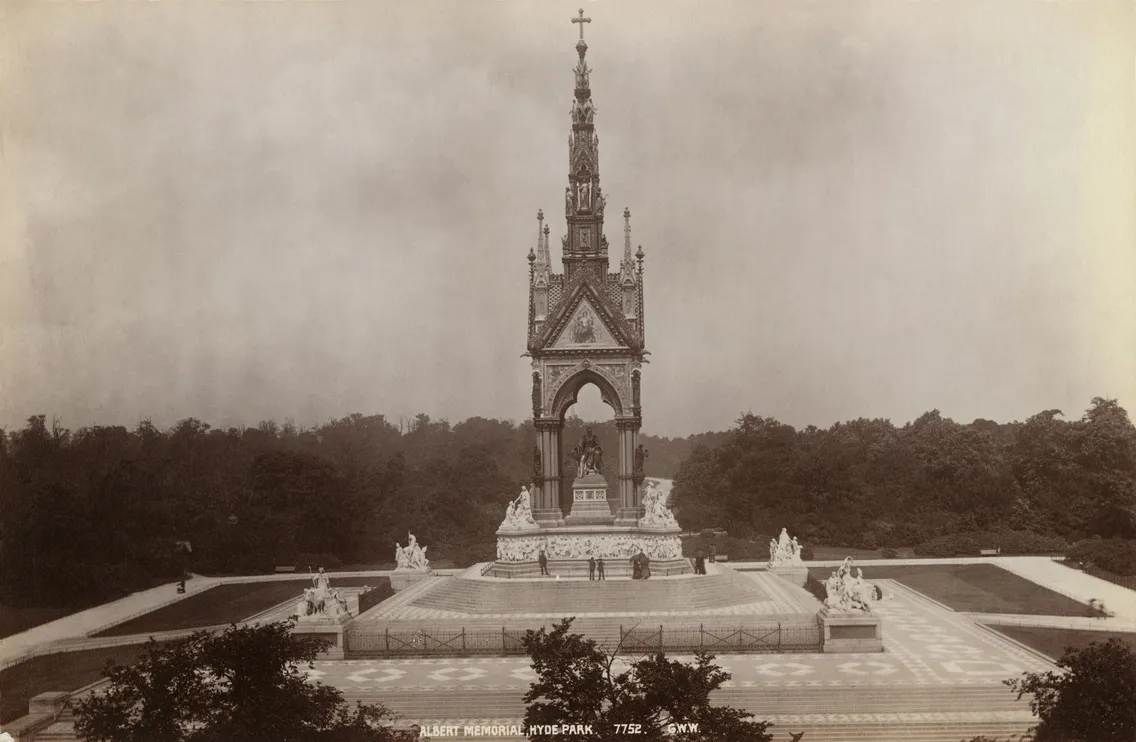
The Albert Memorial was commissioned by Queen Victoria in the memory of her late husband.
Peter Pan and the Elfin Oak
In 1912, a statue of Peter Pan ‘magically’ appeared in the garden. It was the plan of the fictional hero’s creator, the local resident and author JM Barrie. The statue was secretly erected overnight, and Barrie placed an announcement in The Times the next day: “There is a surprise in store for the children who go to Kensington Gardens to feed the ducks in the Serpentine this morning.”
Barrie found inspiration for his stories during his many visits to Kensington Gardens. It’s said that the statue’s location marks the exact spot where Peter Pan lands his bird-nest boat.
There’s more magic in the north-western corner of the park, at the curious Elfin Oak, a 900-year-old gnarled tree stump. It was intricately carved with tiny figures of elves, gnomes and small animals by Ivor Innes in 1930.
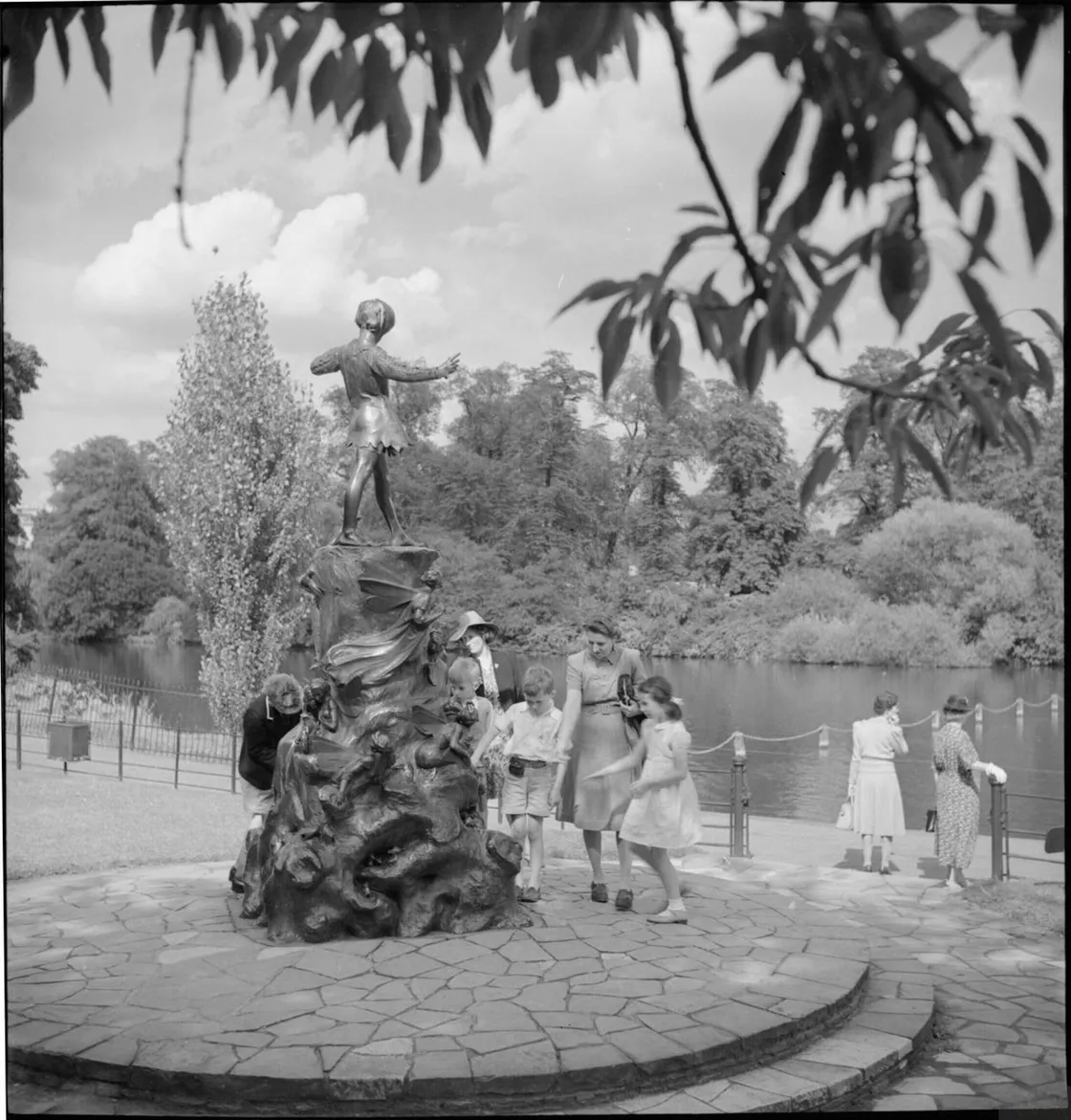
The Peter Pan statue by the Serpentine, photographed in 1943.
Art in Kensington Gardens
Henry Moore's The Arch, a 6-metre-high sculpture overlooking the Long Water, was donated by the artist in 1980.
The park also contains the Serpentine Galleries, which have hosted some of the world’s most renowned artists since the 1970s. The gallery commissions the annual Serpentine Pavilion, which sees architects and artists design a new structure each year.
Tags
-
Photography
 Photography
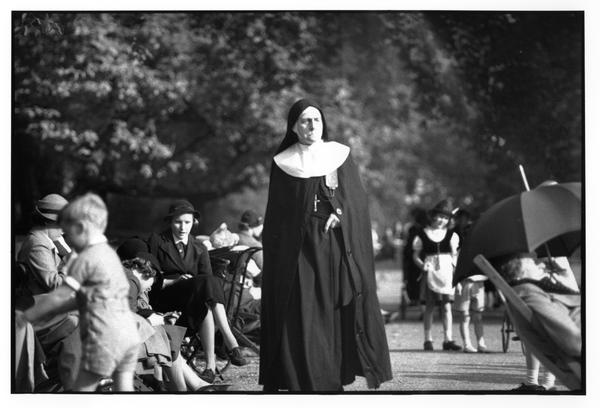
A nun walking through Kensington Gardens (photograph)
Monck, Margaret, Monck, Margaret
1931-1940
-
-
-
Photography
-
Paintings, Prints & Drawings

-
Paintings, Prints & Drawings
 Paintings, Prints & Drawings
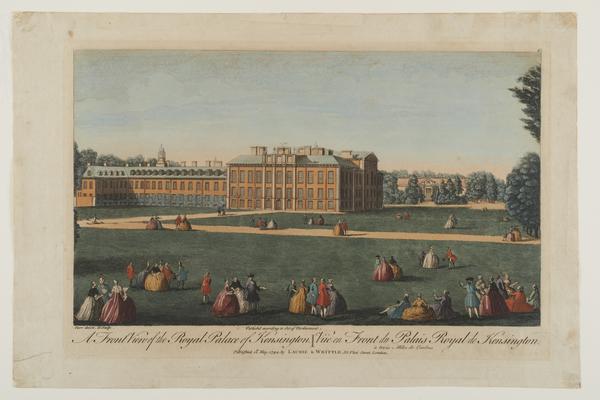
A front view of the Royal Palace of Kensington / Vue en front du Palais Royal de Kensington (coloured engraving)
Laurie & Whittle
1794-05-12