The wild 700-year-long history of Bartholomew Fair
Every summer for hundreds of years, Londoners flocked to Smithfield to let loose at Bartholomew Fair. It was a spectacle like no other.
West Smithfield, City of London
1133–1855
A carnival of pleasure and chaos
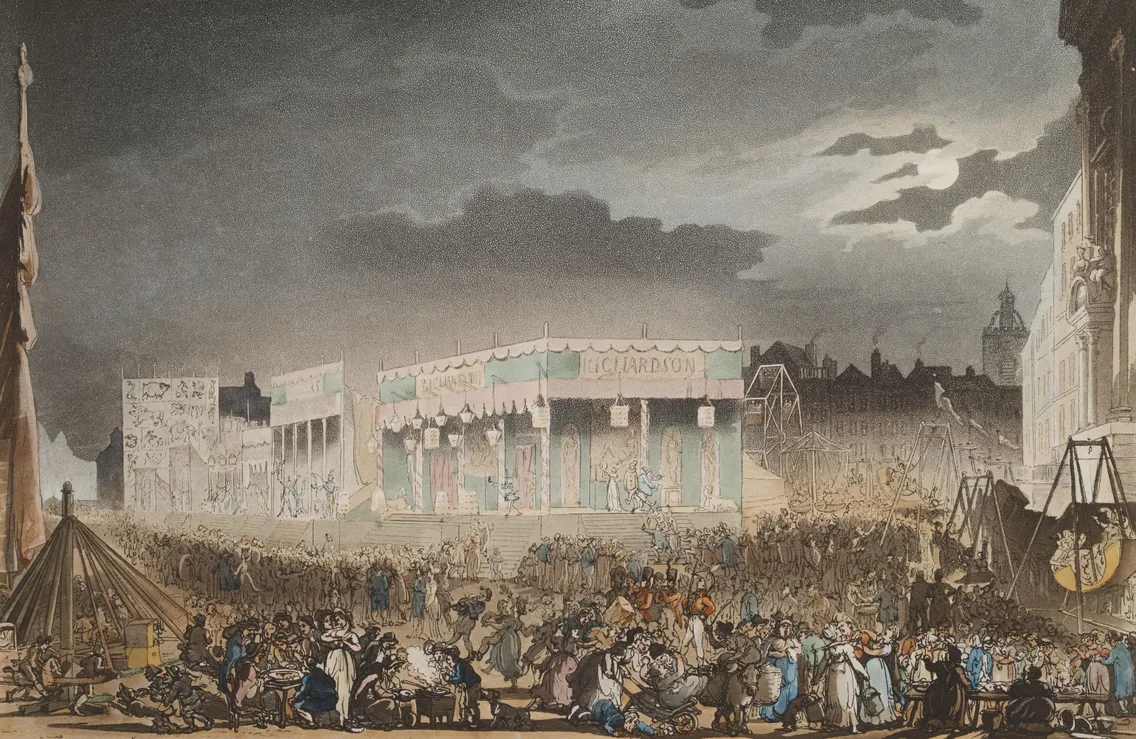
Bartholomew Fair was a sensory overload. The smell of hot pies, freshly baked gingerbread and pigs roasting all day on an open fire. The sounds of laughter, sellers’ cries, trumpeters, drummers and animals all battling each other. As the fair spilled into the open space in West Smithfield, just outside the city walls, this festival would have been hard to avoid.
The fair was founded in 1133 as a trade show for buyers and sellers of cloth. It took place around St Bartholomew’s Day on 24 August, evolving into a two-week-long carnival crammed with all kinds of entertainment. Prints in our collection bring glimpses of the yearly chaos to life.
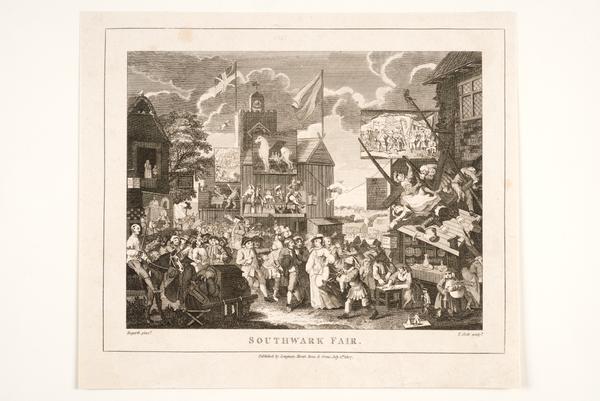
While other London fairs offered similar pleasurable escapes, like those at Southwark between 1461 and 1762, there wasn’t anything quite like this one. Bartholomew Fair had come to represent something of everyday London life: where culture and chaos, pleasure and violence, all came together quite spectacularly.
Rahere and St Bartholomew
Bartholomew Fair came from the founding of St Bartholomew’s priory and hospital in 1123 by Rahere, Henry I’s courtier and a canon of St Paul’s Cathedral. Rahere became very sick on a pilgrimage to Rome and promised to build a hospital on his return if he survived. Later, St Bartholomew came to him in a vision and instructed him to build a church at Smithfield.
In 1133, Henry granted Rahere a charter to organise an annual three-day fair on the priory grounds to mark St Bartholomew’s Day on 24 August. The fair would also make money for the priory from fees taken from people’s stalls.
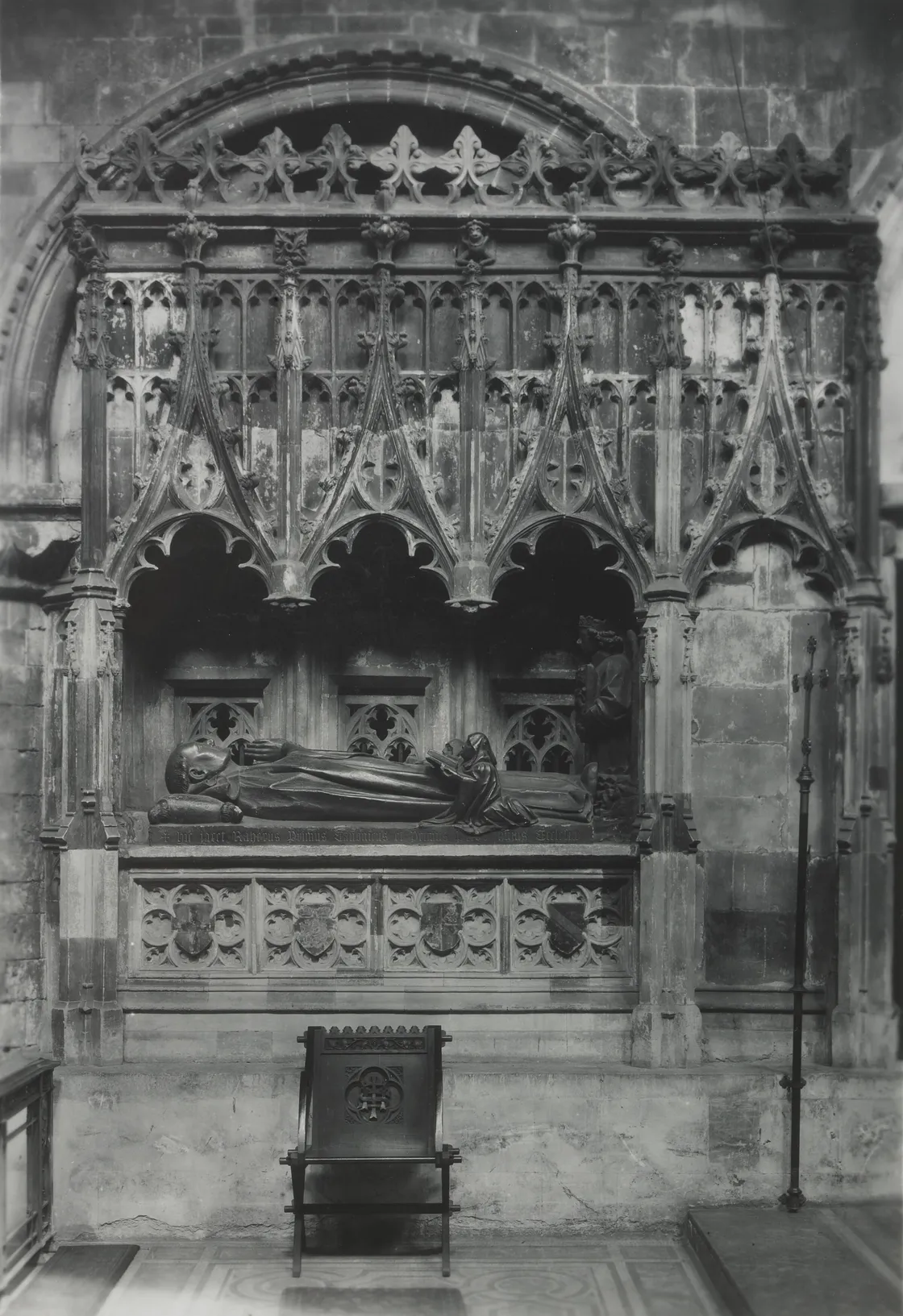
Rahere’s tomb in St Bartholomew the Great church in Smithfield.
The medieval cloth fair
For the first few hundred years, Bartholomew Fair was the country’s top cloth market. It was nationally important – cloth and wool generated a lot of wealth for England in the 1200s and 1300s. Merchants travelled to it from all over Europe.
A street called Cloth Fair, sitting just below present-day Smithfield Market, takes its name from where traders would pitch up every August.
Like other English fairs, Bartholomew Fair had special courts known as ‘courts of piepowder’ for quickly resolving trade disputes or sometimes other offences. You could be tried and punished in the stocks or whipping-posts within a day. For many years, the courts were held at the Hand and Shears pub, which still stands on Cloth Fair.
How Bartholomew Fair evolved
After Henry VIII closed St Bartholomew’s priory in 1539 during the dissolution of the monasteries, the land passed into the hands of successive gentry families.
By the 1600s, the City of London had secured a share of the fair’s tolls, and the lord mayor of London began the tradition of ceremonially opening the fair.
-
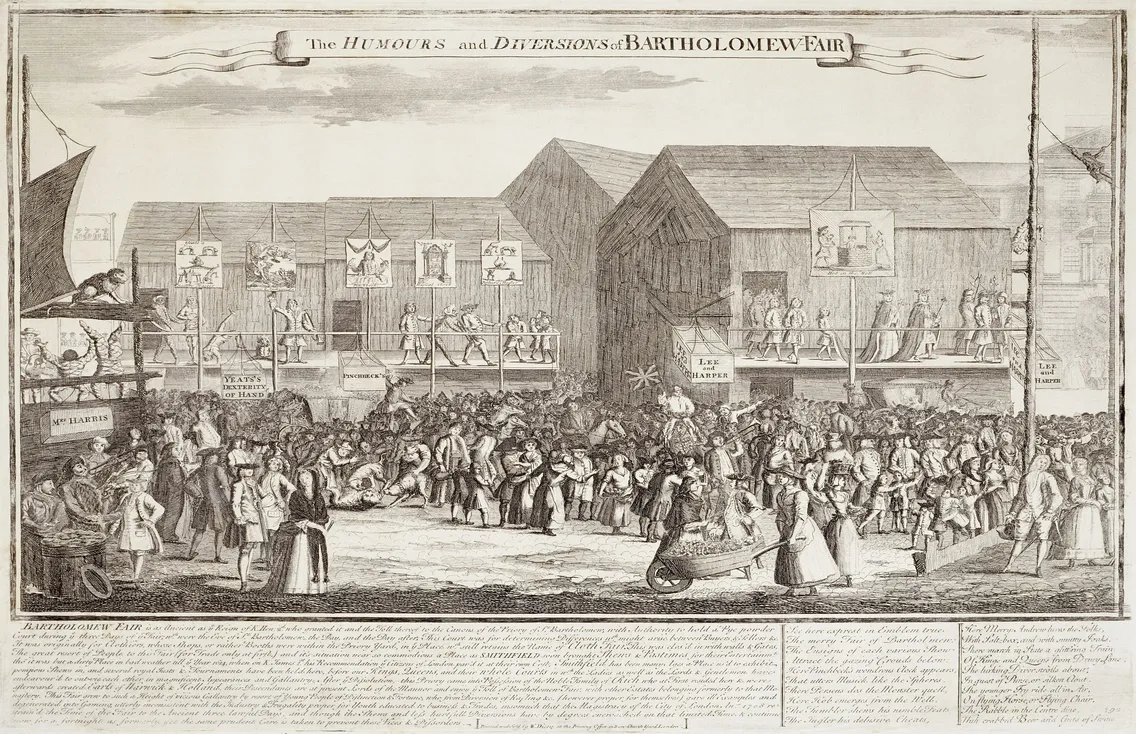
In this engraving of a busy Bartholomew Fair crowd, carnival acts mix with fairgoers and street sellers.
The fair had also moved away from being purely commercial. Thanks to the rise of international trading links, London’s drapers and clothiers could access more extensive markets elsewhere.
Instead, Bartholomew Fair had evolved into a carnival, a temporary escape from life in the city. It had snowballed into a two-week-long affair. And it had attracted a very mixed crowd. Royals would sometimes join in the fun, with their festival activities reported in the press like celebrity gossip.
Entertainment at Bartholomew Fair
The print in our collection below looks a little too orderly for the reality of Bartholomew Fair in the early 18th century. But it gives us a glimpse of what Londoners got up to there.
-
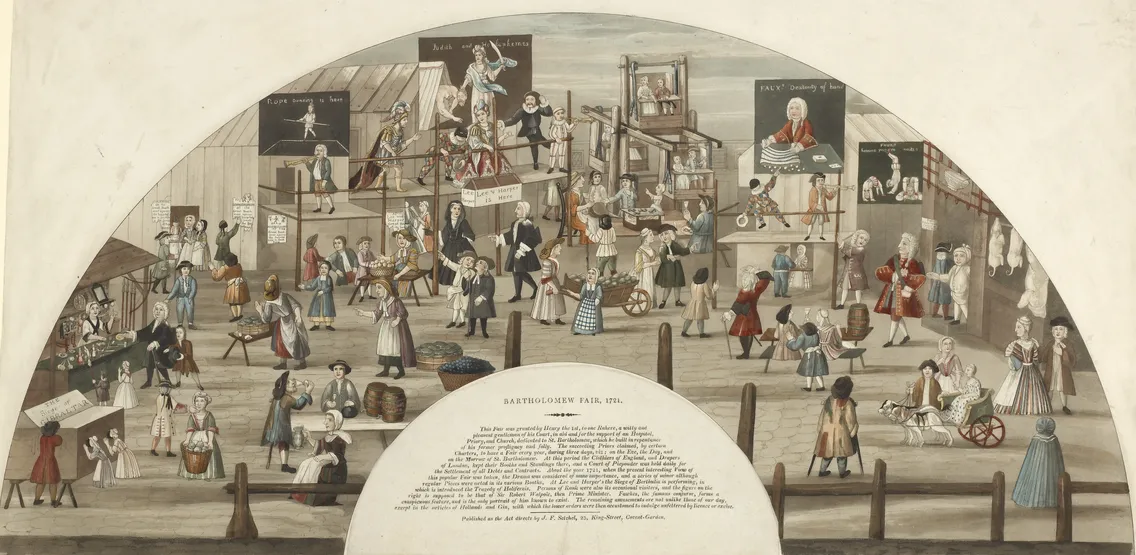
Print from a fan design of Bartholomew Fair in the early 18th century.
To the left, you can see a peep show and a person selling various toys and haberdashery. People are riding an early version of a Ferris wheel, known as an “ups and downs. There are advertisements for rope dancing, a comedy and a magician. Spot trumpeters, fruit-sellers, drinkers and possibly even the prime minister Robert Walpole, represented by the well-dressed figure on the right.
Puppet shows, like Punch and Judy, were popular at Bartholomew Fair. And so were plays. Many of London’s West End theatres closed for the summer, making this two-week fete an appealing new stage for the city’s actors.
The fair was even immortalised in a chaotic, unwieldy play by Ben Johnson called Bartholomew Fair, written in 1614.
Increasingly, the fair hosted novelties like sideshows, waxworks, prize-fighters and fire-eaters. There were ‘menageries’ of animals, such as lions and tigers. Some animals danced, others were billed as “learned”, able to blow the minds of audiences with their human-like tricks.
People were also exhibited. They were advertised as “curiosities”, with many people taken from their home countries around the world as Britain’s imperial exploits expanded.
“What anarchy and din… Monstrous in colour, motion, shape, sight, sound!”
William Wordsworth, 1805
A place of vice
Bartholomew Fair always had its critics. It also had a long reputation for pickpocketing, gambling and soliciting sex work.
The cloister of St Bartholomew’s Hospital seemed to be the centre of the fair’s more shadowy business. One 1703 article in The Observator remarked it was “a strange medley of lewdness”, and that those who ventured there “have the devil’s livery on their backs”.
-
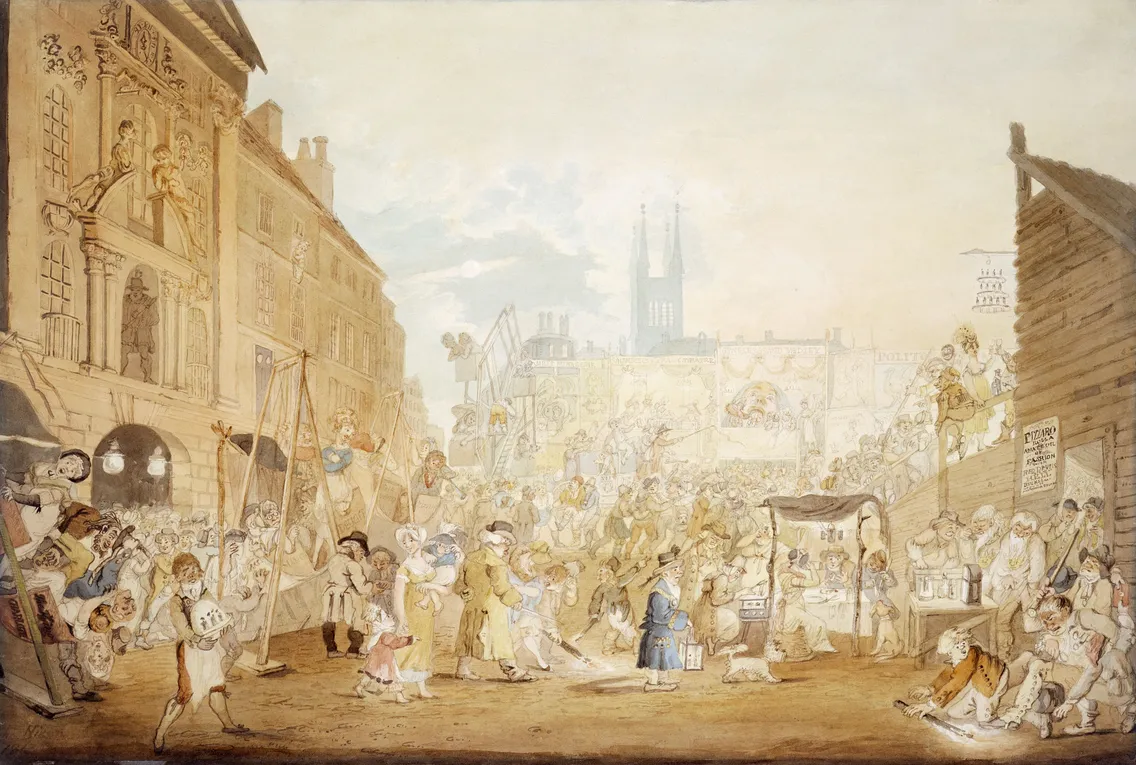
This watercolour from 1813 shows fairgoers rushing around, drinking, fighting and looking a little worse for wear.
The pushback only got stronger as the fair became more of an entertainment spectacle. The poet William Wordsworth called it a “Parliament of Monsters” in a work published in 1805. “What a shock / For eyes and ears! What anarchy and din… Monstrous in colour, motion, shape, sight, sound!”
In the 18th and 19th centuries, many more Londoners came to see the fair’s anarchic, unruly character as something they just wanted to get rid of.
How Batholomew Fair was shut down
Authorities tried many times to shut the whole thing down, but the popularity of Bartholomew Fair kept it going. When they tried to ban plays in 1735, for example, the resulting protests meant theatre booths were back at Bartholomew the following year. However, it was cut down to three or four days.
In the early 1800s, the City of London took greater control over the fair and tried to squeeze stall-holders out by increasing the tolls. In 1843, shows of all kinds were banned for good.
When the lord mayor went to proclaim the fair open in 1850, it was said he found “no fair worth proclaiming”. Just a collection of toy and gingerbread stalls and fruit barrows. City officials did the job afterwards.
Finally, with this once-great carnival a shell of its former self, Bartholomew Fair took place for the last time in 1855.
Tags
-
Paintings, Prints & Drawings
 Paintings, Prints & Drawings
Bartholomew Fair, 1721 (hand coloured etching)
Anonymous, -, Setchel, J.F.
1821
-
Paintings, Prints & Drawings
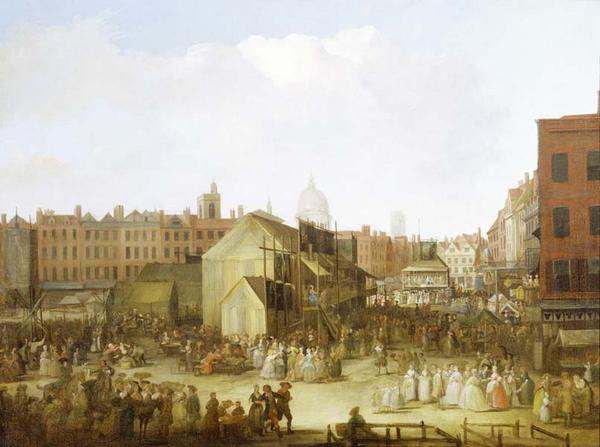 Paintings, Prints & Drawings
St Bartholomew's Fair, Smithfield (oil painting)
British School, 18th century, British School
C. 1740
-
Paintings, Prints & Drawings
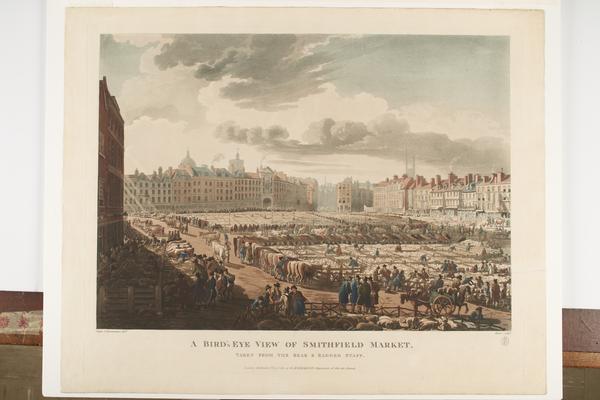 Paintings, Prints & Drawings
A Bird's Eye View of Smithfield Market taken from the Bear and Ragged Staff (coloured aquatint)
Rowlandson, Thomas, Pugin, Auguste Charles, Bluck, J., Ackermann, Rudolph
1811-01-01
-
Paintings, Prints & Drawings
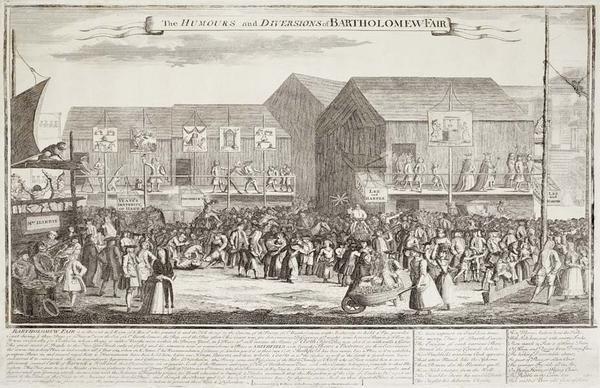 Paintings, Prints & Drawings
The Humours and Diversions of Bartholomew Fair (engraving)
Dicey, William
C. 1733-1735
-
Paintings, Prints & Drawings