Why does London have so many squares?
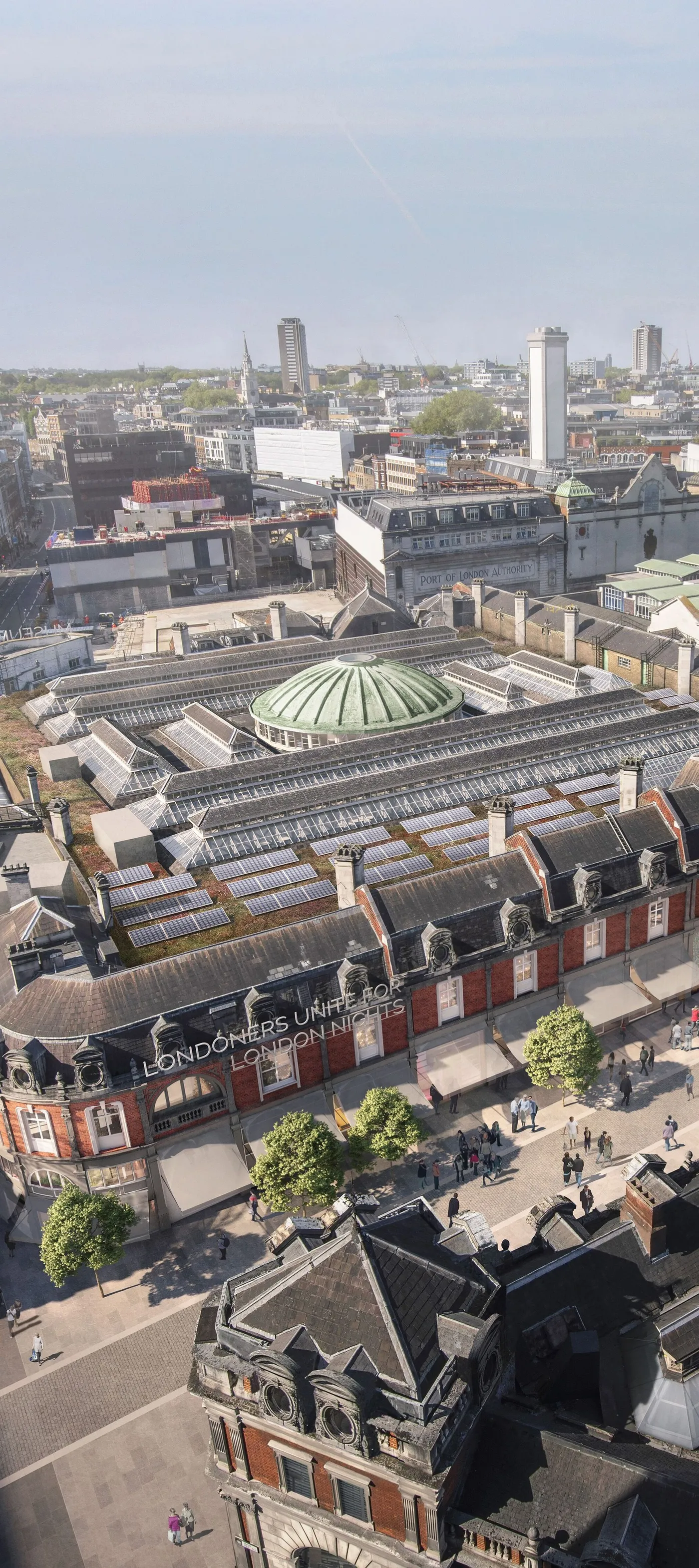
London is a city full of squares. They’ve been a feature of the city since the 17th century, built into new neighbourhoods as the capital grew in all directions.
Since the 1630s
Order and symmetry in a sprawling city
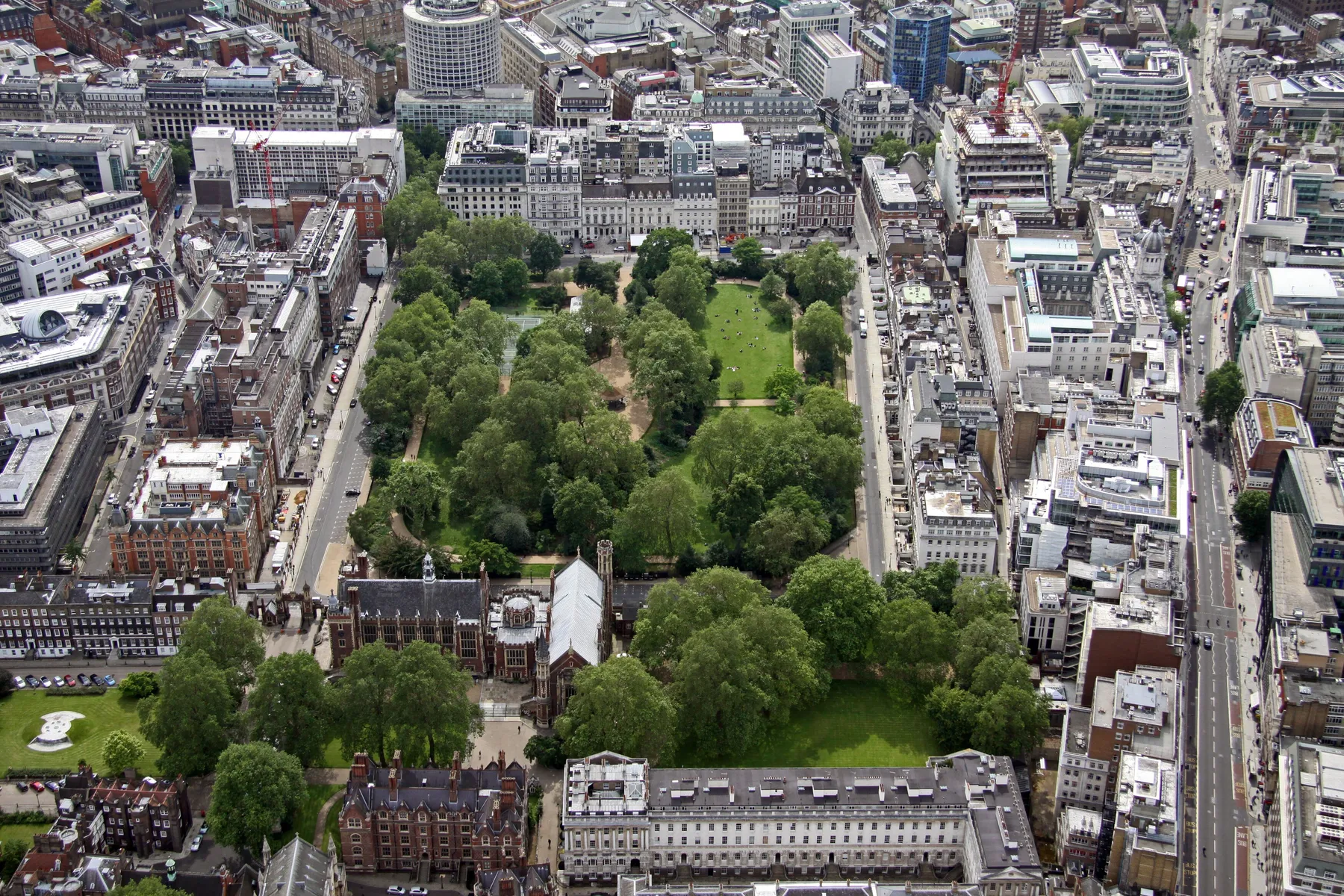
Squares were designed as communal places for Londoners, mostly as open spaces for the residents of surrounding houses.
Some are more exclusive than others. Private garden squares make up some of the capital’s most prestigious addresses, and leave the rest of us peering through their black iron railings from the outside. Many were named after the aristocrats who owned the land.
London’s squares have survived centuries of constant change. Now, there are as many as 600 dotted all over, each telling little London histories of nature, power and resistance.
What was London’s first square?
London’s first square was Covent Garden, which was laid out in the 1630s to designs by the famous architect Inigo Jones. The square was influenced by the Italian ‘piazzas’ Jones saw on his travels.
The square was enclosed with streets, sophisticated housing, a church and a manor house for the landowner, a noble named Francis Russell, 4th Earl of Bedford. A market was set up inside the square in the following decades.
The Covent Garden fields were previously owned by Westminster Abbey and used as a kitchen garden (or ‘convent’ garden) for its monks. During the dissolution of the monasteries between 1536 and 1540, King Henry VIII forcibly closed all Catholic religious houses and sold their buildings and land to wealthy nobles. Covent Garden’s land was given to John Russell, Francis’ great-grandfather, and passed down the family line.
-
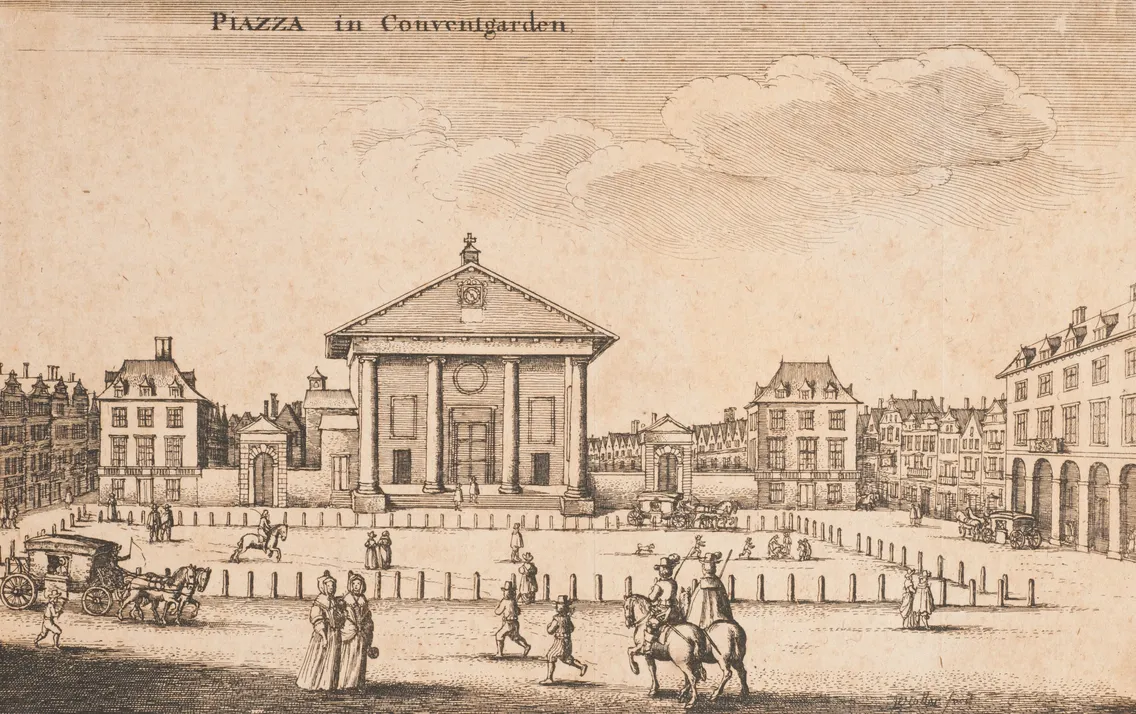
Wenceslaus Hollar’s etching gives us a view of the new Covent Garden square in 1647, before the introduction of the market.
Covent Garden influenced new neighbourhoods
Wealthy Londoners were prepared to pay a lot of money to live in the fashionable Covent Garden residences. And Russell made a lot of money leasing out these houses. Other aristocratic landlords were inspired to build up sought-after suburbs on their own land.
Many of London’s squares were built on land that upper-class families acquired from medieval monasteries after their dissolution. The names of many squares refer to the families who owned the land. Leicester Square, for example, got its name from Robert Sidney, Earl of Leicester.
In the early 1660s, Thomas Wriothesley, 4th Earl of Southampton, built a grand townhouse and square on land formerly owned by the monks of the London Charterhouse. Southampton Square was the first square to be called so by name. It later became known as Bloomsbury Square.
-
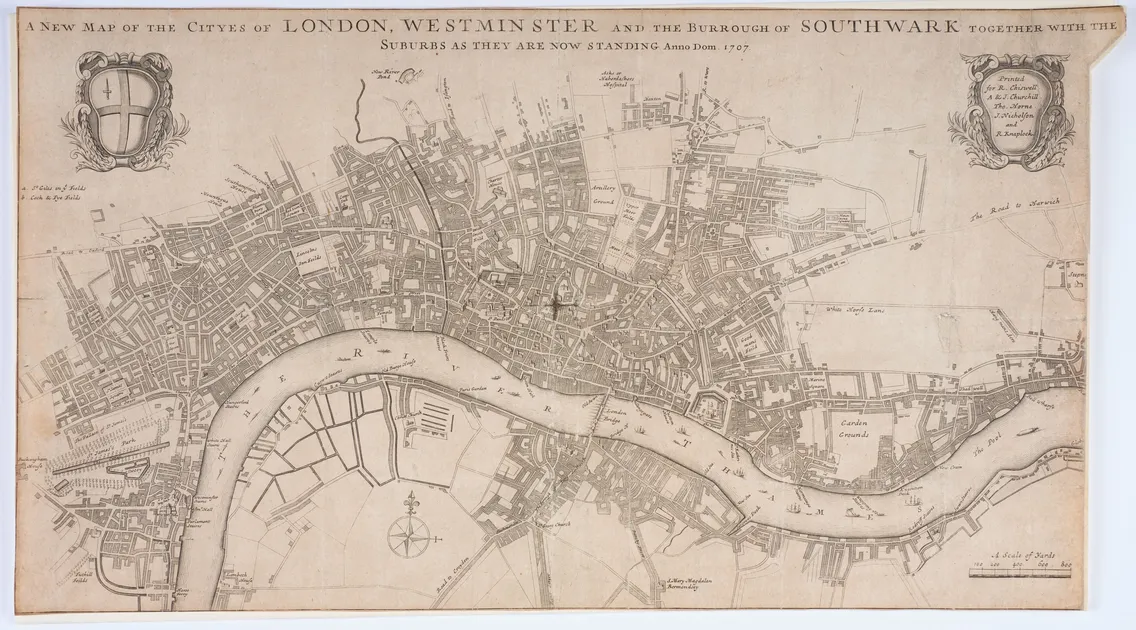
This tourist map from 1707 shows some of London’s first squares as the city expanded westwards.
After the Great Fire of London ravaged the City of London in 1666, landowners to the west seized the opportunity to create more spacious, elegant residences on their fields, woods and meadows. St James’s Square (1667), Soho (originally King’s) Square (1681), Golden Square (1688) and Grosvenor Square (1695) all used Covent Garden as the blueprint.
The birth of the garden square
Most of London’s squares were built as the city expanded in all directions during the 1700s and, particularly, the 1800s. The majority were laid out as residential developments enclosed by terraces of townhouses. Smaller houses and shops developed nearby, where communities served their wealthy neighbours.
-
Paintings, Prints & Drawings
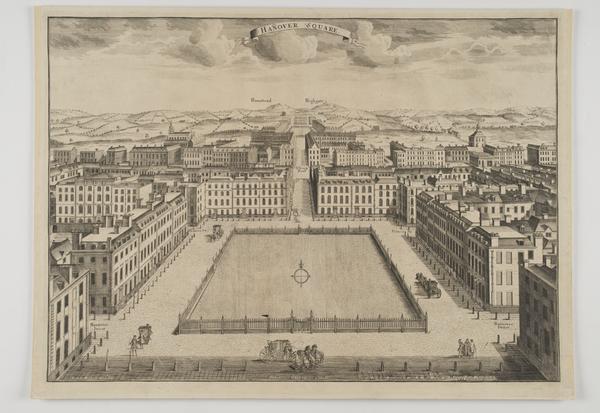
-
Paintings, Prints & Drawings
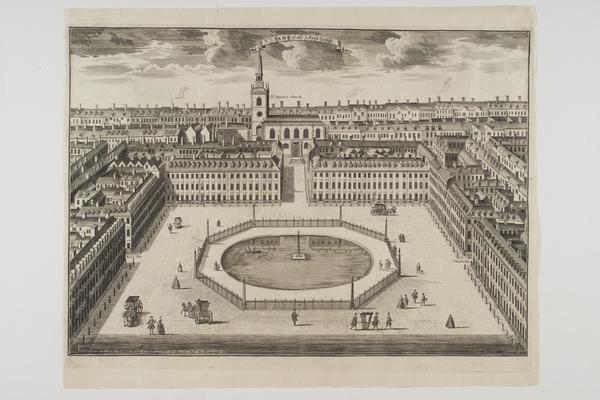 Paintings, Prints & Drawings
St. James's Square (line engraving)
Nicholls, Sutton, Bowles, John
C. 1731
-
Paintings, Prints & Drawings
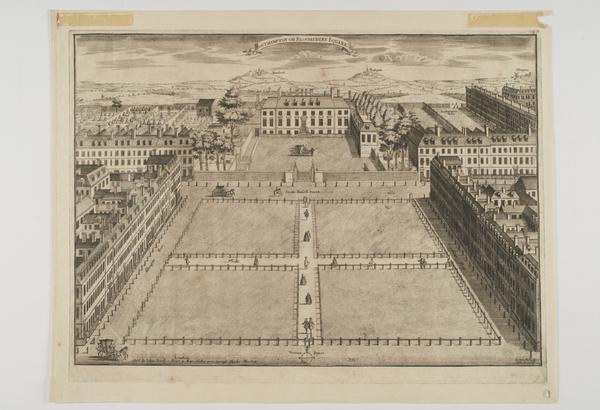 Paintings, Prints & Drawings
Southampton or Bloomsbury Square (engraving)
Nicholls, Sutton, Bowles, John
C. 1731
-
Paintings, Prints & Drawings
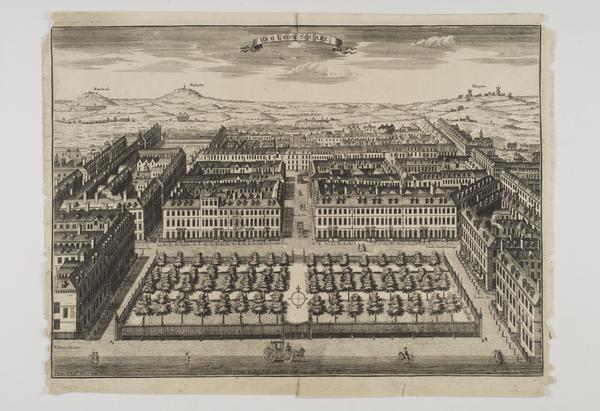
-
Paintings, Prints & Drawings
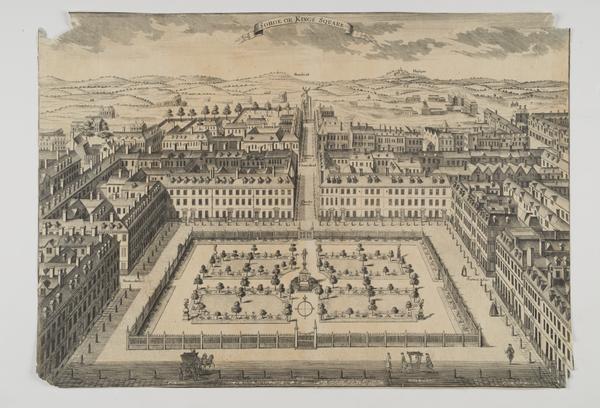 Paintings, Prints & Drawings
Sohoe or Kings Square (engraving)
Nicholls, Sutton, Bowles, John
C. 1731
-
Paintings, Prints & Drawings
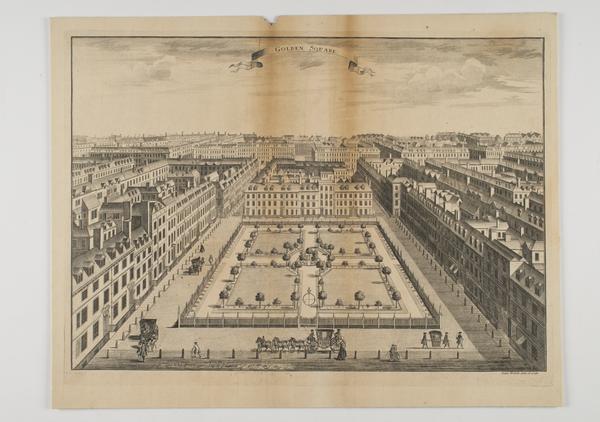
These prints above by Sutton Nicholls show different squares in London in the early 1700s. Some were right on the city’s outer edges, as you can see from the rolling hills of the Hampstead and Highgate countryside in the background. And not all of these ‘squares’ are totally square.
These squares were transformed from unplanted open spaces into properly landscaped gardens, and so the term ‘garden square’ was born. Gardens were increasingly planted with shrubs and trees, like the London plane, over the 1700s. Older squares also got a sprucing up of greenery.
While there’ve been gardens in London since medieval times, green spaces became more appealing and important in the industrialising, more densely populated capital. Developers knew residents would pay a premium for houses with access to gardens.
-
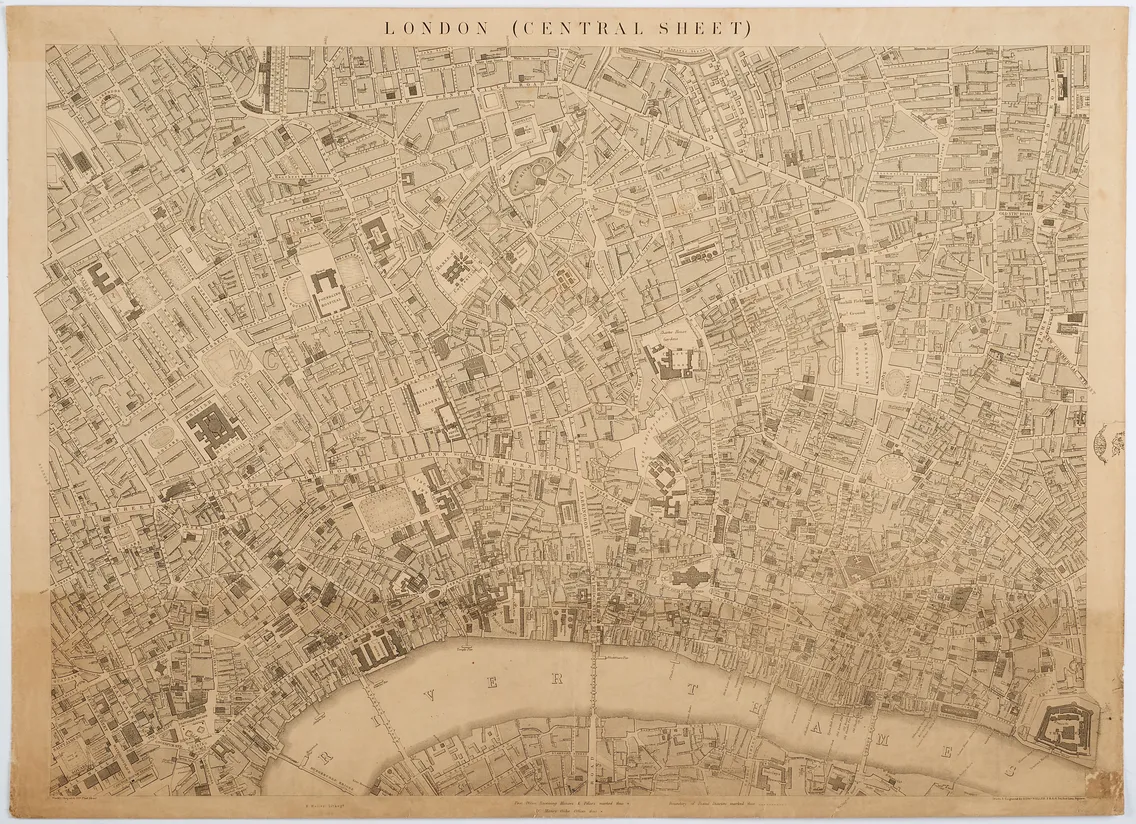
Spot the many squares of central London in this map from 1861.
How have London’s squares survived?
In a city that’s constantly changing, London’s garden squares have been remarkably resilient. Organisations, local authorities and Londoners have fought to protect the gardens themselves from development.
In the late 1800s, a charity called the Metropolitan Public Gardens Association saved a number of ageing squares from development. De Beauvoir Square in Hackney and Red Lion Square in Holborn were among those that were improved and opened to the public.
“Even the ground underneath London’s squares hasn’t been spared from development”
The 1931 London Squares Preservation Act protects over 400 of the city’s historic squares, restricting their use to “ornamental gardens, pleasure grounds or grounds for play, rest or recreation".
However, this doesn’t protect the buildings around them. The character of many squares has changed dramatically. The Georgian townhouses that once surrounded many of Bloomsbury’s squares, for example, have been replaced with a mishmash of modern university and hospital buildings.
Even the ground underneath London’s squares hasn’t been spared from development. Both Finsbury Square and Cavendish Square now sit above car parks.
Who has access to London’s squares?
Some squares, including Trafalgar Square (opened 1844) and Parliament Square (laid out in 1868), were made to be public spaces from the start. These open, visible and accessible spaces have long histories as sites of protests – both peaceful and violent.
-
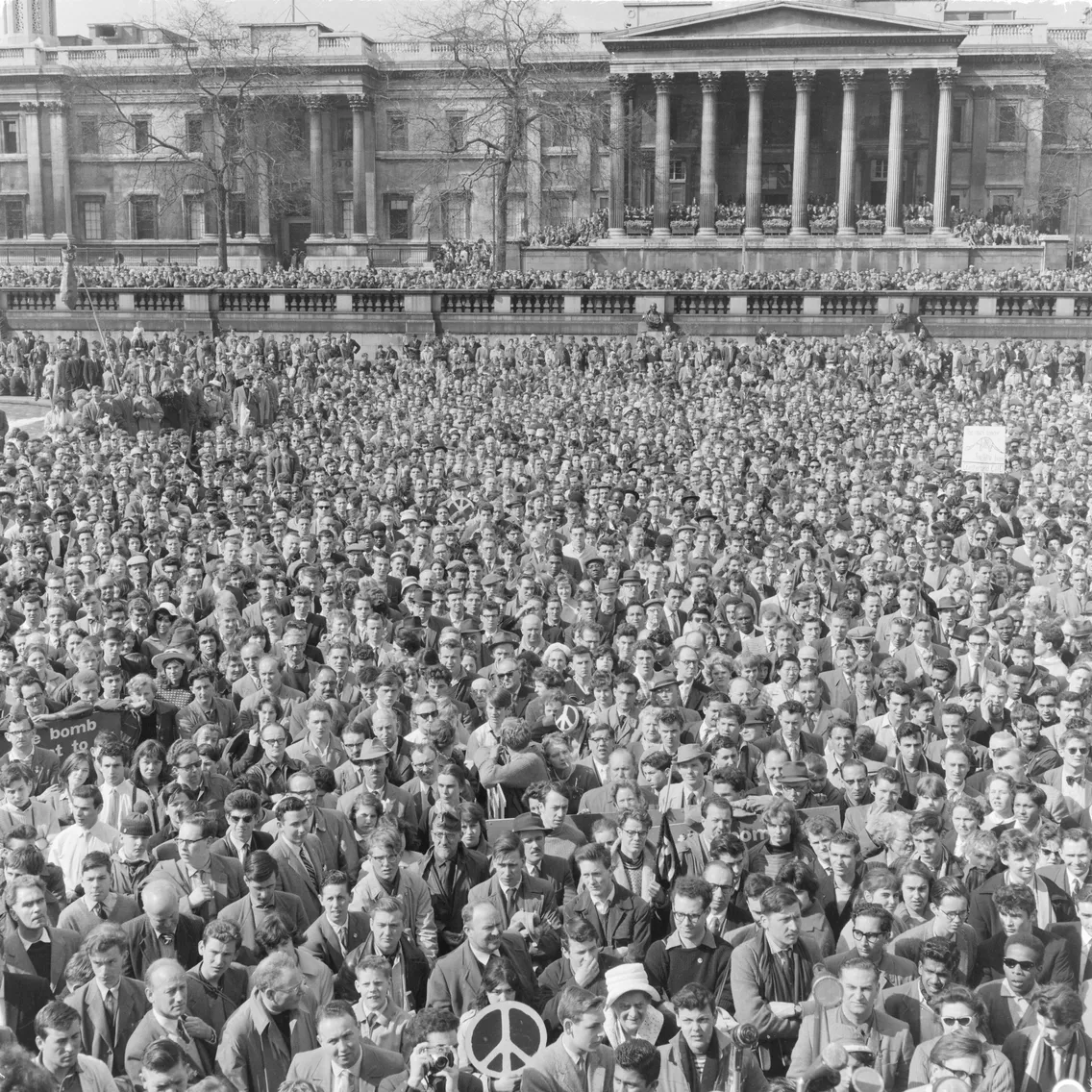
Crowds pack into Trafalgar Square during an anti-nuclear weapons demonstration in 1960.
-
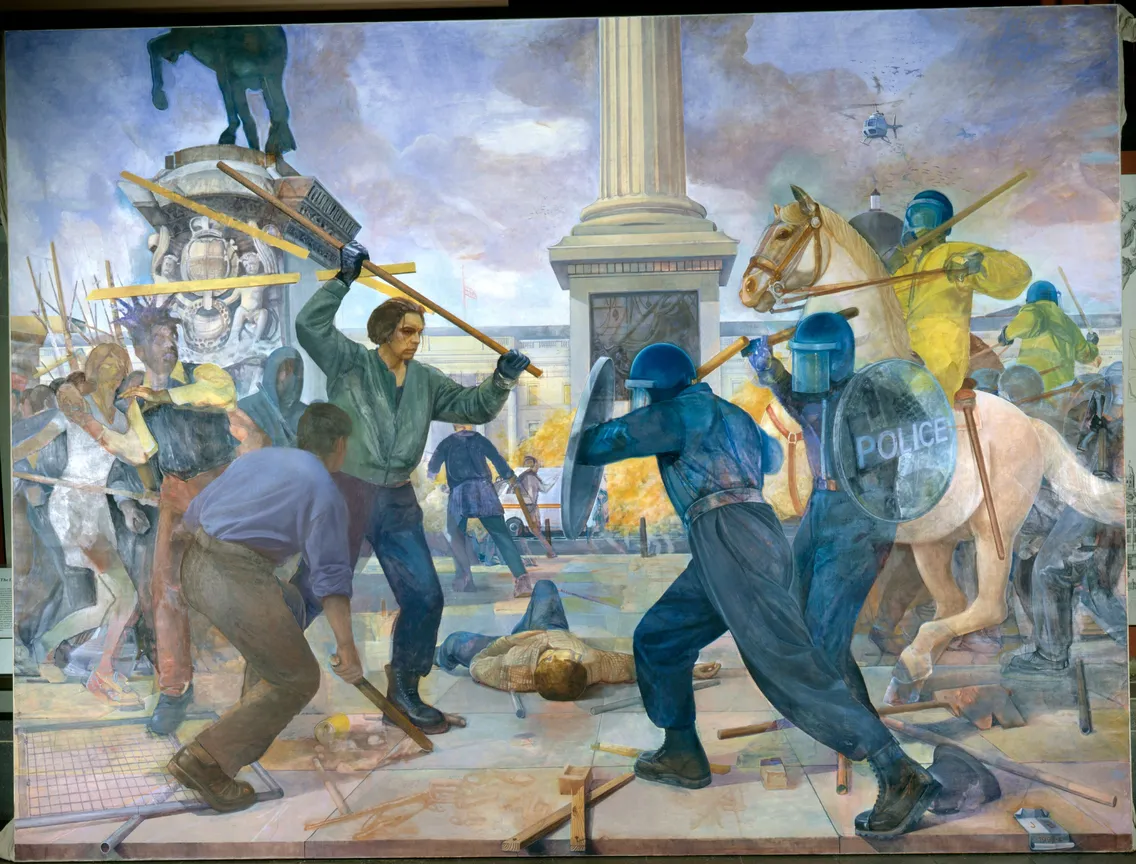
This painting by John Bartlett shows the 1990s Poll Tax riot at Trafalgar Square.
-

Supporters of the British fascist movement leader Oswald Mosley clash with police in around 1960.
However, most squares were exclusive by design, the private oases of their wealthy London residents. In the 1700s, many garden squares were enclosed with iron fences and locked gates, including all the squares in Bloomsbury. Bedford Square, built in 1776, had five gates with lodges and gatekeepers. It’s the only 18th-century square that’s survived intact.
Some of these squares’ gates were taken down and opened up to the public at the turn of the 20th century. But there are still gated squares all over London, including in busy areas, such as Manchester Square near Oxford Street.
Elsewhere, there’s been a creeping rise in privately owned public spaces (POPS) across the city in recent years. Walk through the wide-open Granary Square in King’s Cross or Paternoster Square in St Paul’s, and you’d be forgiven for thinking this is public land. But both are owned by private companies. POPS like these often have private security, and their owners can control who has access to them.
During the 2011 anti-capitalist Occupy movement, demonstrators were stopped from setting up their camp at the London Stock Exchange in Paternoster Square by its private owner. They were forced to camp outside St Paul’s Cathedral instead.