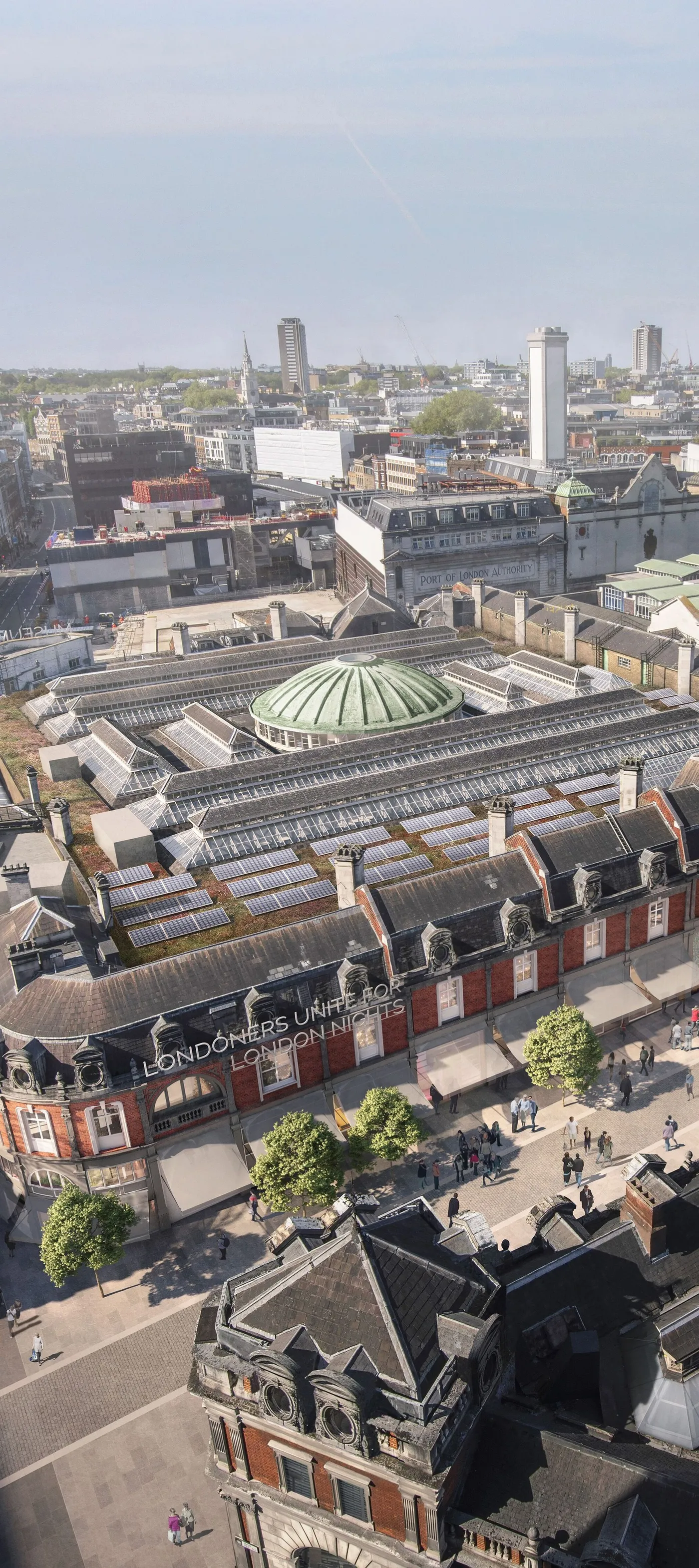
The 900-year history of St Bartholomew’s Hospital
St Bartholomew’s is the oldest hospital in England still operating on its original site. Founded in 1123, it’s survived fire, war and constant development to provide specialist care for Londoners today.
West Smithfield, City of London
Since 1123
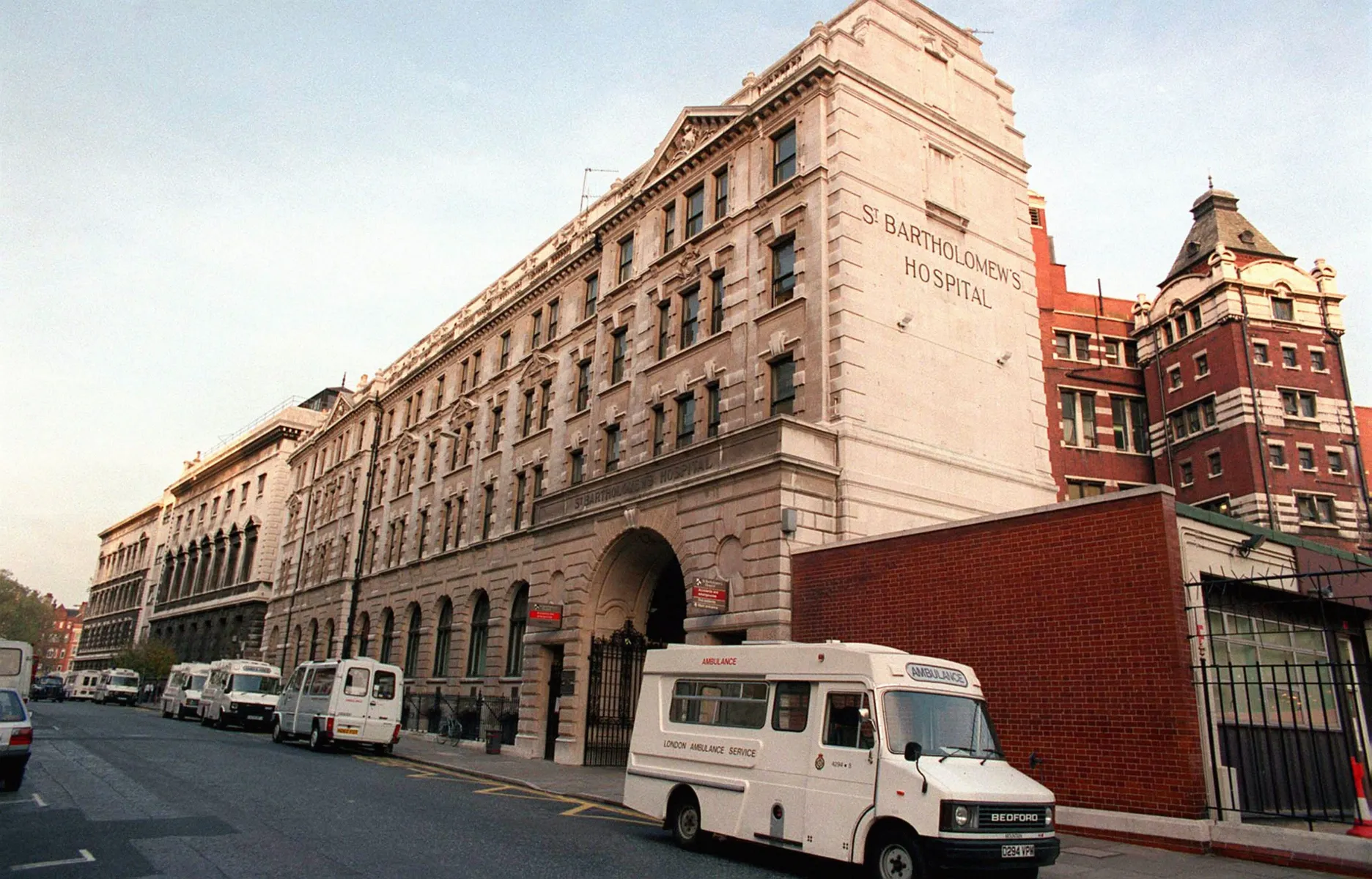
St Bartholomew’s Hospital in 1992.
Caring for the city for centuries
St Bartholomew’s Hospital was founded as a fever dream. In the 12th century, one of Henry I’s courtiers, Rahere, became very sick on a pilgrimage to Rome. He promised to build a hospital on his return, if he survived. Later, he had a vision of St Bartholomew instructing him to build a church at Smithfield.
The medieval monastic hospital was nearly shut down by King Henry VIII in the 1530s. But it survived. It was run as a charitable institution until the founding of the state-run NHS in 1948, surviving the Great Fire of London in 1666 and bombs from the Blitz in the mid-20th century.
Looking at the history of ‘Barts’, as it is fondly known, allows us to trace how medicine and hospital care developed in the capital. Over its 900 years, we see herbal remedies and prayers, early forays into surgery and pioneering cancer technology.
The medieval St Bartholomew’s Hospital
Henry I granted Rahere land at Smithfield, just outside the city walls, to build his Catholic priory and a hospital to shelter sick and poor Londoners.
St Bartholomew’s was a refuge for the sick that mostly offered rest, food and spiritual comforts. At first, the priory’s nuns and brethren supervised treatment. Treatments were often religious or based on prayer. For example, a patient’s swollen tongue was healed by washing it with water that a holy relic had been dipped into. Herbal and other traditional remedies were probably used.
-
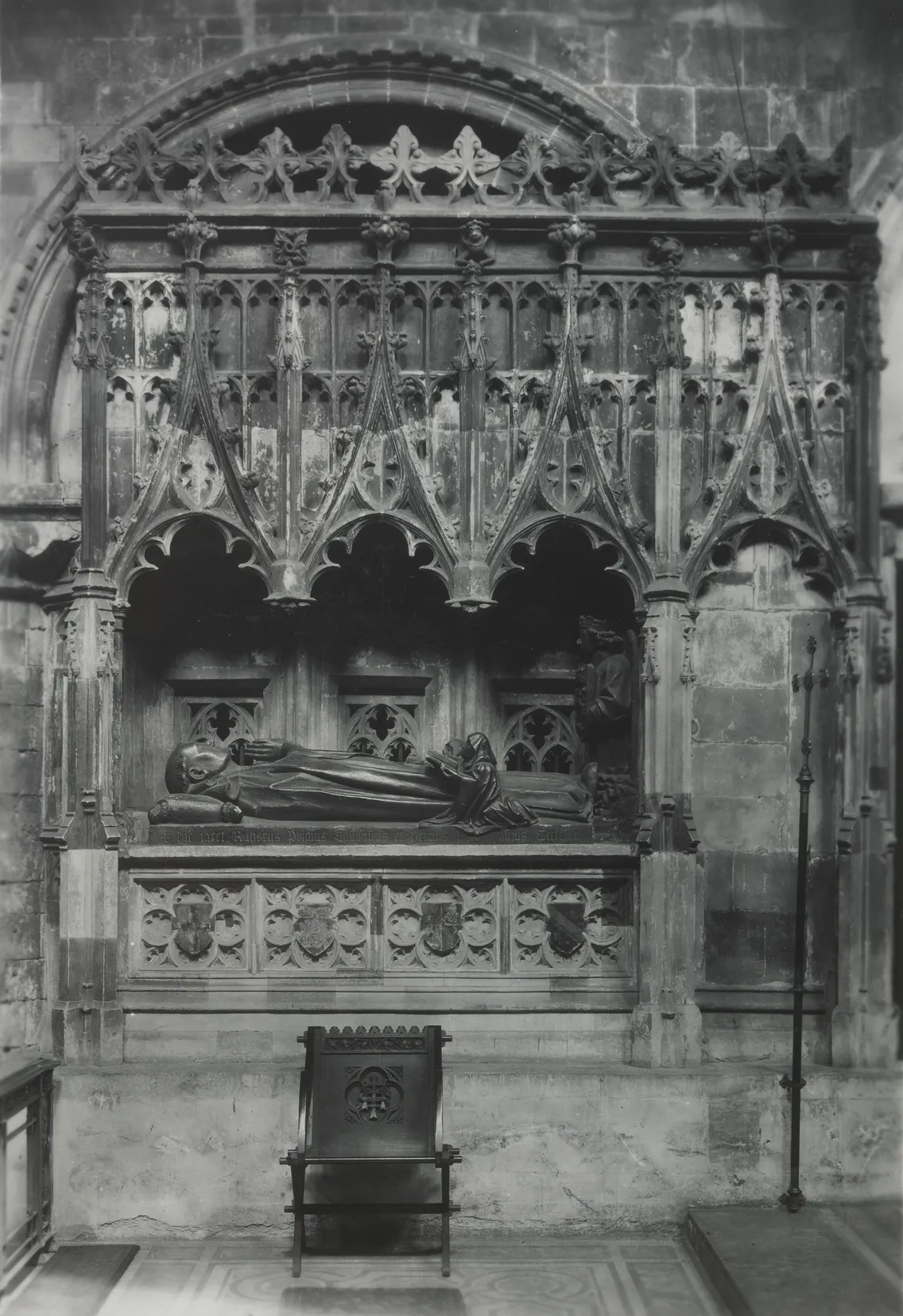
Rahere’s tomb in St Bartholomew the Great church, Smithfield.
-
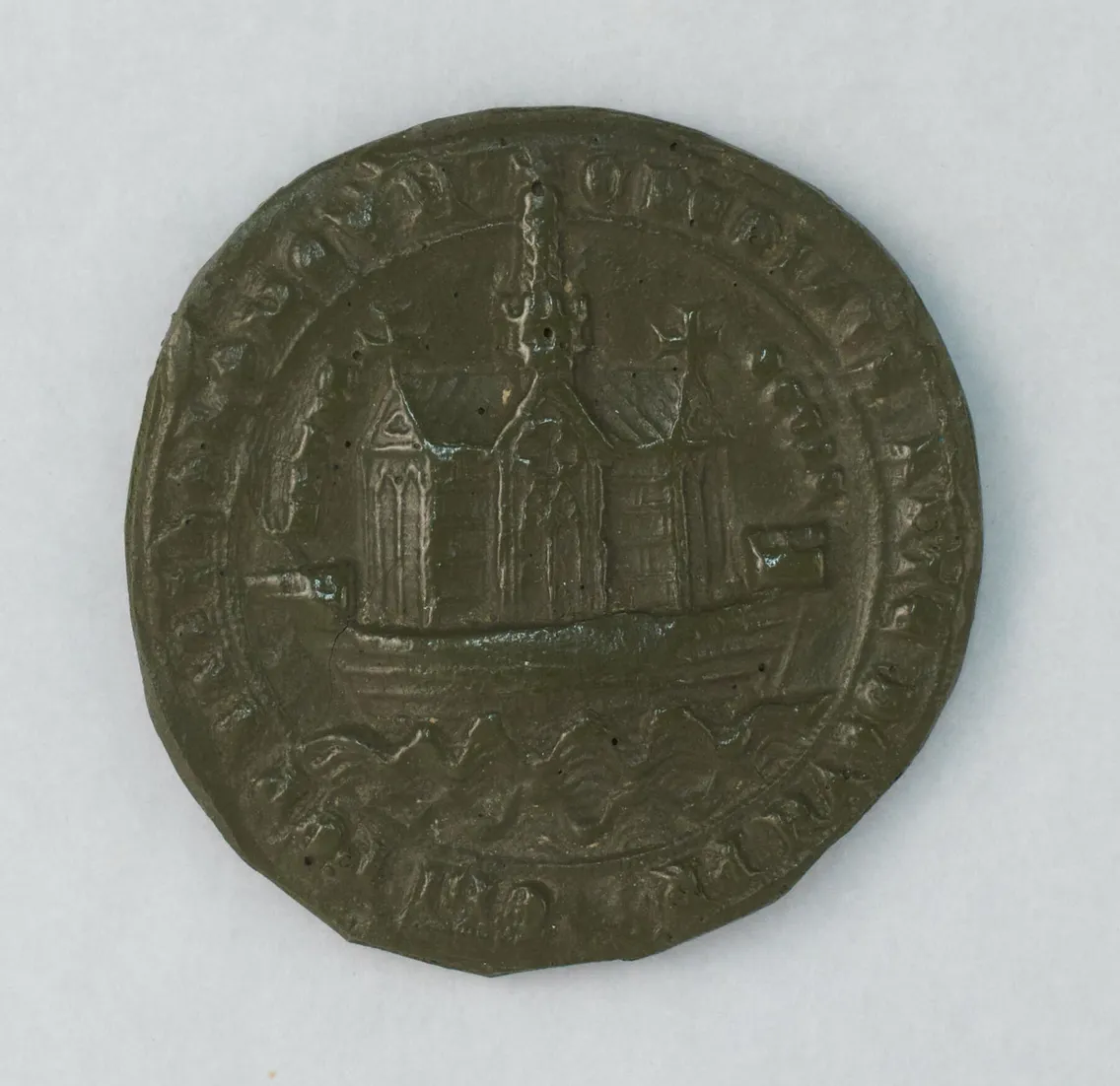
Replica seal impression of the Priory of St Bartholomew.
While Christianity continued to shape life at St Bartholomew’s, the hospital became increasingly independent from the priory. It has its own seal to validate official orders. A replica of one of the seals from the priory is in our collection and can be seen above. By 1453, the hospital was officially its own entity with its own master.
The surrounding Smithfield area also began to develop. From 1133, Bartholomew Fair took place on and around the priory grounds, growing from England’s top cloth fair into a carnival of chaos. Smithfield was also a famous site of public executions.
The dissolution of the monasteries
Between 1536 and 1540, Henry VIII shut down all of the country’s Catholic religious houses, a process known as the dissolution of the monasteries. St Bartholomew’s priory was closed. Its properties and revenues were confiscated, and its monks and nuns were expelled.
The hospital was allowed to keep going. But with its income slashed, St Bartholomew’s was on its knees. At one point, it was even running out of bedsheets. Officials and other Londoners petitioned Henry. Religious houses did much of the caring for sick and dying back then, so who’d care for them now they were gone?
Eventually, the king gave in to the people’s pressure and refounded the hospital. Just in time, too. He died a few days after signing the final order.
How the refounded hospital was run
St Bartholomew’s became one of the four royal hospitals managed by the City of London, alongside Bethlem, St Thomas’ and Bridewell. In the following years, the hospital appointed three surgeons, a physician and a nursing staff of 12 sisters, led by a matron.
Physicians were seen to have a higher status than surgeons. Only they could sign off on prescriptions from the apothecary.
But surgeons were still apprenticed and trained, and they were required to top up their knowledge at lectures and demonstrations. Surgeries have been performed at Barts since at least 1547, when a bladder stone removal was recorded. Pain relief from anaesthetics wouldn’t come for another 300 years.
-
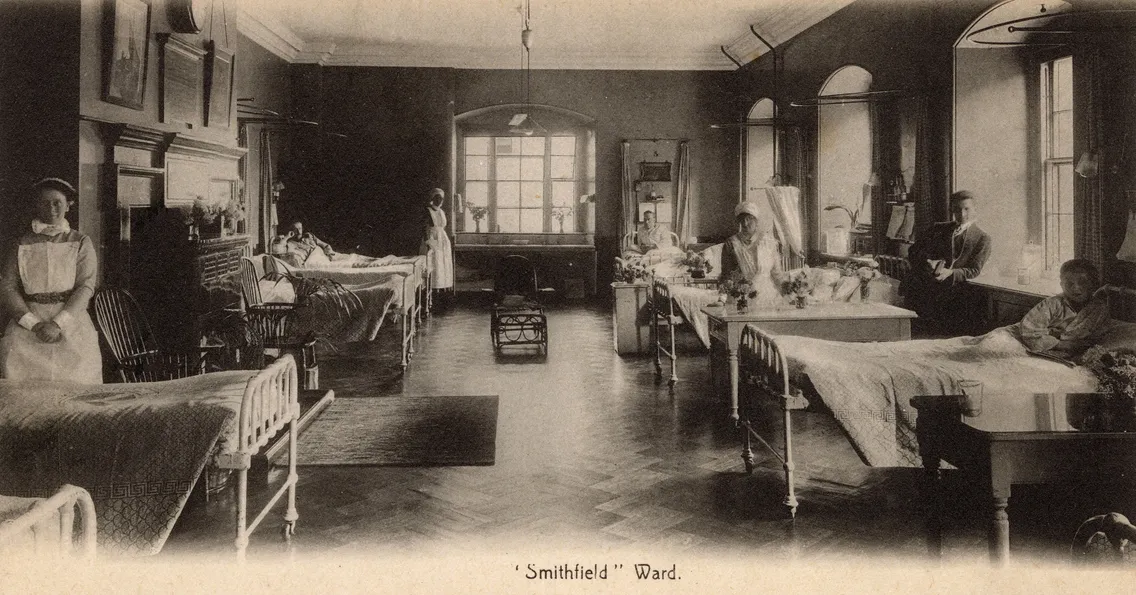
St Bartholomew’s Smithfield Ward.
Back then, nurses weren’t trained like they are today. Instead, they’d do cleaning and other manual work.
The matron was even allowed to top up her wages by selling ale and beer from a room above a hospital cellar. It wasn’t until 1707 that hospital governors decided to convert this space into a ward.
The hospital was rebuilt by James Gibbs
By the early 1700s, St Bartholomew’s was looking a little worse for wear.
It had escaped the Great Fire of London in 1666. But many of its properties were destroyed, and some wards were closed to accommodate shops and companies who’d lost their premises in the disaster.
The hospital was also overcrowded. London’s population had increased significantly – from around 80,000 in 1550 to over 700,000 in 1750. It just didn’t have the space to care for all the sick and poor Londoners who needed help.
In came James Gibbs, the famous architect of St Martin-in-the-Fields church in Westminster. From 1730 to 1759, the medieval hospital maze of alleyways and timber was swept away. In its place was Gibbs’ stone neo-classical building, designed with typically Georgian symmetry and order in mind.
-
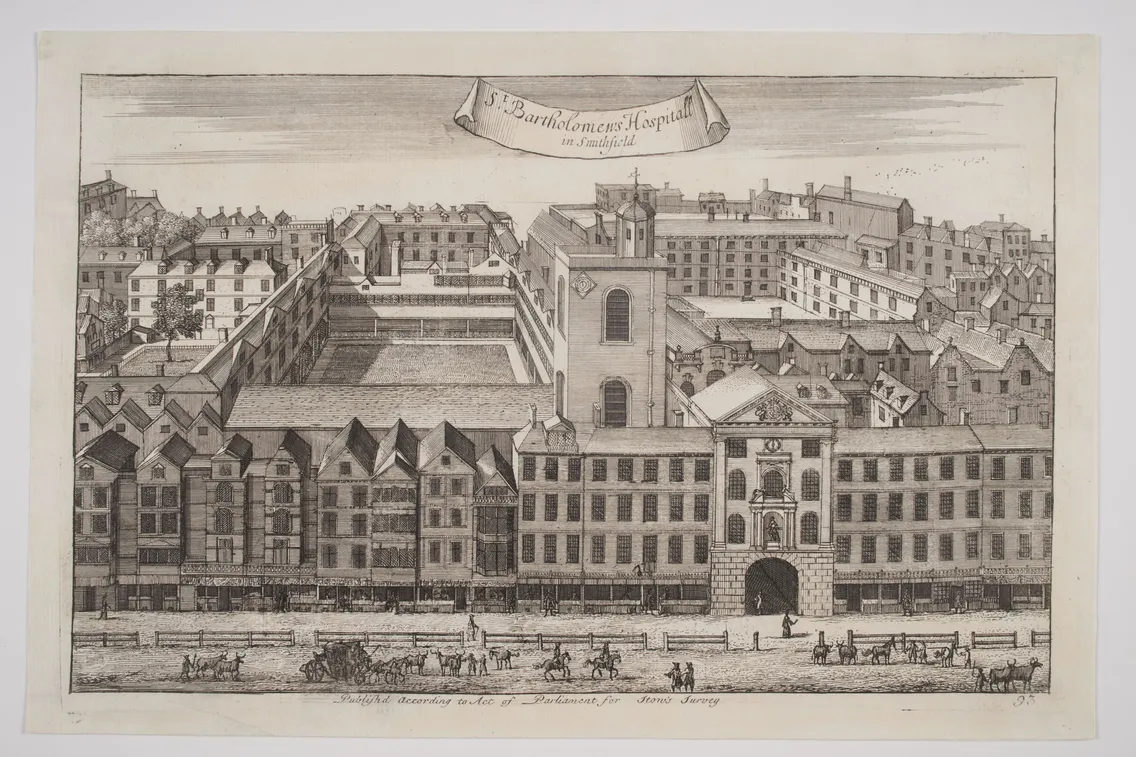
Print of St Bartholomew’s Hospital from 1755.
The new hospital had 504 beds across four hospital blocks, which were organised around a courtyard. It was light and airy – perfect at a time when people believed diseases spread through miasma, or bad air.
How medicine evolved at St Bartholomew’s
Many people who’ve worked at Barts have been important to the development of modern medicine.
The physician William Harvey was the first to discover the circulation of blood, publishing his findings in 1628. And the surgeon Percival Pott pioneered orthopaedic procedures at Barts in the 18th century. He also found a link between soot and scrotal cancer in chimney sweeps, which was essentially the first time a cancer was linked to a type of work.
In 1850, Elizabeth Blackwell was the first woman to enrol at St Bartholomew’s medical school. When a second female student, Ellen Colborne, was admitted in 1865, the other male students vehemently opposed. The result? Women were excluded from studying at the hospital until 1947.
“Barts is my second home and my life here is cherished”
Derek Jarman, 1993
It survived threats of closure in the 1990s
St Bartholomew’s might have survived the Great Fire, and bombing during the Blitz between 1940 and 1941. But in the 1990s, Barts was nearly closed for good during a Conservative Party-led shakeup of London’s hospital services.
-
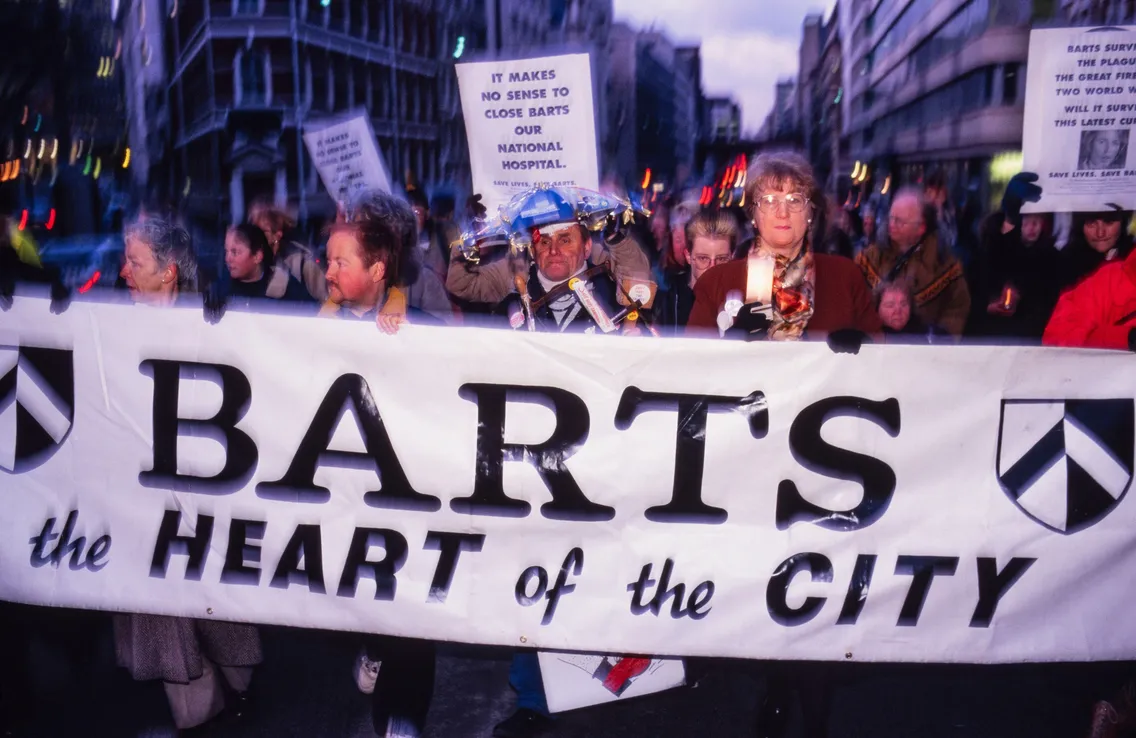
Protestors take to the streets against the proposed closure of St Bartholomew’s.
The Save Barts Campaign launched in 1993. It spread worldwide. The Sherlock Holmes Appreciation Society in Tokyo sent a £650 donation, inspired by how the character Holmes met Dr Watson at the hospital.
The artist Derek Jarman, who was being treated for AIDS-related illnesses there, wrote in the Independent in 1993: “To shut Barts would be a crime against the past and against the metropolis… Barts is my second home and my life here is cherished.” He died there the following year.
In 1997, the Labour government decided to save the hospital by merging it with the nearby Royal London Hospital and turning it into a specialist centre. The hospital’s focus on cancer and cardiac care continues today.