

13 February 2026 — By Kate Sumnall
Why Mudlarks search the Thames foreshore at night
Called nightlarking, some dedicated mudlarks prefer to search the Thames foreshore by torchlight. The darkness offers quiet focus and peaceful solitude while the illuminated city glows above.
-
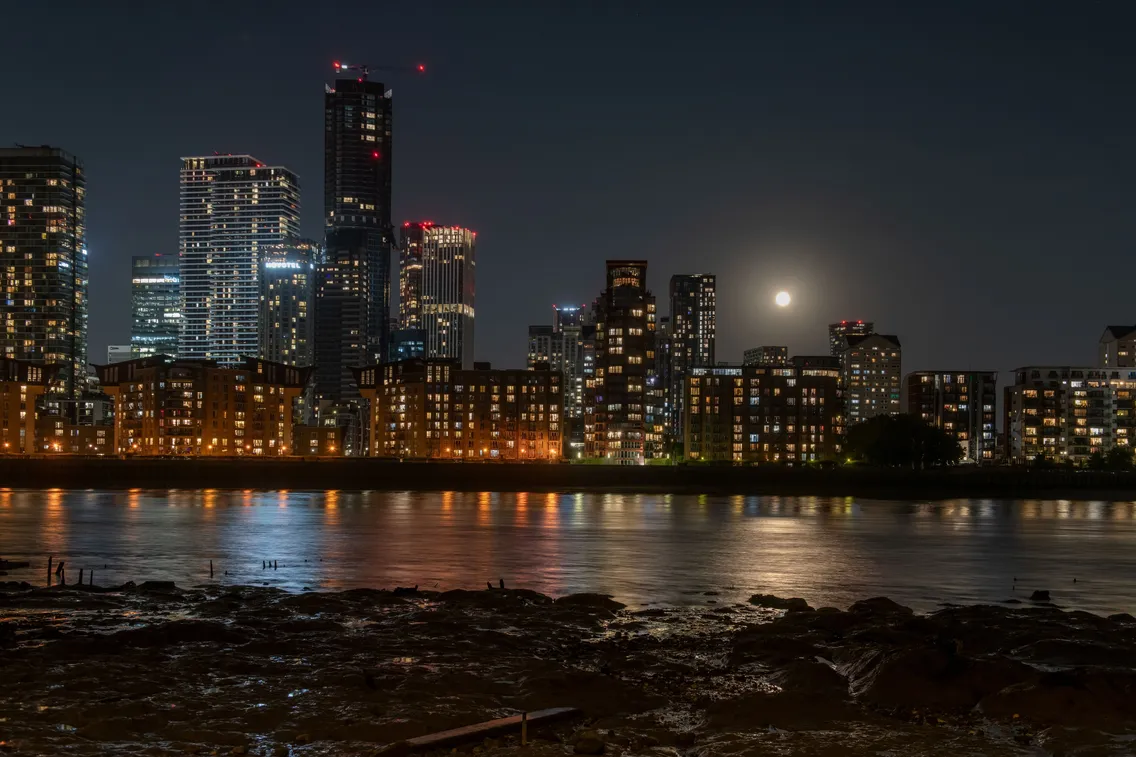
Thames foreshore during a full moon night.
Twice a day, the River Thames flows out, exposing the rocky foreshore. And mudlarks seize the window of opportunity to search and see what historic objects they might find. Most mudlarks only visit the foreshore during daylight hours, but some dedicated mudlarks even venture down during the night’s low tides.
Tom Chivers, mudlark, writer and researcher, writes: “Beyond and below the sodium glare of the city, night arrives early on the foreshore. It is my favourite time to search, working by torchlight and the glow of the moon.”
What makes nightlarking special?
Many mudlarks explain the appeal of mudlarking as a combination of feeling peaceful by the river, with its sights and sounds, the meditative nature of the search and the thrill of discovery. It offers a direct connection with the past, knowing that you are the first person to touch an object since it slipped from the fingers of the owner.
When the sun sets, the atmosphere of the river shifts, and the search becomes even more focused.
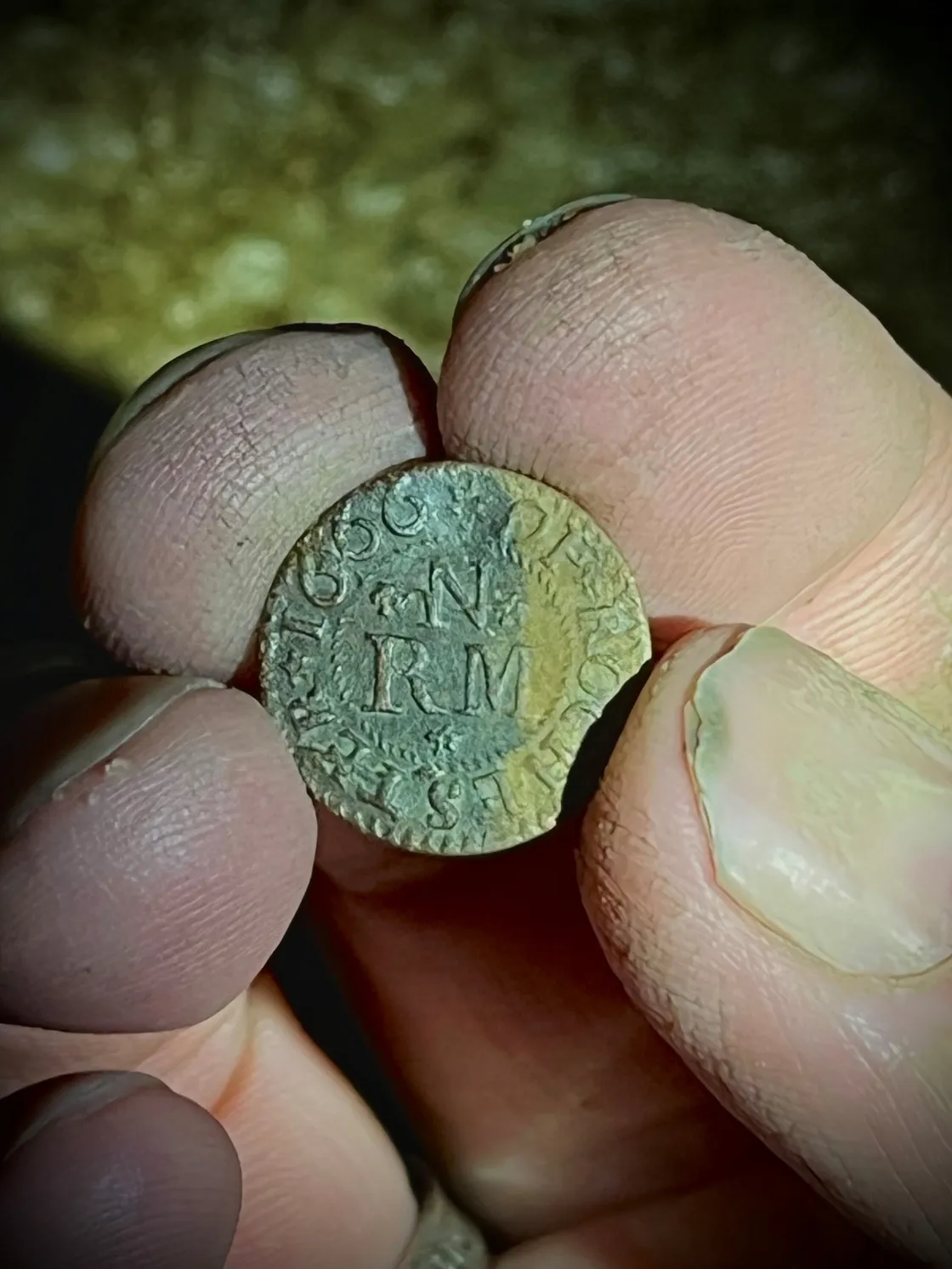
A 1666 trade token found by Tom Chivers while nightlarking.
Tom further describes his experience as a nightlark: “After dark, when the noise of the city subsides, my ears attune to the music of the river: the creaking of wooden piers and jetties; the clanking of iron chains in the ebb tide. Sometimes, when the wind is in the right direction and my head is close to the ground, I have heard the footsteps of another mudlark or the scuttle of a fox across the gravel a hundred metres away.
“At night, I search the foreshore with forensic detail. Small patches of ground, lit up like a film set by the beam of my head torch”
Tom Chivers, mudlark
“On other occasions, the foreshore seems to breathe; when kneeling in areas of soft mud, I have heard faint gargles arising from the surface as pockets of air beneath the surface are released by the weight of my body.
“At night, I search the foreshore with forensic detail. Small patches of ground, lit up like a film set by the beam of my head torch. I have found buckles and gemstones, glass marbles shining like orbs, a copper trader’s token dated 1666. It is my favourite time to search.”
Recreating the foreshore
In the Secrets of the Thames exhibition (Apr 2025 – Mar 2026) at London Museum Docklands, we wanted visitors to step into the world of the mudlarks. We recreated the foreshore as accurately as possible – a jumble of the ancient alongside the modern – and built the atmosphere using sounds of the river that Tom recorded.
Those sounds take the visitor from the noisy, busy city to the sounds of the river, recreating the mudlarks’ journey as they leave street level and descend the slippery steps down the 6–7 metres to get to the foreshore. The Thames has one of the biggest tidal drops in the country.
Objects don’t tend to travel far from where they were used, dropped or thrown into the Thames. They map onto the activities that took place all along the river. For example, mudlarks find iron ships’ nails in Rotherhithe where ship building and breaking took place in the 17th–18th centuries.
-
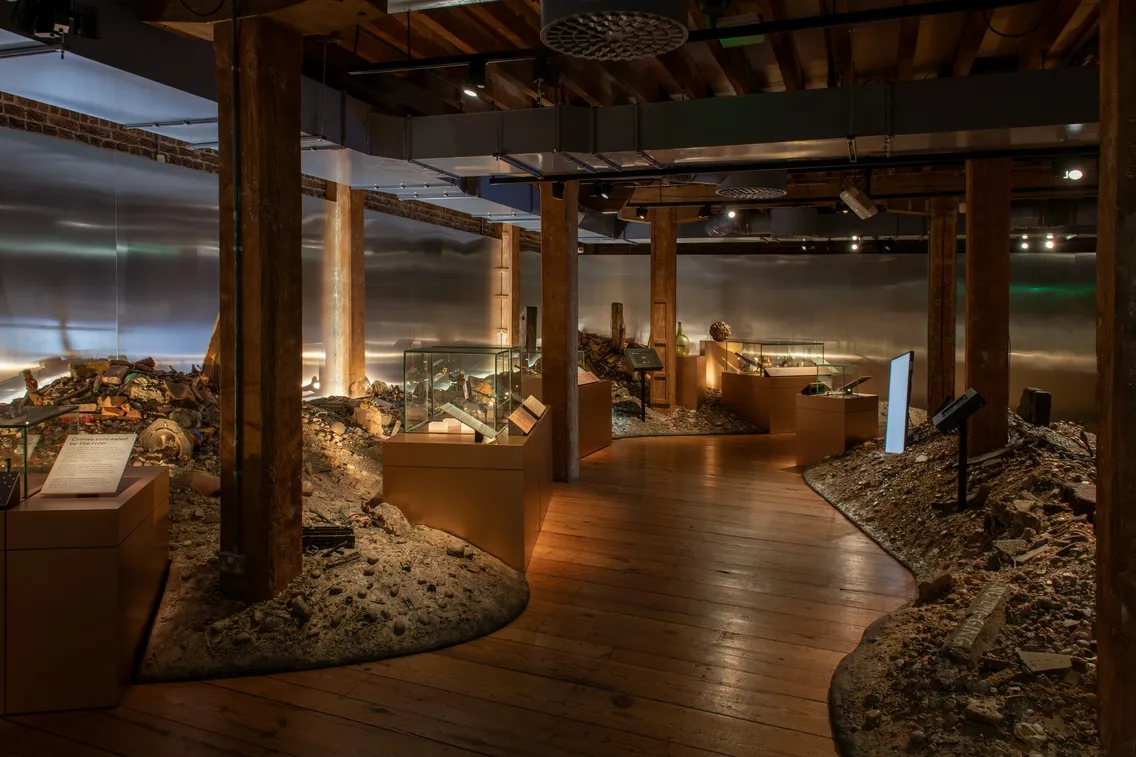
Our reconstructed foreshore mimicked the real foreshore in being a jumble of the ancient alongside the modern.
-

The Moon by Luke Jerram.
Hydraulis: Capturing river sounds
As the final moment of the exhibition, we paired artist Luke Jerram’s ‘The Moon’ with a soundscape from south London sound artist felix taylor. Tom Chivers introduced Felix to the foreshore and nightlarking. The two bonded over their shared love of sound and the river.
Felix was struck by the musicality of the river and how the foreshore sounded like a musical instrument. He composed a new piece blending the recordings from the river with the sounds of mudlarking. It’s called ‘hydraulis!’ after an ancient Greek organ, powered by water and air. It perfectly captures the atmosphere of the river at night and the calm and peace that many mudlarks find next to the river when absorbed in the quiet search.
“The dark, cold, fast-flowing river, the uneven surface littered with sharp objects are just a couple of the risks”
The magic and dangers of nightlarking
“Nightlarking is a magical and solitary experience. Focus narrows down and sharpens into the small pool of light from the headlamp. There is darkness all around and a heightened awareness of river sounds – the wash from a party boat rushing onto shore and the stillness when the Thames holds its breath at slack tide, before turning back to sea,” shares Anna Borzello, mudlark, journalist and photographer. She also loves to visit the river during the nighttime low tides.
-
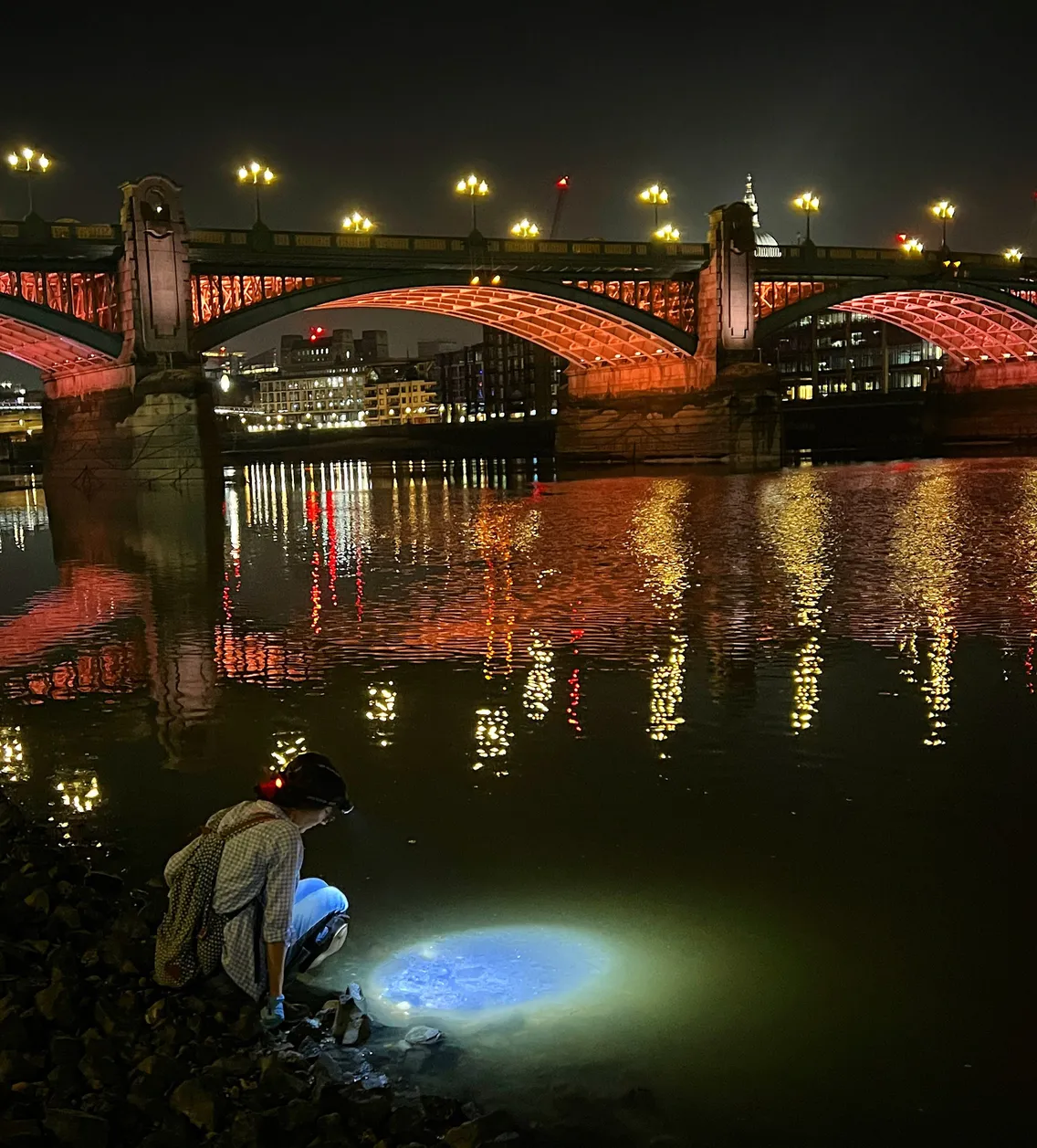
Nightlarking on the River Thames.
-
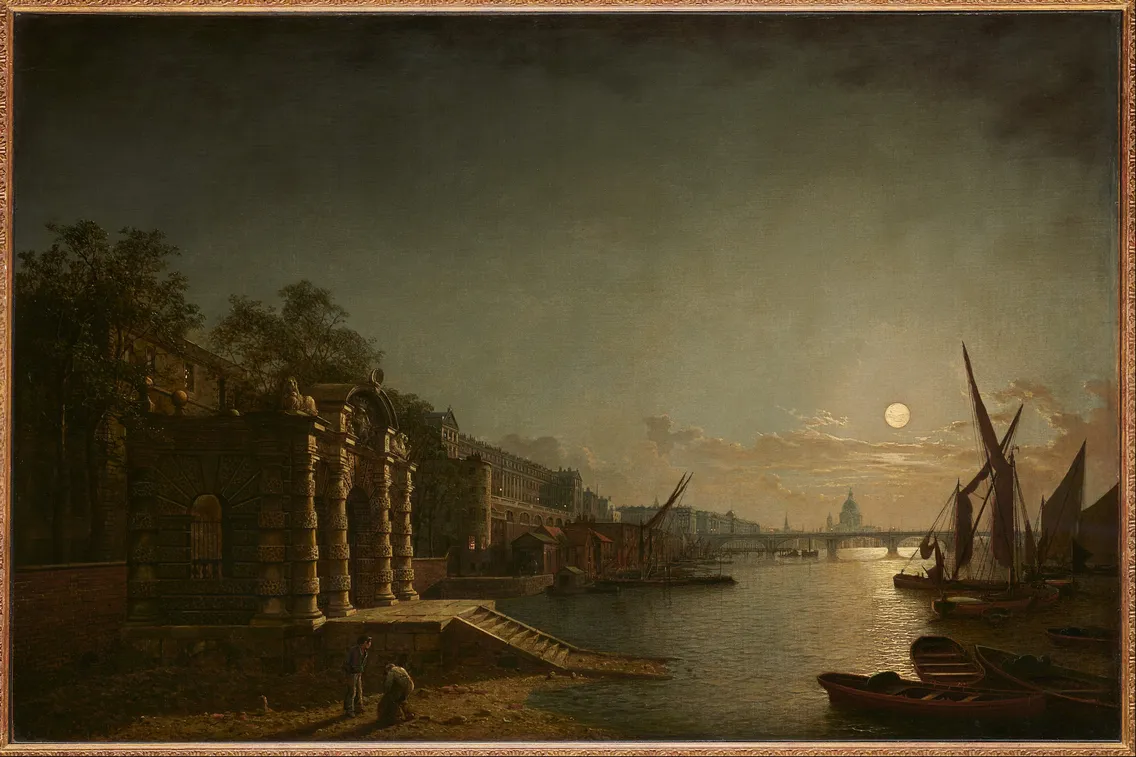
This painting from around 1850 shows two mudlarks on the foreshore during a moonlit night.
Anna took this photograph that beautifully contrasts the illuminated city with the darkness of the foreshore. She’s also mindful that all the dangers that are present on the river during daylight are vastly amplified at night.
The dark, cold, fast-flowing river, the uneven surface littered with sharp objects are just a couple of the risks. To help with the risk, Anna nightlarks with Christina Nicolaou, who features in the photograph with the beam of light from her headtorch mimicking the moon. It is thanks to the moon that mudlarking is even possible on the Thames. The gravitational force of the moon, and to a lesser extent the sun, draws the tide back, revealing the foreshore.
At night, the river seems completely different. The modern world recedes and the connection with the past seems even stronger. This is the appeal of nightlarking and what keeps mudlarks venturing down to the dark river.
Kate Sumnall is Curator, Archaeology at London Museum and Lead Curator of the 2025–2026 Secrets of the Thames exhibition at London Museum Docklands.
Please note that you must have a permit from the PLA to go mudlarking on the Thames foreshore.
Tags
-
 Exhibitions
5 must-see highlights from Secrets of the Thames exhibition
Stories of forgery, faith and ancient battles
-
 Exhibitions
How archaeological finds help tell LGBTQ+ stories
Three objects, thousands of years of queer history
-
 From our experts
Gold struck: A mother-son mudlarking adventure on the Thames
River reflections of a mudlark over 50 years
-
 From our experts
Fired up about pipe finds: A Thames mudlark’s passion
While plain tobacco pipes are common, decorated ones are a special find for Germander Speedwell
-
 From our experts
The sacred River Thames
Mudlarked discoveries show the Thames has been revered by many as a sacred space for millennia