07 May 2026 — By Corrina Eastwood
By Appointment Only: Romani art, history & resistance
The new art display ‘By Appointment Only’ at London Museum Docklands is an exploration of Romani art, culture and heritage, providing a space for the acknowledgment of important, often unspoken, histories.
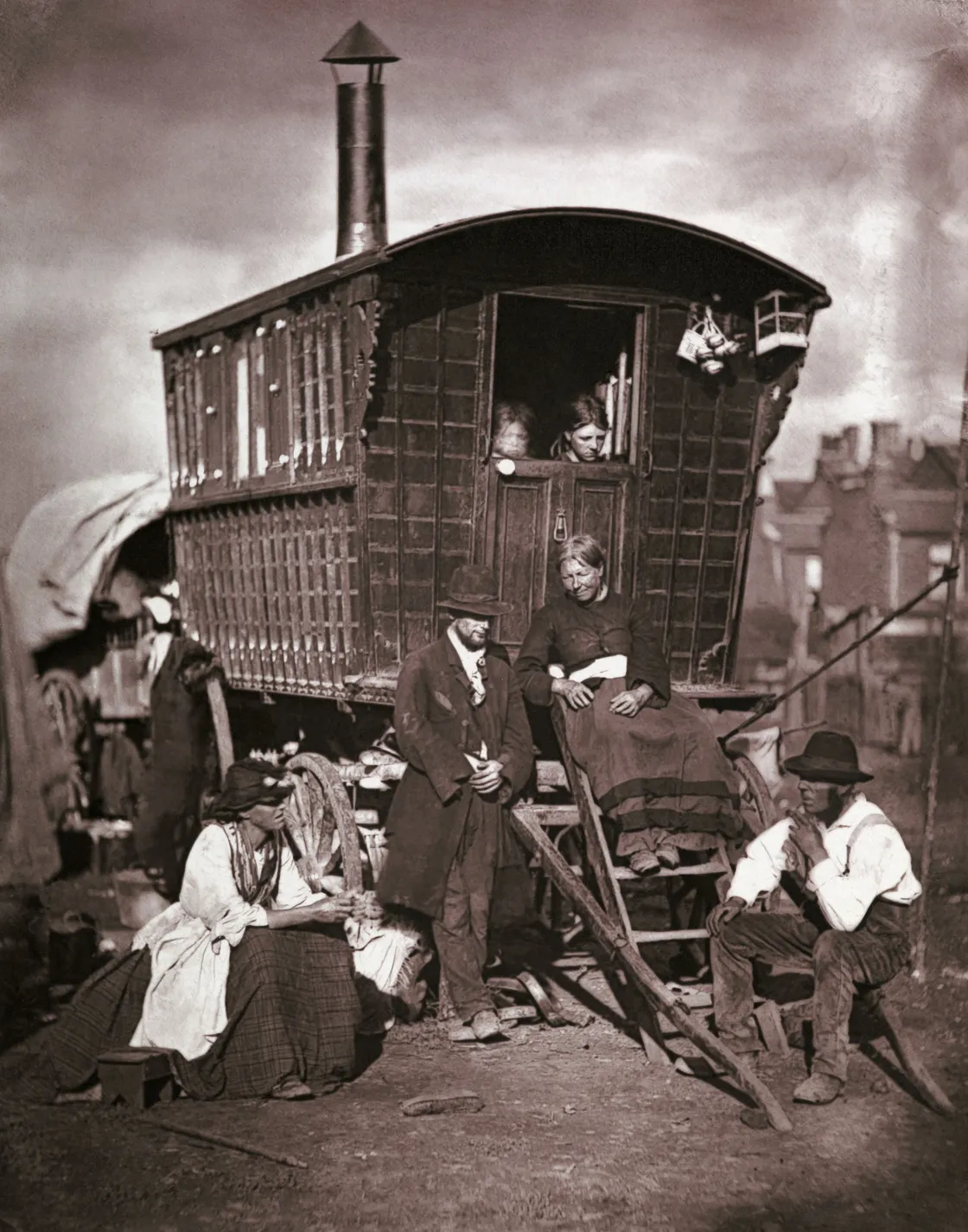
Romani travellers in Battersea, London, in 1877.
From a young age, I’ve experienced the racism and marginalisation that comes with being Romani. I’ve also inherited the creativity and resilience as part of my cultural identity. Growing up in Britain in the late 70s to early 90s, signs in pub and restaurant windows often read “No travellers or Gypsies allowed”.
In my late teens, those gradually changed to “Travellers by Appointment Only”. The exclusion of our GRT (Gypsy Romani Traveller) community continued either way.
This ‘request’ to make an appointment to enter public space remains a powerful metaphor. It reflects the marginalisation and oppression that Romani communities still face today.
The title of the ongoing art display I’ve co-curated at London Museum Docklands draws directly from that history: By Appointment Only.
-
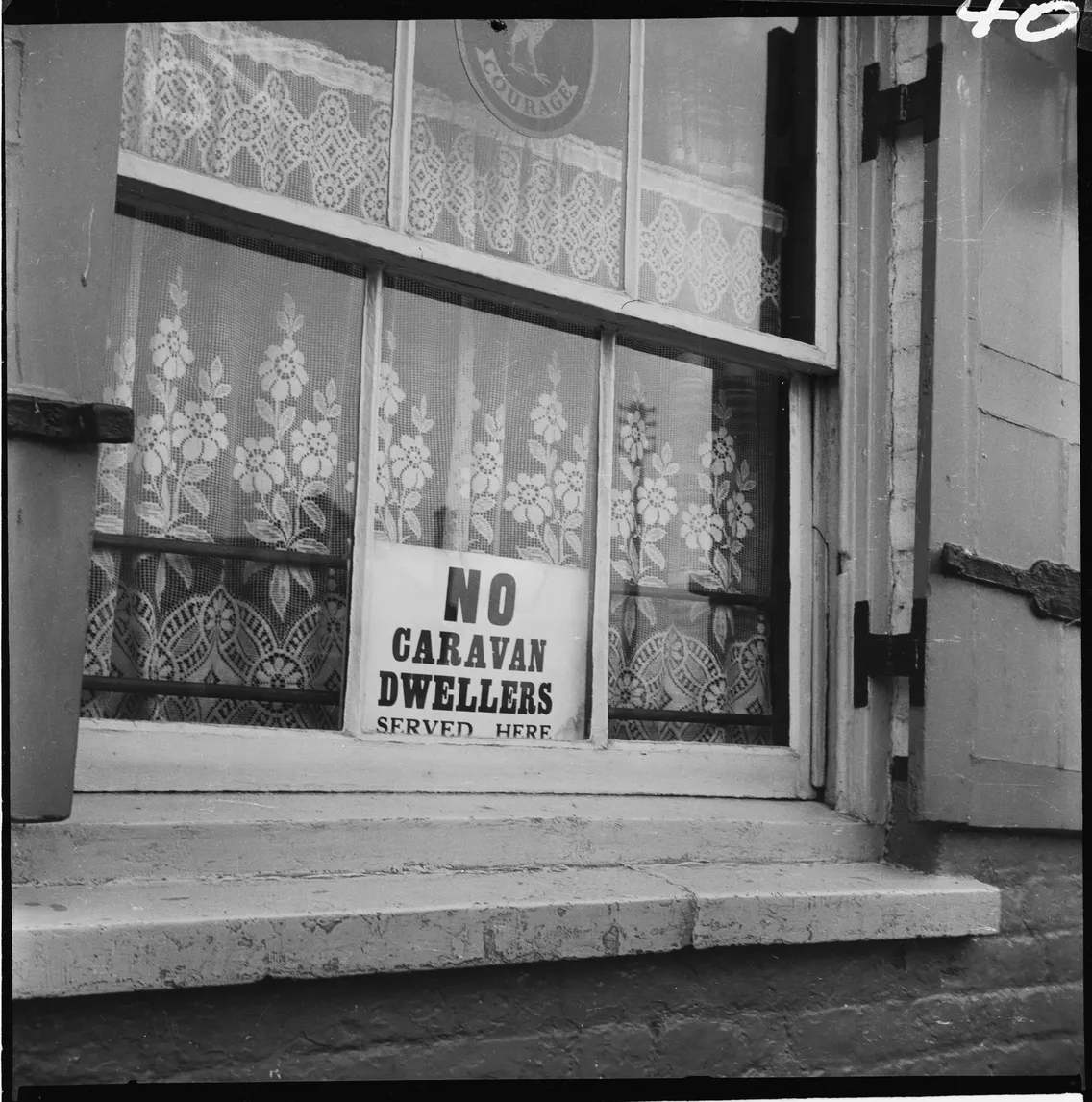
A discriminating window sign, 1953.
-
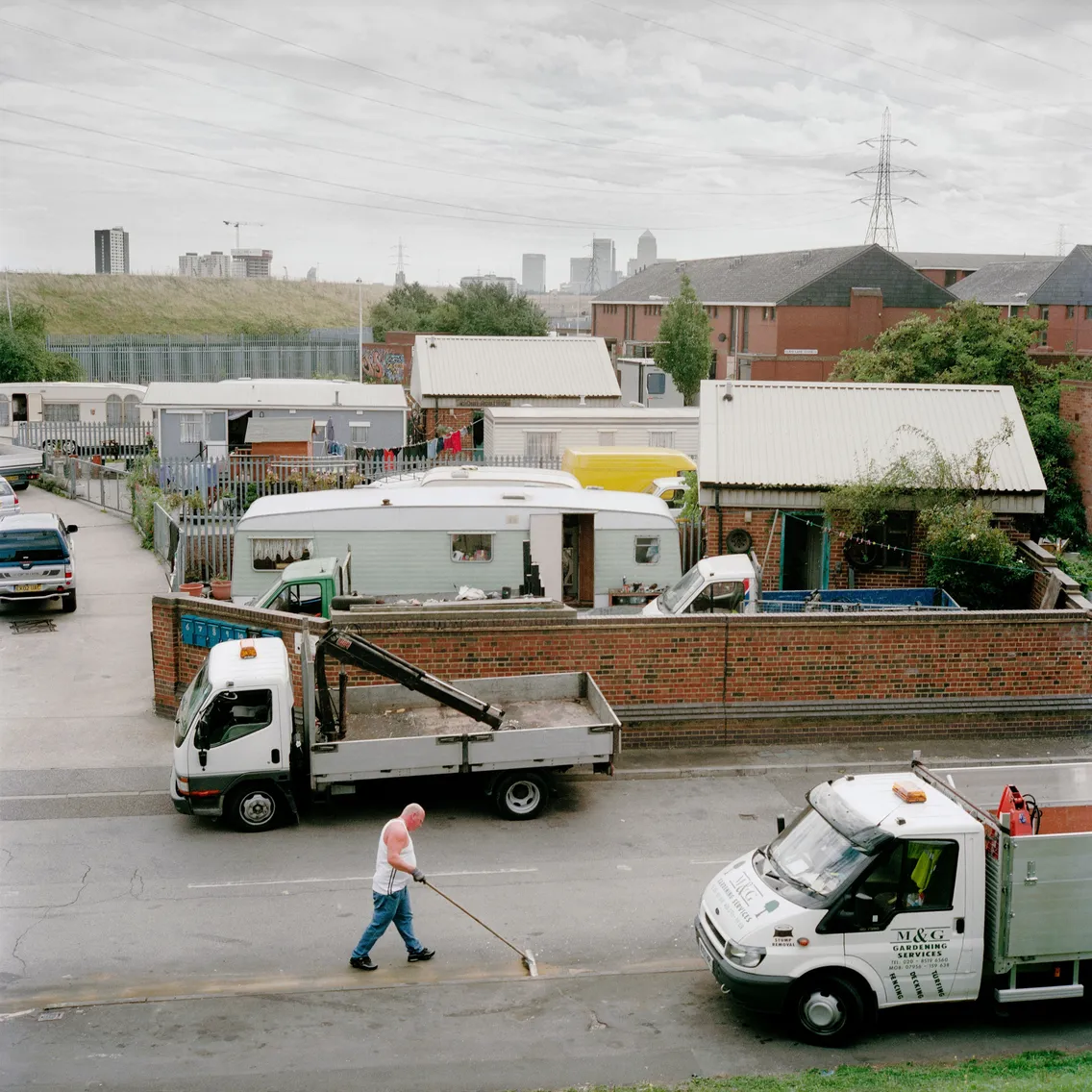
The Clays Lane travellers' site, Temple Mills, Stratford, 2006. This site had been occupied by English Romany gipsies since 1971.
History of Romani people in the UK
This history of exclusion didn't begin with pub signs. Romani people are proven to be genetically distinct from other European populations. This is because our origins can be traced to north-western India, ie, the Punjab and Rajasthan regions. Linguistic and cultural evidence suggest that our ancestors migrated westward during 500–1000 CE. They passed through Persia, Armenia and other countries along the way, and many settled there.
Contrary to popular belief, the word ‘Romani’ doesn’t originate from Romania or Romanian. One theory is that it comes from ‘rom’, a term in the Romani language meaning ‘man’.
Romani people were first recorded in Britain in 1505. They were initially referred to as Egyptians, because they were mistakenly thought to have come from Egypt. Over time, this nomadic community became a distinct ethnic group here – known as the Romanichal community or Romany Gypsies, with a ‘y’.
“Despite consistent anti-Romani laws, the nomadic communities survived to establish a unique culture”
Upon arrival, Romani people were soon persecuted by the Egyptians Acts of 1530 and 1554, which ordered their expulsion or assimilation under duress. Despite consistent anti-Romani laws, communities survived to establish a unique culture with elements often formed from a nomadic existence. Trades like peg making, flower selling and palmistry, for example, have been such ways of earning a living on the road.
By Appointment Only, a display of unspoken histories
The art display at the museum’s Reflections Room explores these traditional and more contemporary trades. Here, two other artists and I cover Romani people’s links to London and our wider histories through our personal narratives and stories. The display is inspired by inherited objects of significance to the community.
The artworks are accompanied by a timeline compiled by Romany historian John Henry Phillips. It traces significant events in Romani history, including episodes of slavery and genocide.
One such important instance is the official recognition of Romany Gypsies as a protected ethnic group under the 2010 Equality Act. Some protection had previously existed through the Race Relations Act 1976 and the Human Rights Act 1998. However, those did not eliminate societal exclusion. To this day, Romani people still face systemic racism.
-
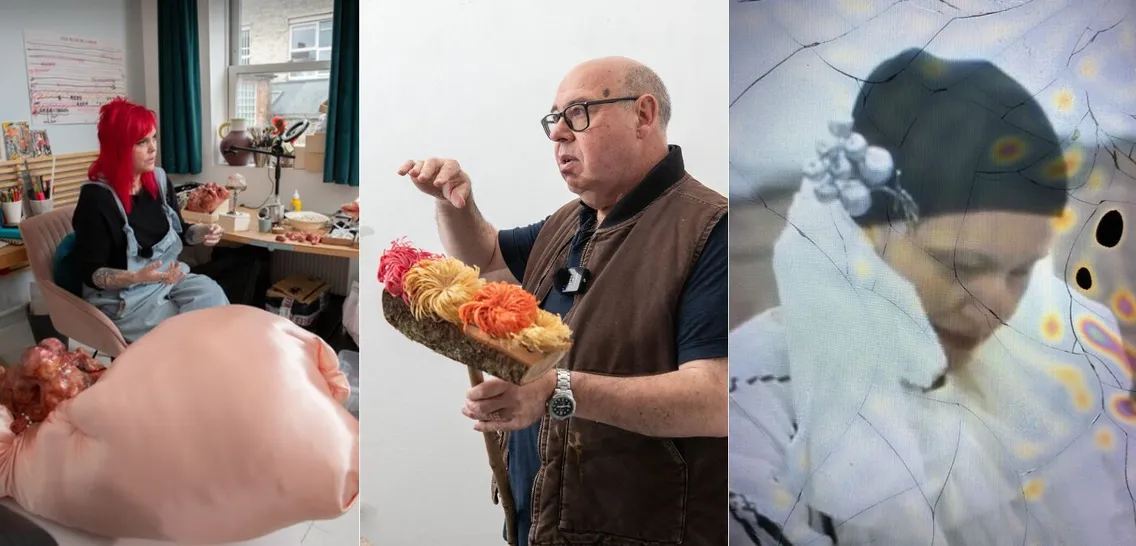
(From left) Corrina Eastwood, Dan Turner and Delaine Le Bas, the three artists exhibiting at By Appointment Only.
Co-curating the display
Working on the display as co-curator was an important personal and professional journey for me. I collaborated with Senior Curator Jean-Francois Manicom, fellow Romani artists Dan Turner and Delaine Le Bas in what felt like an act of visual activism. I created my artwork ‘Sugar Coated’, a very personal piece, while broadly exploring an ethical representation of my community and culture, within historical and socio-political contexts.
The installation connects my personal memory of Romani working life, centred on my father’s tyre trading business and the childhood ritual of pouring sugar into his blackened hands to clean them.
A different type of visual activism
Bringing this art display together gave us an opportunity to explore how Romani and Traveller communities have historically co-existed in the UK. A key point is the focus on our traditional trades that have served wider communities.
Delaine’s installation centres on a calico dress. The textile originated in Kozhikode (formerly Calicut), India, a detail that echoes our own community’s Indian roots. It’s covered in rosettes inspired by the one her grandfather won in a horse and cart event. The work also references her 2024 Turner Prize nomination and raises questions about who gets included or excluded from cultural recognition.
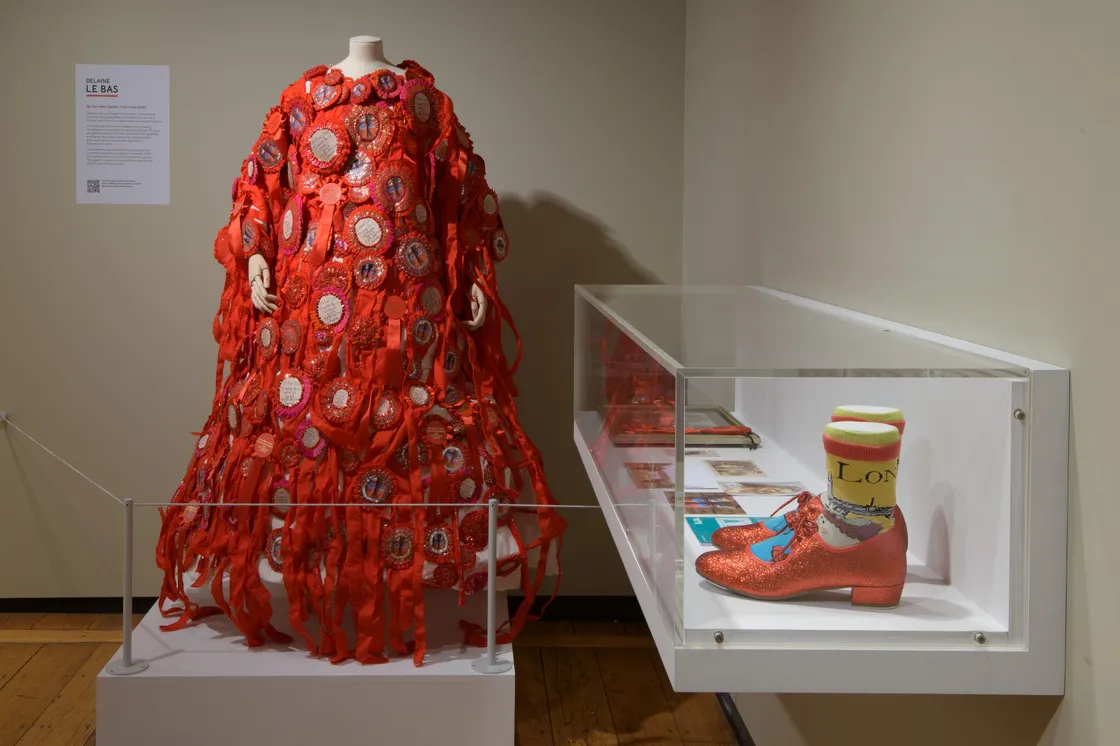
Delaine La Bas’ installation that centres on a calico dress.
Dan’s work represents trades made possible by traditional travel by horse and cart – such as peg making and wooden flower carving. These objects were historically sold door-to-door by Romani women, a practice called Calling.
My own art installation explores a more recent common trade in Romani communities of buying, restoring and selling part-worn tyres.
The connected human stories, feelings and memories evoked by and held in the artworks act as a different type of visual activism. One that offers an alternative to racist stereotypes perpetuated about our people, often in the media. The works challenge prejudice and support understanding, acceptance and celebration of difference between communities.
Fighting for the Romani way of life
Making this work was also a reminder of the ongoing struggle for Romani voices to be heard. A recent example of this is the 2021 Police, Crime, Sentencing and Courts Bill, which criminalised the traditional nomadic life of GRT communities. At the time, over 500 people, including politicians, protested the Bill. Delaine Le Bas, one of my fellow artists in this display, and I had joined in the protest at Parliament Square.
-
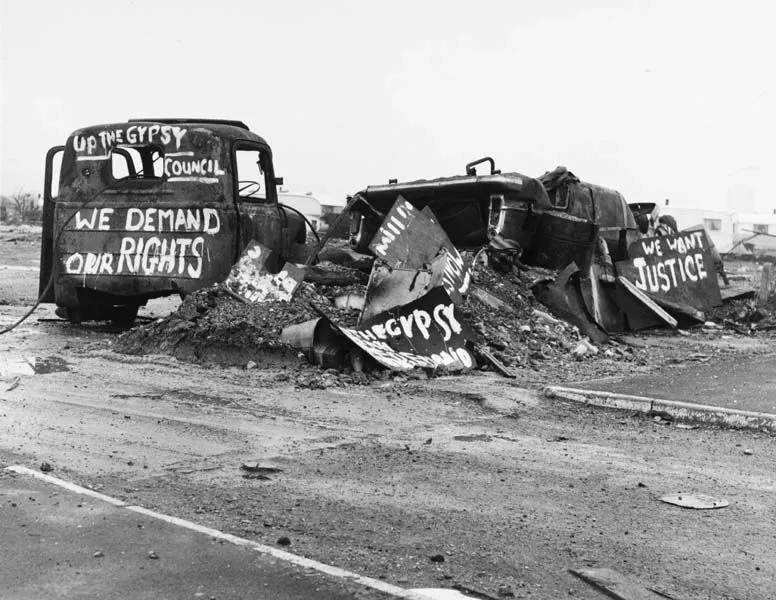
An abandoned travellers' encampment with graffiti protesting the eviction of gypsies from the site, 1969–1990.
-
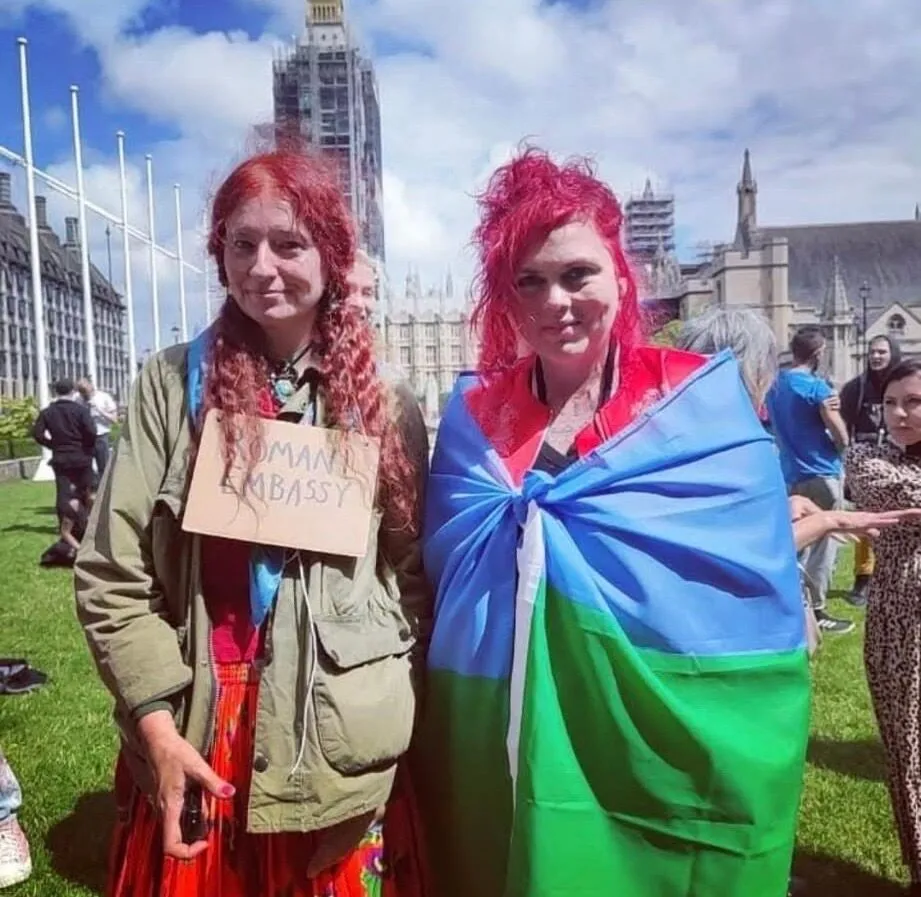
Corrina (right) at the 2021 protest against the Police, Crime, Sentencing and Courts Bill.
-

A sign from the 2021 protest.
Despite that, the Act passed in 2022. But Romani Gypsy Wendy Smith took the law to court, supported by Friends, Families and Travellers and National Council for Civil Liberties (Liberty). In 2024, they finally won. The government has since agreed to repeal a provision that banned GRT communities from returning to an area for up to 12 months.
This was a landmark judgment as the court acknowledged the Act to be unjustified discrimination against nomadic communities. However, the battle for full recognition of our traditional cultural values continues as does the fight against other sections of this Act. But it is a victory. And it is the kind of victory those pub signs once made feel impossible.
Corrina Eastwood is an artist and co-curator of By Appointment Only: Romani art, culture & heritage at London Museum Docklands.