14 April 2025 — By Thomas Ardill
The art of mudlarking: London’s past, present & future
Uncover the magic of mudlarking through artistic time travel. Past pottery fragments, present riverside soundscapes and future relics tell Thames’ secrets beyond historical objects.

Misfired plates from Pickleherring Pottery with ‘Bird on the rock’ designs. Such plates are often found by mudlarks on the Thames foreshore.
As you’d expect from an exhibition about mudlarking, Secrets of the Thames (Apr 2025 – Mar 2026) at London Museum Docklands featured a lot of fantastic archaeology. But our story of London is not told through historical artefacts alone. Art also played a vital role in this major exhibition.
Three new artworks were made especially for Secrets of the Thames. Inspired by the river and city today and in the past, objects found on the foreshore, the mudlarks who found them, and questions about our environmental future, these artworks told the story of mudlarking: past, present and future.
Past: A potted history of London’s Delftware
The Thames has been central to London’s pottery history, serving as a transport route for materials and finished goods. Factories would also often use the foreshore to discard broken pieces, making ceramic ‘sherds’ abundant mudlarking finds today. (Archaeologists call broken pieces of pottery ‘sherds’, and broken glass or other materials ‘shards’).
These fragments span 6,000 years of history and provide evidence of London’s Thames-side pot houses.
From sherds to masterpiece: Raewyn Harrison

Raewyn Harrison working in her studio.
Ceramicist and mudlark Raewyn Harrison was captivated by this history when Thames archaeologist Mike Webber shared his collection with her to make moulds and prints.
One of her favourite pieces is a fragment of a London Delft charger (a large platter) featuring a bird on a rock from Pickleherring Pottery in Southwark. This blue-and-white style mimicked Dutch tin-glazed pottery, which in turn imitates Chinese porcelain.
“The work focuses on sherds of Delftware made in London as they are my favourite finds from the foreshore”
Raewyn Harrison, ceramicist and mudlark
Inspired by sherds from Pickleherring and Hermitage potteries, Raewyn created a porcelain vessel called ‘London Delft’.

Muddy fragments, brilliant creations
Her research led her to Finds Liaison Officer Stuart Wyatt at London Museum.
Stuart found kiln and pot fragments from the Hermitage Pottery repurposed as a Wapping causeway. These, and fragments found by other mudlarks, helped reconstruct the pot house’s history.
At London Museum’s Library, with help from curators Kate Sumnall and Thomas Ardill, and librarian Lluis Tembleque Teres, Raewyn located both the Hermitage and Pickleherring potteries on John Rocque’s 1746 map. She transformed scans of the map into prints applied to the vessel’s surfaces.
-

'London Delft' by Raewyn Harrison.
Raewyn chose porcelain for its historic link to the original ‘blue and white’ ceramics and its paper-like quality that beautifully receives transfers and mimics the appearance of the original maps.
Working with porcelain is challenging, as one needs to account for shrinkage and explosions during firing are not uncommon.
Present: Music, moonlight and the Thames
From the feel of the mud to the sound of the river, felix taylor’s musical composition ‘hydraulis!’ explored today’s mudlarking experience, alongside Luke Jerram's ‘The Moon’ sculpture.
This smaller version of Jerram’s inflatable masterpiece, printed with NASA imagery, took on new significance in the context of the exhibition.
Tides, treasures & trowels: felix taylor
For Secrets of the Thames, we highlighted the moon’s gravitational pull on the tides, and its psychological pull on mudlarks.
This connection inspired the commissioning of Felix's bespoke soundscape for the installation.

felix taylor, composer of hydraulis! with Luke Jerram’s The Moon, 2025.
The south London performer, composer and artist works with electronic and acoustic sounds, instrumentation, field recordings and oral histories. His works explore history, memory and the concept of how the perception of time can be altered or skewed.
During a foreshore visit with writer Tom Chivers, felix learned about the mud’s strange acoustic properties.
“The piece imagines that pockets of air carry sound and music alongside the already sought after treasures, secrets and histories”
felix taylor, performer, artist and composer of hydraulis!
He was fascinated by how stepping on mud could expel air pockets several metres away, suggesting a living, breathing riverbed. This reminded him of the hydraulis, an ancient Greek pipe organ powered by pumping air and water.
His 15-minute soundscape merged recordings of the river lapping at the shore, tramping feet, squelching mud and scraping trowels with synthesisers and effects.

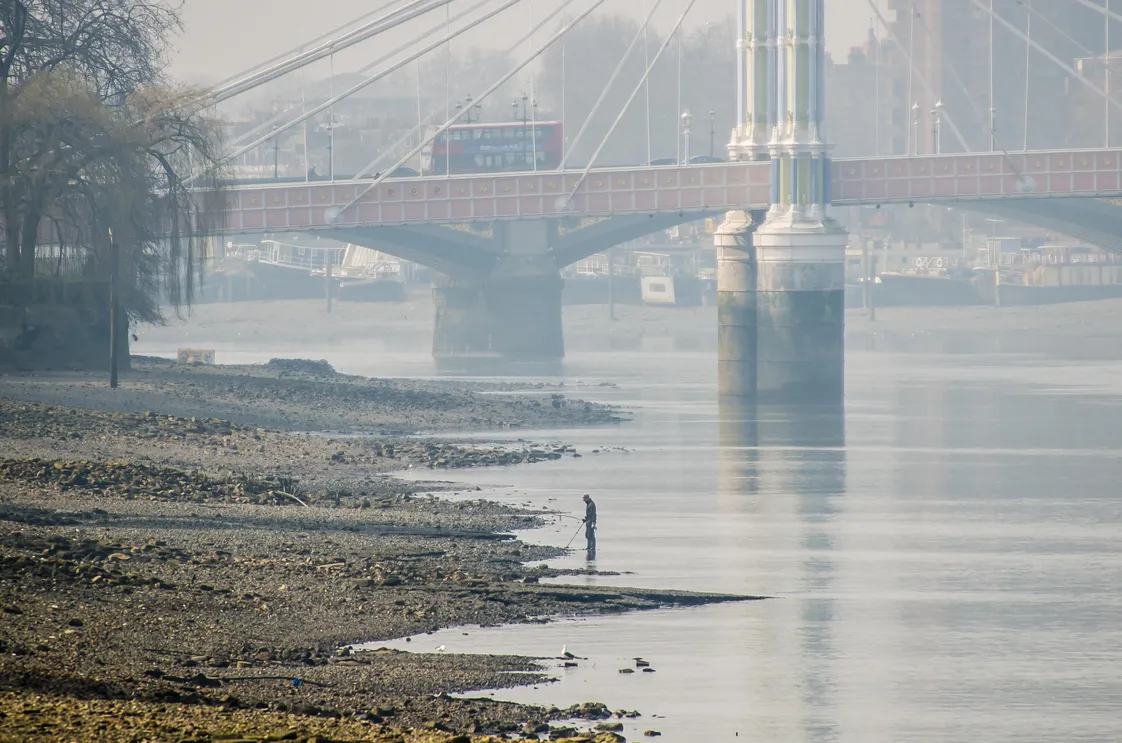
The moonlit Thames foreshore.
The intended effect was for visitors to listen to hydraulis! while gazing at the moon, perhaps imagining themselves as a piece of clay pipe surfacing and submerging with the tide’s rhythm.
Future: Kabir Hussain’s cycle of time
For our final artwork, we looked into the future of mudlarking through Kabir Hussain's visionary lens. While developing Secrets of the Thames, we wondered what tomorrow’s mudlarks might discover from our time.
We turned to Kabir, an artist and master metal-caster, who makes works intended to last way into the distant future.
His previous works transformed bronze casts of everyday objects – plastic bottles, lampshades, cutlery, toys – into anthropogenic (human-made) fossils, by burying them in artificial stone, and then excavating them again. Viewers were left to puzzle out what the original objects might have been, prompting reflection on the environmental legacy of our throwaway consumer culture.
-

Velocipede, 2025, by Kabir Hussain, imagines mudlarking finds in the 21st... or even 31st century.
For the exhibition, we invited Kabir to make a new work on objects that might survive in the anaerobic (oxygen-free) mud of the Thames.
His curiosity was captured by a hire bike. While often touted as an eco-friendly option for city transport, these bikes have sparked controversy with complaints of littering the pavement and being dumped in London’s waterways.
Pedalling through time
Annually, over 100 bikes get thrown into London canals, causing pollution and risk to wildlife and boats. The Canals and Rivers Trust provided Kabir with such a bike recovered from London Docks for his artwork.
Velocipede joins a long and illustrious line-up of artwork made out of bicycles, including Pablo Picasso (Bull’s Head, 1942) and Marcel Duchamp (Bicycle Wheel, 1951).
Kabir’s Velocipede returns to this tradition for the 21st (or, perhaps, the 31st) century.
“The plaster coating resembles ‘Thames race’”
The title (a term for an early form of bicycle) evokes an extinct species. The bronze casting process, where the original object is replaced by molten bronze, mirrors fossilisation. The plaster coating resembled ‘Thames race’, a natural calcium carbonate layer that forms on metal objects submerged for years in the Thames.

Late Bronze Age copper alloy sword before conservation treatment, covered in ‘Thames race’.
Set against objects that were similarly found on the foreshore, this fossilised fragment of 21st-century life was exhibited for the first time in Secrets of the Thames.
Together, these artworks – along with works by other contemporary artists like Amy-Leigh Bird, Billie Bond, Charlie Dixon, Luke Jerram and Mark Sowden – help us to understand the true essence of mudlarking. It's not just about searching for objects, but also making sense of history. It's an exploration of how the lives of Londoners are preserved in the muddy embrace of the Thames foreshore.
Thomas Ardill is Curator of Paintings, Prints and Drawings at London Museum.
Tags
-
 Exhibitions
5 must-see highlights from Secrets of the Thames exhibition
Stories of forgery, faith and ancient battles
-
 From our experts
Gold struck: A mother-son mudlarking adventure on the Thames
River reflections of a mudlark over 50 years
-
 From our experts
My life as a mudlark: Finding the sacred in the River Thames
Mudlark Caroline Nunneley shares her journey discovering medieval artefacts in the Thames
-
 Exhibitions
From tiny to titanic: Mudlarking treasures from the Thames
Ready to explore what the river has preserved?
-