Alternatively search all objects in our collectionAlternatively search our collection
  • Shop
  • Account
Visit What's on Objects & Stories Schools & Communities Join & Support
  • Visit
  • Visit London Museum Docklands
  • Free galleries
  • Families
  • Access
  • London Museum Opening 2026
  • About the project
  • About the buildings
  • About the architects
  • What's on
  • Find events
  • Fun for families
  • Group visits
  • Free galleries
  • Top things to see for free
  • Fun for under-8s
  • Objects & Stories
  • Search the collections
  • About our collections
  • Research
  • What's in your borough?
  • Browse by time period
  • Explore London stories
  • Blog
  • Schools & Communities
  • Schools
  • Schools sessions
  • Schools resources
  • Community engagement
  • Engagement Charter
  • Join & Support
  • Donate
  • Membership Coming soon...
  • Corporate support
  • Legacy gifts
  • Our supporters
  • Home
  • Visit
    • Back
    • Visit
    • Visit London Museum Docklands
    • Free galleries
    • Families
    • Access
    • London Museum Opening 2026
    • About the project
    • About the buildings
    • About the architects
  • What's on
    • Back
    • What's on
    • Find events
    • Fun for families
    • Group visits
    • Free galleries
    • Top things to see for free
    • Fun for under-8s
  • Objects & Stories
    • Back
    • Objects & Stories
    • Search the collections
    • About our collections
    • Research
    • What's in your borough?
    • Browse by time period
    • Explore London stories
    • Blog
  • Schools & Communities
    • Back
    • Schools & Communities
    • Schools
    • Schools sessions
    • Schools resources
    • Community engagement
    • Engagement Charter
  • Join & Support
    • Back
    • Join & Support
    • Donate
    • Membership Coming soon...
    • Corporate support
    • Legacy gifts
    • Our supporters
  • Shop
  • Account
  • Home
  • Objects & Stories

Fashion — 1815-1830

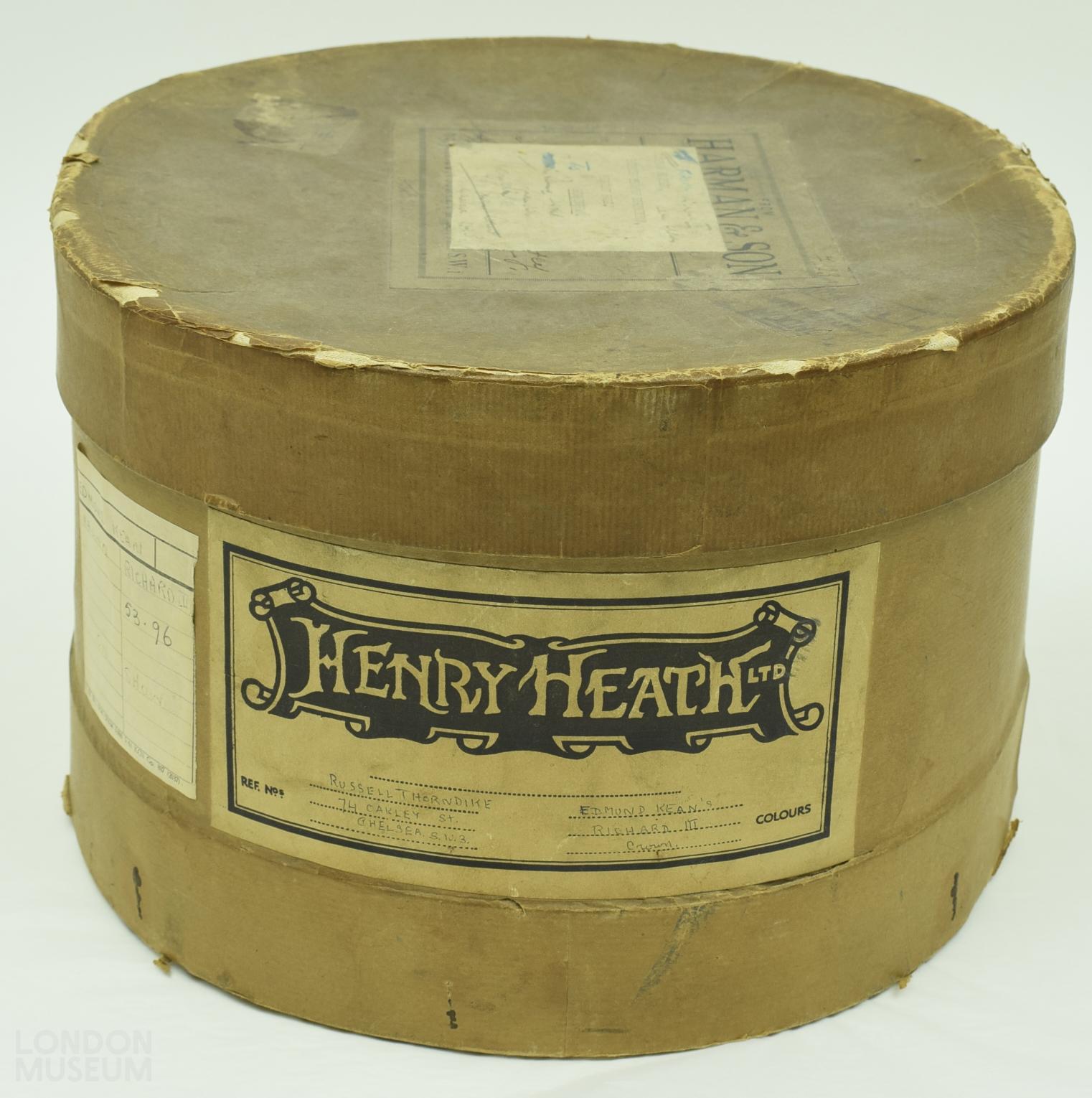
Box, hat box

Improving our records

We're actively looking for ways to improve our object records, including using artificial intelligence to generate alt text for some object images. If you think we've made a mistake or have information about an object that you'd like to share, you can fill in the details below.

Our collections contain objects and information which some people may consider sensitive or offensive. Some of the text was written in past decades and reflects the language and social attitudes of the time. Find out more

This site is protected by reCAPTCHA and the Google Privacy Policy and Terms of Service apply.

Hat box associated with theatrical costume worn by Edmund Kean in the role of Richard III, while performing in the Shakespeare play of the same name.

Kean made his career breakthrough in January 1814, when he made his Drury Lane debut as Shylock in The Merchant of Venice. This was the first of a series of tragic Shakespearean roles that he would become famous for, also including Iago, Macbeth and Richard III. His acting style as Richard III incorporated both naturalism and ‘tragic grandeur’. He repeated his performance of Richard 25 times in his first season alone. His performance in this role on 12 February 1814 (just three weeks after his debut as Shylock) was described as follows: 'Kean bustled across the stage, every movement of his body alert and quick. The audience, accustomed to the heroic strut of tragedians, were startled. He seemed completely unaware of them; conscious of nothing but his own reflections. His opening soliloquy was not declaimed but spoken in natural tones.' The poet Samuel Coleridge said that seeing Kean act was 'like reading Shakespeare by flashes of lightning.'

Kean wore this costume as Richard III in both England and America. The costume includes a crown, a pair of boots, an armhole-cloak , a doublet , a pair of paned trunk-hose, and a theatrical sword belt, or baldric. It also includes a cushion, worn under the other garments to give the appearance of a "hump" in Kean's back. Shakespeare's play characterises the Plantagenet king as ‘deformed’ – what we would today call ‘disabled’. References are made to his hunched back, a week or immobilised arm, and a limp. It has been suggested that this was the first modern cultural representation of disability. It is widely presumed today that Shakespeare drew this image of the king from exaggerated descriptions in Tudor propaganda, designed to discredit past rulers. For example, in Thomas More’s History of King Richard III (1513-1518) Richard is described as being ‘little of stature, ill-featured of limbs, crook-backed, his left shoulder much higher than his right, hard-favoured of visage'. In that period, physical deformity or disability was sometimes believed to represent moral weakness, a ‘deformed’ mind, evil intent, or even villainy.

The excavation of Richard III’s skeleton in 2012 exposed Shakespeare’s depiction of the King to be exaggerated. Analysis of the skeleton revealed that the King had a scoliosis, resulting in some curvature of the spine and spiralling in the bone formation. Today this is known as 'adolescent onset idiopathic scoliosis', and is one of the commonest forms of scoliosis. Scientists concluded that this condition may have resulted in a slightly shorter-than-usual body (trunk), but would not have prevented his participation in normal physical activities.

There are two portraits of Kean as Richard III made in 1814; an etching by George Cruickshank and an engraving by Charles Turner. Both portraits show Kean clutching his left arm to his body, as if to communicate its weakness. The Turner portrait might also be suggesting curvature of the spine or another slight physical deformity around the shoulders, but this is not explicit. Either way, these portraits inform us that Kean did play the role with some physical demonstration of disability in addition to the "hump" cushion.

Though many actors became famous for their depiction of the character of Richard III, including Henry Irving and Laurence Olivier, the role was not played by a disabled actor in a significant production until the 2000s.

Category:
Fashion
Object ID:
53.96/6
Object name:
box, hat box
Object type:

box, hat box

Artist/Maker:
Harman and Son
Related people:

Related events:

Related places:

Production date:
1815-1830
Material:

card, paper, ink

Measurements/duration:
H 193 mm, W 345 mm, D 283 mm
Part of:
—
On display:
—
Record quality:
40%
Part of this object:
—
Owner Status & Credit:

Permanent collection

Copyright holder:

digital image © London Museum

Image credit:
—
Creative commons usage:
CC BY-NC 4.0
License this image:

To license this image for commercial use, please contact the London Museum Picture Library.

Tags

Fashion Hanoverian Georgian Art & Design Class & Economics Crime & Legislation Transport Trades & Workers

Download image file

You are welcome to download and use this image for free under Creative Commons Licence CC BY-NC 4.0.

Credit: London Museum

To licence this image for commercial use please contact the London Museum Picture Library
Box, hat box Image preview

Box, hat box

Resolution: 1522 x 1530 Download image
  • London Museum

    London Museum

    Smithfield
    London EC1A 9PS

    Opening 2026
  • London Museum Docklands

    London Museum Docklands

    No. 1 Warehouse
    West India Quay
    London E14 4AL
    Tube & DLR: Canary Wharf
    or West India Quay

    Monday to Sunday:
    10am – 5pm
    Free entry

    Closed 24, 25 & 26 Dec

  • London Museum Stores

    London Museum Stores

    46 Eagle Wharf Road
    London N1 7ED

    Currently closed to the public

  • London Museum Spaces

    London Museum Spaces

    150 London Wall
    London EC2Y 5HN

    Open for venue hire only

Subscribe and get email updates:

Subscribe

Share your London experiences with us:

  • Facebook
  • Instagram
  • TikTok
  • YouTube
  • X
  • LinkedIn
  • Visit
  • London Museum
  • London Museum Docklands
  • Families
  • Plan your visit
  • Ticketing info
  • Access
  • What's on
  • Free galleries
  • Group visits
  • Objects & Stories
  • About our collections
  • What we collect
  • Collections access & enquiries
  • Managing our collections
  • Improving our collections
  • Schools & Communities
  • Schools
  • Schools sessions
  • Schools resources
  • Community engagement
  • About
  • Our locations
  • Careers
  • Press
  • Supporting London Museums
  • Policies
  • Contact us
  • Join & Support
  • Donate
  • Membership
  • Corporate support
  • London stories
  • Blog
  • Browse by borough
  • Browse by time period
  • Commercial
  • Venue hire
  • Picture Library
  • Location filming & photography
  • Visit
  • London Museum
  • London Museum Docklands
  • Families
  • Plan your visit
  • Ticketing info
  • Access
  • What's on
  • Free galleries
  • Group visits
  • Objects & Stories
  • About our collections
  • What we collect
  • Collections access & enquiries
  • Managing our collections
  • Improving our collections
  • Schools & Communities
  • Schools
  • Schools sessions
  • Schools resources
  • Community engagement
  • About
  • Our locations
  • Careers
  • Press
  • Supporting London Museums
  • Policies
  • Contact us
  • Join & Support
  • Donate
  • Membership
  • Corporate support
  • London stories
  • Blog
  • Browse by borough
  • Browse by time period
  • Commercial
  • Venue hire
  • Picture Library
  • Location filming & photography
City of London logo Supported by Mayor of London logo Supported using public funding by Arts Council England logo
Bloomberg Philanthropies

The London Museum website was developed with the support of Bloomberg Philanthropies’ Digital Accelerator for Arts and Culture.

  • Terms of use
  • Privacy policy
  • Cookies
  • Website accessibility policy
Museum of London registered charity number 1139250