

We are the Youth of Today
This research project tries to understand what matters most to young Londoners. With over 3,000 young people surveyed it’s one of the largest studies of Generation Z in the capital to date.

Young Londoners at a London Museum event.
Duration: April–December 2020
Research partner: Partnership for Young London
“I get so many amazing opportunities in London which I honestly don’t think I would get if I lived elsewhere”
Participant, 16 years
Young people under 25 make up nearly a third of London’s population. Yet, their needs and experiences vary greatly based on factors like wealth, race, class and locality. The research explores two central questions:
- What are the issues that young Londoners care about?
- What is the relationship between young people and their city?
This project is foundational as we open our new museum at Smithfield in 2026. It puts young people at the forefront of our minds and will inform many aspects of our work and our future relationship with the city as we continue to engage the whole of London.
The museum aims to create a space where young people – historically infrequent visitors – feel comfortable, valued and inspired.
How we did it
The research began with a literature review, followed a survey co-designed with young Londoners. This was crucial to ensure that the questions were relevant and appropriately worded.
Partnership for Young London’s Mayoral Hustings youth board – 18 members aged 13 to24 from across London – took part to a focus group to feedback on questionnaire design. They provided their views on proposed questions and flagged jargon that needed clarifying.
Notably, when discussing gentrification, the youth board insisted on using verbatim language from young people themselves, explaining that “understanding gentrification is a lot of things, and has a lot of definitions”.
Their input shaped how the survey captured experiences of redevelopment, culture shifts and cost of living pressures.

A young Londoner being interviewed for Curating London’s Brexit Talks project.
What we found
The research reveals distinct patterns in how young Londoners experience the city.
Education matters most, with education and employment having the biggest impact on mental health.
A critical finding was that young people don't feel heard. Black and Asian young people especially ranked having their voice heard as important, yet many weren’t optimistic that those in power understand the issues they face.
Young people living in London overwhelmingly identify as Londoners, and for most this outweighs local or national identity.
Important issues for young people
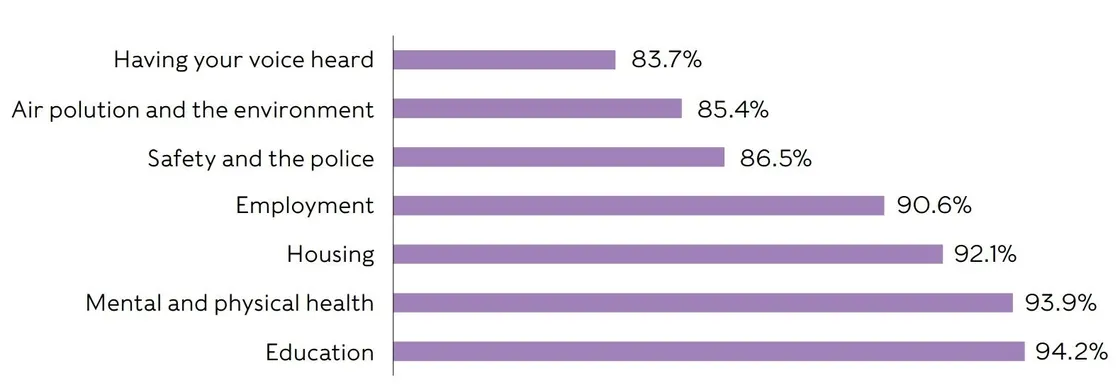
Over 30% rarely or never visit arts and cultural spaces, with significant differences by ethnicity and gender. It also emerged that among public spaces, parks are most used, while youth clubs are at the bottom of the list.
Young people have, on balance, a positive to mixed view on redevelopments in their local area. However, 68.7% of those surveyed did not feel a sense of ownership of their local area.
We are committed to the wider impact of our work by and for young people and acknowledge the limits to our own interpretation of the responses. That’s why we’re not only sharing our findings, but also our data for others to use. The full dataset is open source and can be downloaded below if you want to find out more.
We encourage this be used both as a research and teaching tool to inform work with and for the next generation of Londoners.
More in Projects
-

Finding Home in Football
How do London’s varied football spaces empower communities to forge a sense of ‘home’ in the city?
-

Compassion in London: Life on Buses
Are Londoners compassionate on buses?
-

Calling for Change
Young Londoners’ views on a sustainable future for their city
-

Sugar and its Legacies
How has sugar shaped London through slavery, industrialisation and its impact on health?