
St Thomas' Hospital cemetery
The 1991 excavations at New London Bridge House revealed mass graves linked to St Thomas' Hospital, likely from an epidemic. Here’s what the remains of 227 individuals tell us.
During 1991, excavations were carried out on the site of New London Bridge House, Southwark (SE1) that covered part of a post-medieval cemetery, north of St Thomas’ Street.
The burials identified as mass graves associated with St Thomas’ Hospital were believed to be either paupers or epidemic graves. St Thomas’ Hospital was one of only three hospitals to survive the dissolution of the monasteries.
The earliest pit C [92] had individuals in eight layers, with two rows of burials in each layer. The middle pit B [34] was truncated by a Victorian wall and the latest A [27] extended beyond the limits of the excavation to the west and truncated earlier pits.
The 227 articulated individuals recovered were found beneath a large number of disarticulated remains believed to have been part of a charnel pit and were dated to the 17th century from pottery. Of the 227 individuals recovered, 193 were analysed.
Burials from the identified pits were aligned east-west, and the presence of shroud pins and coffin nails, indicated that many were buried in shrouds and/or coffins.
Methodology
Variations in the method of recording: Joints were recorded as present no further grading was applied or four-digit array.
Preservation
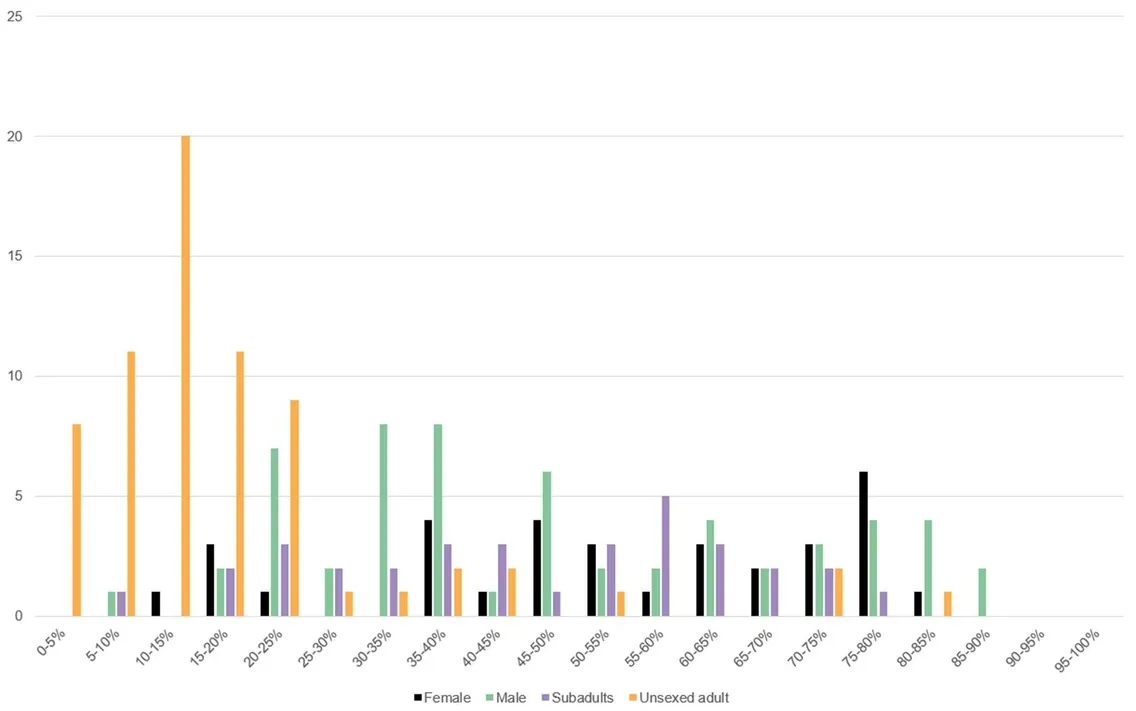
Preservation was relatively good, but completeness was generally not very good with truncation in both adults and sub adults (Fig1).
| Preservation | N= | |
|---|---|---|
Good |
133 |
68.9 |
Medium |
57 |
29.5 |
Poor |
4 |
2.1 |
Figure 1: Skeletal completeness (N=194)
Demography
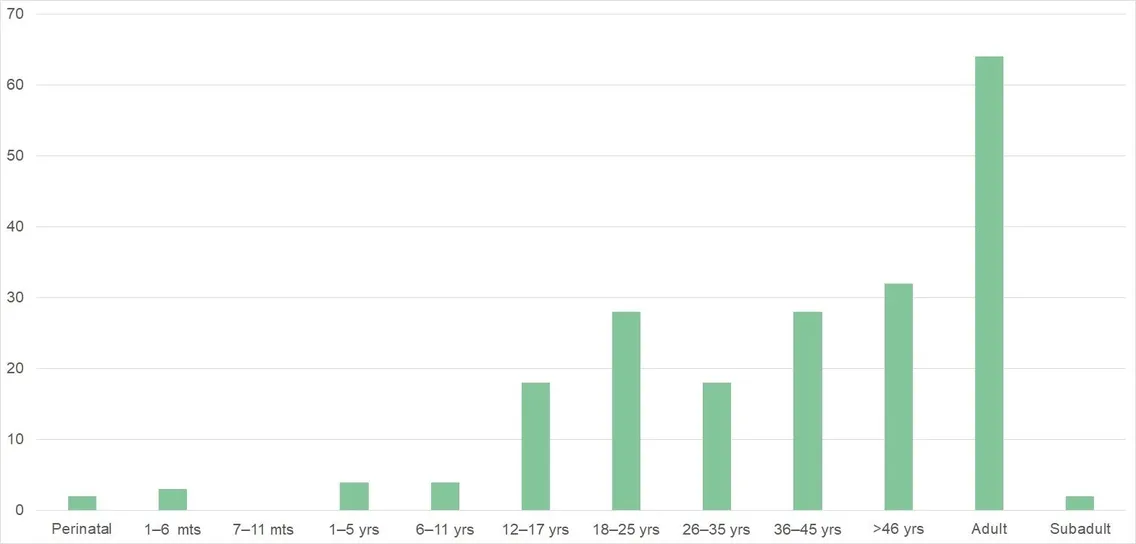
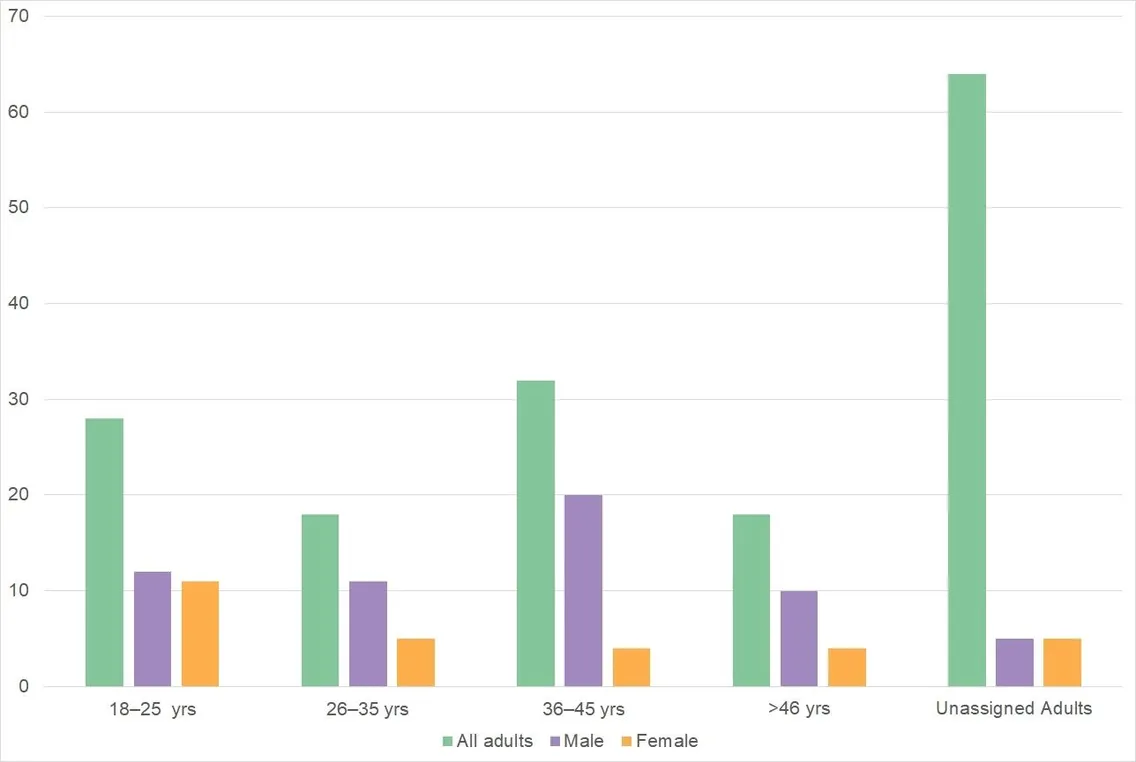
A total of 193 skeletons were included in the final analysis consisting of 160 adults (58 males, 29 females and 73 unsexed) and 33 subadults (Fig 2 and 3).
The demographic profile for the hospital cemetery site was interesting. The overall male to female ratio was 2:1, with the highest number of males dying in the age category 36–45 years, while for females it was the younger age category of 18–25 years. This could, perhaps, be an indication of the risks faced by young females during childbirth.
In the subadults, over half (9.3%) of those who survived the perils of early childhood died in the 12–17 age category.
Figure 2: Age distribution (N=194)
| Age | N= | % |
|---|---|---|
Perinatal |
2 |
1.0 |
1–6 month |
3 |
1.6 |
7–11 month |
0 |
0.0 |
1–5 years |
4 |
2.1 |
6–11 years |
4 |
2.1 |
12–17 years |
18 |
9.3 |
18–25 years |
28 |
14.5 |
26–35 years |
18 |
9.3 |
36–45 years |
18 |
9.3 |
36–45 years |
28 |
16.6 |
>46 years |
32 |
9.3 |
Adult |
64 |
33.2 |
Subadult |
2 |
1.0 |
Figure 3: Adult male and female distribution (N=160)
| All adults | % | Male | % | Female | % | |
|---|---|---|---|---|---|---|
18–25 years |
28 |
17.5 |
12 |
20.7 |
11 |
37.9 |
26–35 years |
18 |
11.3 |
11 |
19.0 |
5 |
17.2 |
36–45 years |
32 |
20.0 |
20 |
34.5 |
4 |
13.8 |
>46 years |
18 |
11.3 |
10 |
17.2 |
4 |
13.8 |
Unsexed Adults |
64 |
40.0 |
5 |
8.6 |
5 |
17.2 |
Total |
160 |
58 |
29 |
Stature
| Sex | Avg_stat | SD | VAR | MIN | MAX | N |
|---|---|---|---|---|---|---|
Female |
0 |
|||||
Male |
172.9 |
5.8 |
34.0 |
165.9 |
179.9 |
4 |
Pathology
The pathological profile for a site identified as a hospital and post-medieval provided many interesting results. Most notably, the extremely high prevalence of syphilis.
Twenty-five individuals (13%) were attributed to having syphilis, one of whom was a sub adult. The prevalence for non-specific periosteal reactions was 35.2%. Trauma was observed in both sexes, with two ante-mortem cases of blunt force trauma in males.
Vertebral pathology
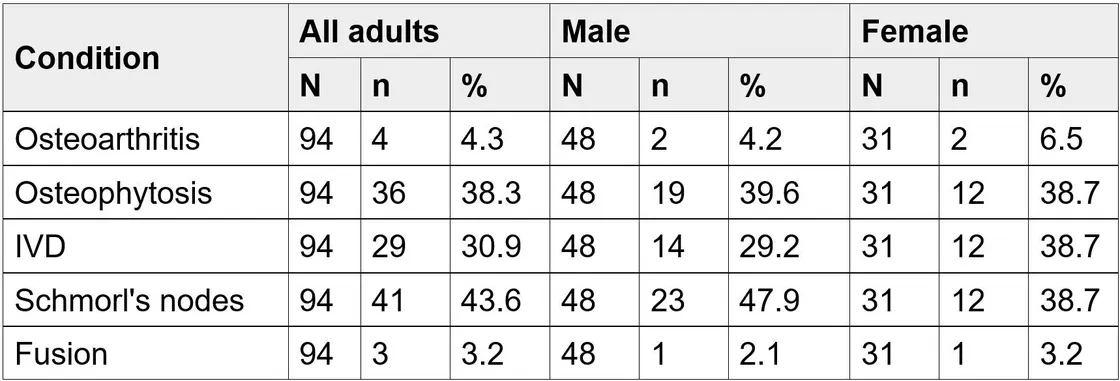
Table 5 provides a crude distribution of vertebral pathologies in the adult population. There was a similar pattern between the males and females, apart from Schmorl’s nodes, which were higher in males and IVD that was higher in females.
Table 5: Distribution of vertebral pathology by sex in adults with one or more vertebrae present
Dental pathology
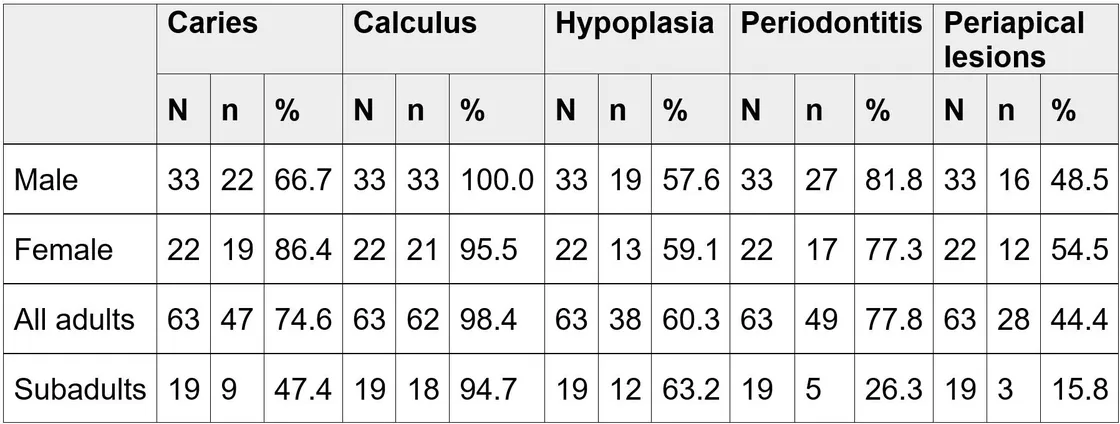
The general dental health of the individuals was seemingly typical of a post-medieval population, with a similar pattern between the males and females. Table 6 indicates that high rates of caries, calculus and hypoplasia were observed in the adults and subadults. Males were marginally more affected with periodontitis and females with periapical lesions.
Table 6: Distribution of dental pathology by sex in adults with one or more vertebrae present
Discussion
The individuals from this site highlighted the perils of health and low status in the post-medieval period. The effects of urbanisation and susceptibility of low status individuals to infectious diseases was clearly apparent and particularly so from the high prevalence of syphilis. However, it should be considered that the pathological numbers may appear inflated from the very nature of the site being associated with a hospital.
Downloadable documents
XLSX: 52.7 KB
This downloadable MS Excel file contains photographs of the human remains excavated at the St Thomas' Hospital site.
XLSX: 10.3 KB
This downloadable MS Excel file contains all data of the human remains excavated at the St Thomas' Hospital site.
Site reference
Jones, H. 1990. Preliminary report of archaeological excavations at New London Bridge House, London Bridge Street, SE1. Unpublished MoLA report.
Site location
New London Bridge House, London Bridge Street, SE1
Site code NLB91
Last Updated: 2025
More post-medieval sites
-
All Saints, Chelsea Old Church churchyard
Findings from the excavations after Blitz bombings uncovered 198 individuals from the 18th–19th centuries
-

Queen's Chapel of the Savoy
These human remains provide insights into the health of Londoners between the 16th and mid-19th centuries
-

St Benet Sherehog churchyard
Findings from the excavations undertaken between 1994 and 1996
-

St Thomas' Hospital cemetery
Findings from the excavations carried out on the site of New London Bridge House, Southwark, in 1991