
St Benet Sherehog cemetery
Excavations at St Benet Sherehog Church uncovered 274 burials from an 11th-century site destroyed in London's Great Fire, offering insights into London's medieval urban population.
The St Benet Sherehog Church and graveyard, otherwise known as ‘No.1 Poultry’, was excavated by Museum of London Archaeology Service (MoLAS) between 1994 and 1996. The church was originally constructed in the 11th century, as a simple, single-celled structure.
It remained in use until its destruction during the Great Fire of London in 1666.
Of the 274 burials excavated from the site, 270 were retained for analysis. Of those, only 39 were dated to the medieval period. The burials were aligned roughly east-west with the heads towards the west end of the graves.
The post-medieval burials have been analysed separately. Please refer to the Post-medieval St-Benet Sherehog site summary for more information.
Methods
Non-metrics and dental measurements were not recorded for subadults on this site.
Preservation
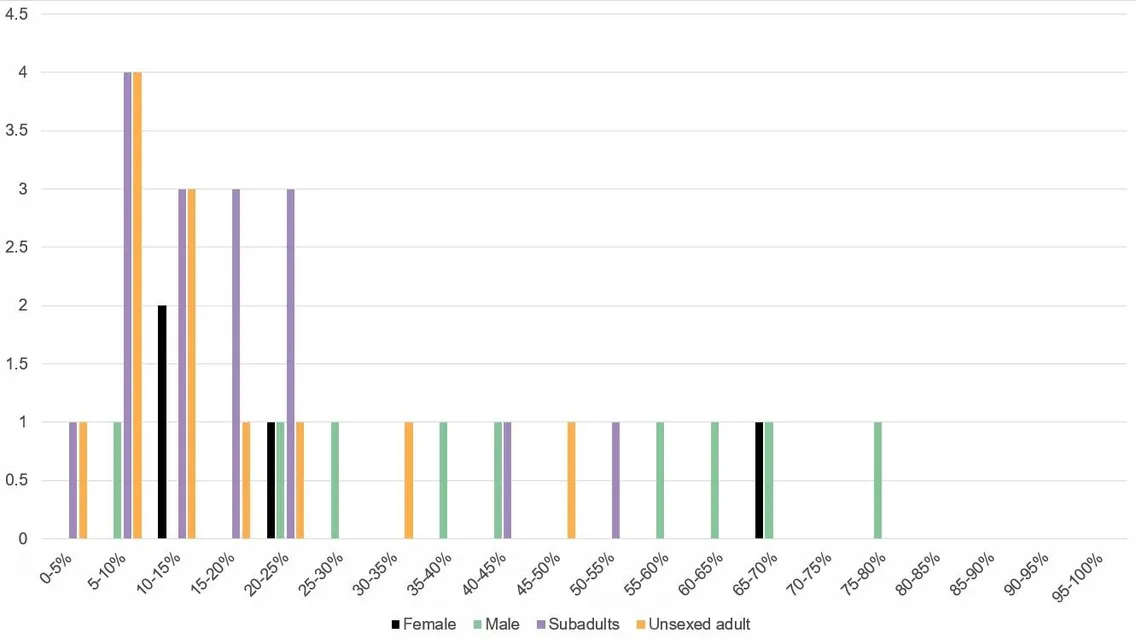
Although the overall bone quality was good, the skeletal completeness was generally poor. The majority of the skeletons were less than 25% intact.
| Preservation | N= | % |
|---|---|---|
Good |
34 |
87.2 |
Medium |
5 |
12.8 |
Poor |
0 |
0 |
Figure 1: Skeletal completeness (N=41)
Demography
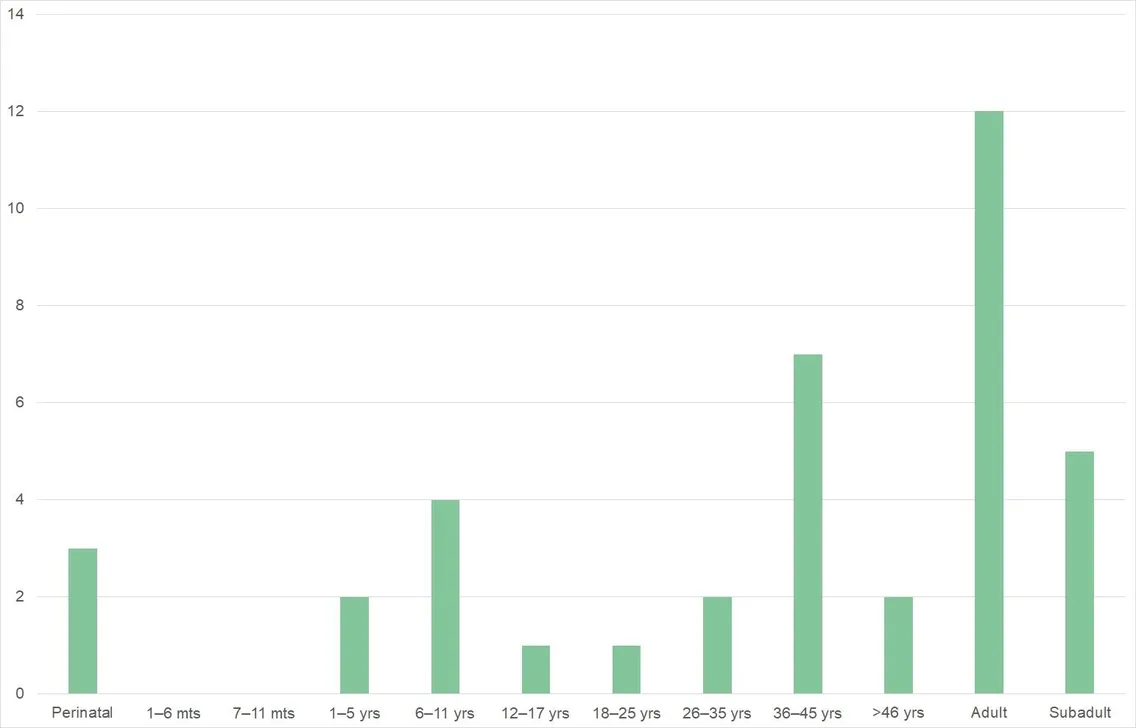
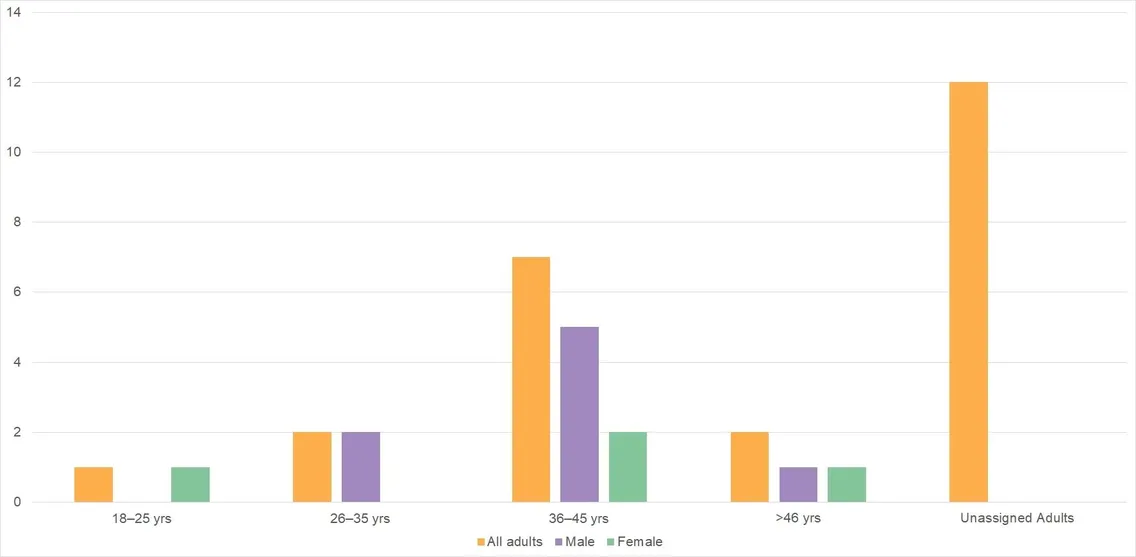
Of the 39 individuals recovered, there were 24 adults (eight males and four females) and 15 subadults. The 35–46 years demographic was the single largest adult group represented, and it had the highest male to female ratio, with 2.5 males to each female. One-third of all subadults could not be aged due to poor preservation. However, there were three perinatal deaths and four children aged 6–11.
Figure 2: Age distribution (N=39)
| Age | N= | % |
|---|---|---|
Perinatal |
3 |
7.7 |
1–6 months |
0 |
0.0 |
7–11 months |
0 |
0.0 |
1–5 years |
2 |
5.1 |
6–11 years |
4 |
10.3 |
12–17 years |
1 |
2.6 |
18–25 years |
1 |
2.6 |
26–35 years |
2 |
5.1 |
36–45 years |
7 |
17.9 |
>46 years |
2 |
5.1 |
Adult |
12 |
30.8 |
Subadult |
5 |
12.8 |
Figure 3: Adult male and female distribution (N=24)
| All adults | % | Male | % | Female | % | |
|---|---|---|---|---|---|---|
18–25 years |
1 |
4.2 |
0 |
0.0 |
1 |
25.0 |
26–35 years |
2 |
8.3 |
2 |
25.0 |
0 |
0.0 |
36–45 years |
7 |
29.2 |
5 |
62.5 |
2 |
50.0 |
>46 years |
2 |
8.3 |
1 |
12.5 |
1 |
25.0 |
Unsexed adults |
12 |
50.0 |
0 |
0.0 |
0 |
0.0 |
Total |
24 |
8 |
4 |
Stature
| Sex | Avg_stat | SD | VAR | MIN | MAX | N |
|---|---|---|---|---|---|---|
Female |
161.8 |
0 |
0 |
161.8 |
161.8 |
1 |
Male |
171.5 |
5.2 |
27.2 |
167.8 |
175.2 |
2 |
Unsexed |
172.1 |
3.7 |
13.7 |
169.5 |
174.7 |
2 |
Pathology
Non-specific infections and trauma are two of the most prevalent pathologies represented in medieval populations. In the case of St Benet Sherehog, 13% of the recovered individuals exhibited signs of non-specific infections and 8% had some form of accidental trauma. Other diseases are perhaps under-represented, most likely because of the small sample size.
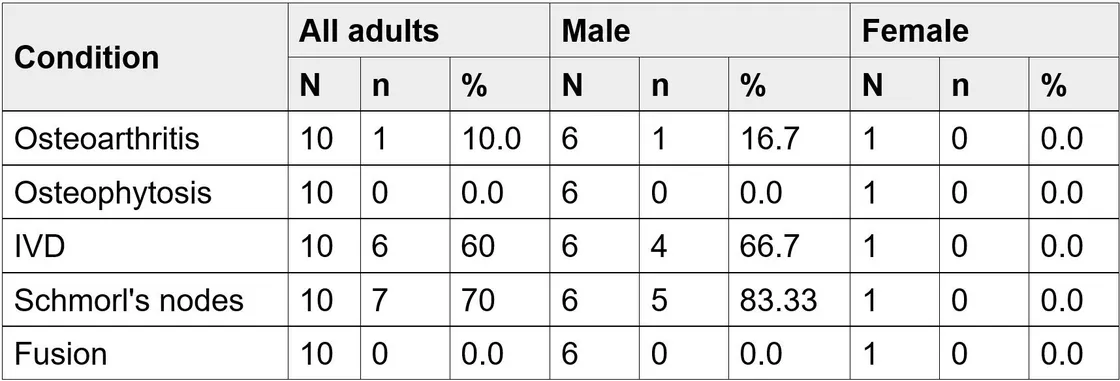
Vertebral pathology
Table 5 provides a crude distribution of adult vertebral pathology. However, the sample size is statistically insignificant.
Table 5: Distribution of vertebral pathology by sex in adults with one or more vertebrae present
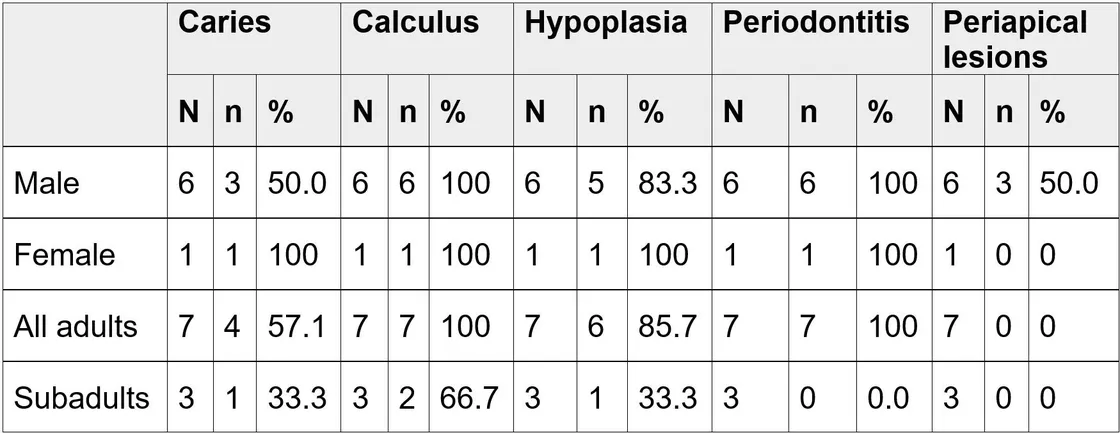
Dental Pathology
Table 6 provides a crude distribution for dental pathology. However, the sample size is statistically insignificant.
Table 6: Distribution of dental pathology by sex in adults with one or more vertebrae present
Discussion
The St Benet Sherehog site represents a late medieval population within the City of London. Due to the small sample size, research potential is limited. However, it has limited potential for comparison with other medieval sites or could be used in conjunction with the Post-medieval St Benet Sherehog site to study the development of one parish over two distinct areas.
Site reference
Miles, A, White, W, and Tankard, D (eds). 2008. Burial at the Site of the Parish Church of St Benet Sherehog Before and After the Great Fire: Excavations at 1 Poultry, City of London. London: MoLAS Monograph 39.
Site location
1 Poultry, 1–19 Poultry, 2–38 Queen Victoria Street, 3–9, 35–40 Bucklersbury, Pancras Lane, Sise Lane, EC2, EC4
Site code: ONE94
Last updated: 2025
More medieval sites
-

Dominican Friary: Carter Lane
During two phases of excavations – in 1987 and 1988 – a substantial part of the medieval cemetery of London Blackfriars was revealed
-
Guildhall Art Gallery, Guildhall Yard cemetery
What the analysis of the human remains of 68 individuals tells us about health concerns of medieval Londoners
-

Spital Square burials
Data from the 126 human remains recovered from the excavations in the precinct of St Mary Spital