

Dominican Friary: Carter Lane
Two phases of excavations – in 1987 and 1988 – revealed a substantial part of the medieval Dominican cemetery of London Blackfriars.
During two phases of excavations at 56-66 Carter Lane, 1–3 Pilgrim Street and 29-33 Ludgate Hill in 1987 and 1988, a substantial part of the Dominican medieval cemetery of London Blackfriars was revealed.
From the excavation and documented evidence, it is believed that a Norman Fortress originally stood on the site and that the Dominicans acquired the land in 1274 or 1276 as a stone quarry. They founded a friary nearby, known as London Blackfriars.
The burials date from the 13th to the 16th centuries, with a majority attributed from the 13th and 14th centuries. There was evidence of wooden coffins and grave linings. One individual was buried in a lead coffin.
The full extent of the cemetery is not known, but the infilled southern ditch, north of the church was known to have become the friary cemetery. The burials excavated from this area were of a standard Christian style, apart from the identification of a mass grave that contained 13 individuals of mixed age and sex, that appeared to have been interred at the same time and may have been from an epidemic. A total of 58 skeletons were excavated, of whom 57 were analysed.
The cemetery and the friary were no longer used after 1538 and the dissolution of the monasteries under Henry VIII.
Methodology
Variations in the method of recording: In dental pathology, the option of 0 and 9 was not implemented. Joints were recorded as present. No further grading was applied or four-digit array. Non-metrics were not recorded for subadults.
Preservation
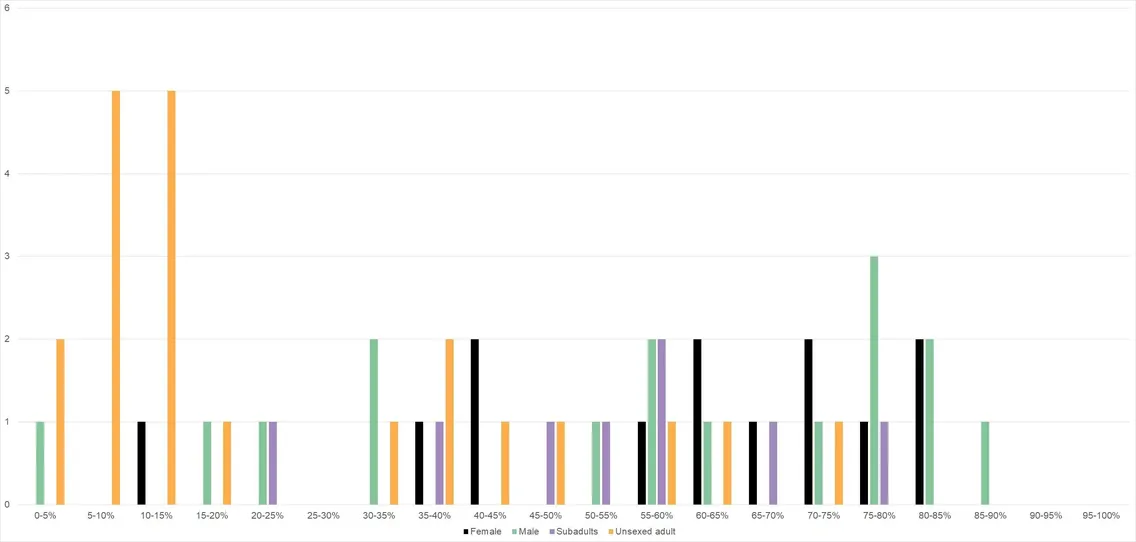
The skeletal preservation for the majority of the skeletons was good, while completeness varied among the adults, with a high degree of truncation and with the subadults being the least complete (Fig 1).
| Preservation | N= | % |
|---|---|---|
Good |
43 |
75.4 |
Medium |
7 |
12.3 |
Poor |
7 |
12.3 |
Figure 1: Skeletal completeness (N=58)
Demography
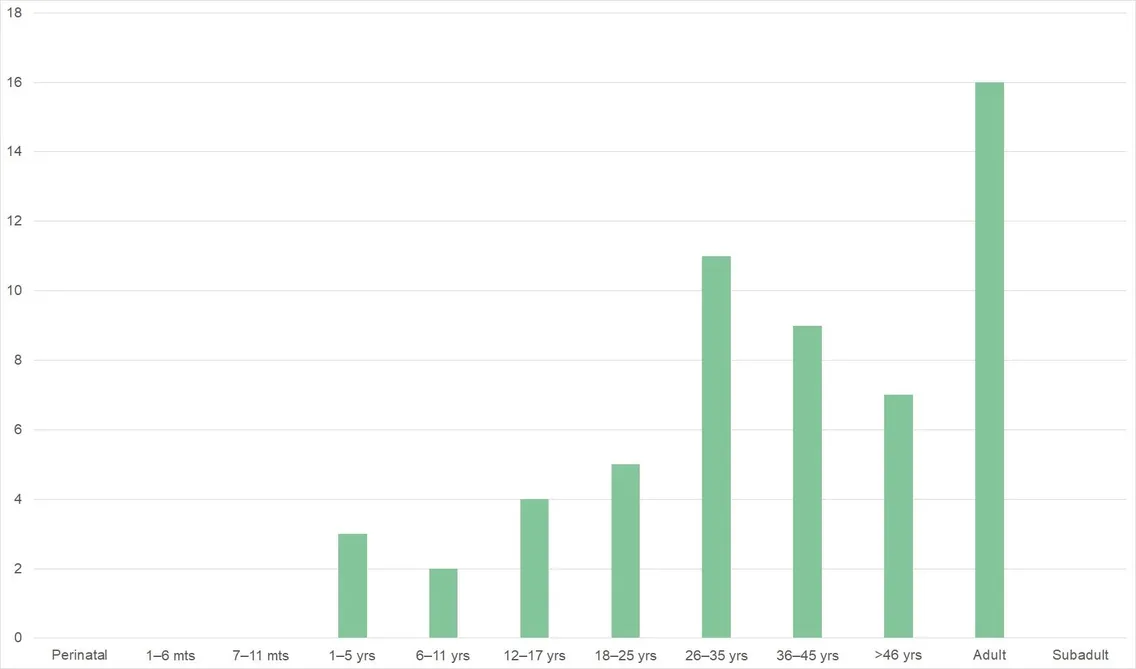
A total of 57 skeletons were included in the final analysis consisting of 48 adults (16 males, 12 females and 20 unsexed) and nine subadults (Fig 2 & 3).
The mass grave contained 13 individuals (6 subadults, 3 males, 2 females and 2 unsexed adults).
Figure 2: Age distribution (N=57)
| Age | N= | % |
|---|---|---|
Perinatal |
0 |
0.0 |
1–6 months |
0 |
0.0 |
7–11 months |
0 |
0.0 |
1–5 years |
3 |
5.3 |
6–11 years |
2 |
3.5 |
12–17 years |
4 |
7.0 |
18–25 years |
5 |
8.8 |
26–35 years |
11 |
19.3 |
36–45 years |
9 |
15.8 |
>46 years |
7 |
12.3 |
Adult |
16 |
28.1 |
Subadult |
0 |
0.0 |
There were slightly more males than females, with the age ranges among them being fairly similar, but with more males in the age category of 26–35 years old. For a majority of individuals, however, it was not possible to assess the age. There were only 9 subadults in the total assemblage and 6 of these were from the mass grave. No subadults were aged at under 1 year old.
Figure 3: Adult male and female distribution (N=48)
| All adults | % | Male | % | Female | % | |
|---|---|---|---|---|---|---|
18–25 years |
5 |
10.4 |
3 |
18.8 |
1 |
18.3 |
26–35 years |
11 |
22.9 |
6 |
37.5 |
3 |
25.0 |
36–45 years |
9 |
18.8 |
3 |
18.8 |
4 |
33.3 |
>46 years |
7 |
14.6 |
3 |
18.8 |
3 |
25 |
Unsexed adults |
16 |
33.3 |
1 |
6.3 |
1 |
8.3 |
Total |
48 |
16 |
12 |
Stature
Stature estimation was only possible for 5 individuals and the ranges appeared consistent with the average stature identified for the time period.
| Sex | Avg_stat | SD | VAR | MIN | MAX | N |
|---|---|---|---|---|---|---|
Female |
160.3 |
1.5 |
2.3 |
159.2 |
161.4 |
2 |
Male |
171.5 |
5.0 |
24.9 |
165.9 |
175.4 |
3 |
Pathology
In the London Blackfriars population, the most frequently observed pathological responses were non-specific periosteal reactions and indications of degenerative joint disease and osteoarthritis, which were evenly distributed among the males, females and unsexed adults.
Interestingly with trauma, no healed fractures were in males. As the individuals were not predominantly of an older population, certain diseases more readily associated with older adults were not prevalent with only one case of osteoporosis being noted.
Vertebral pathology
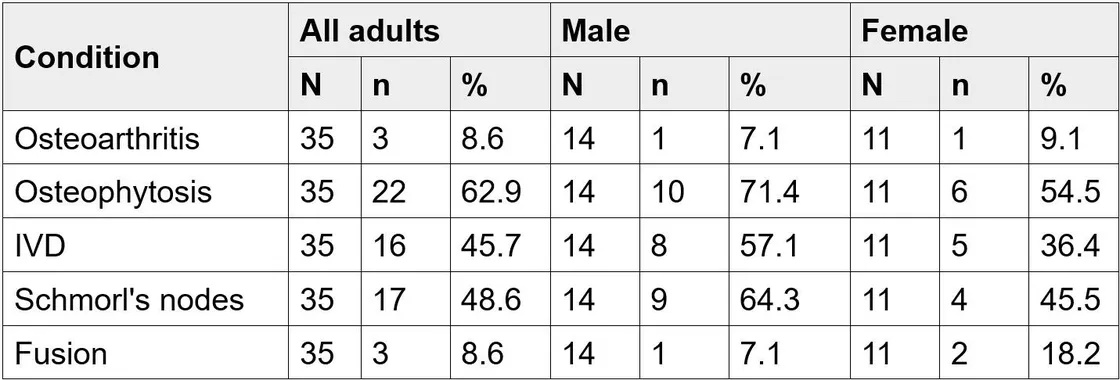
Table 5 provides a crude distribution of vertebral pathologies in the adult population. These were consistently higher in the males, particularly Schmorl’s nodes and osteophytic marginal lipping.
Table 5: Distribution of vertebral pathology by sex in adults with one or more vertebrae present
Dental pathology
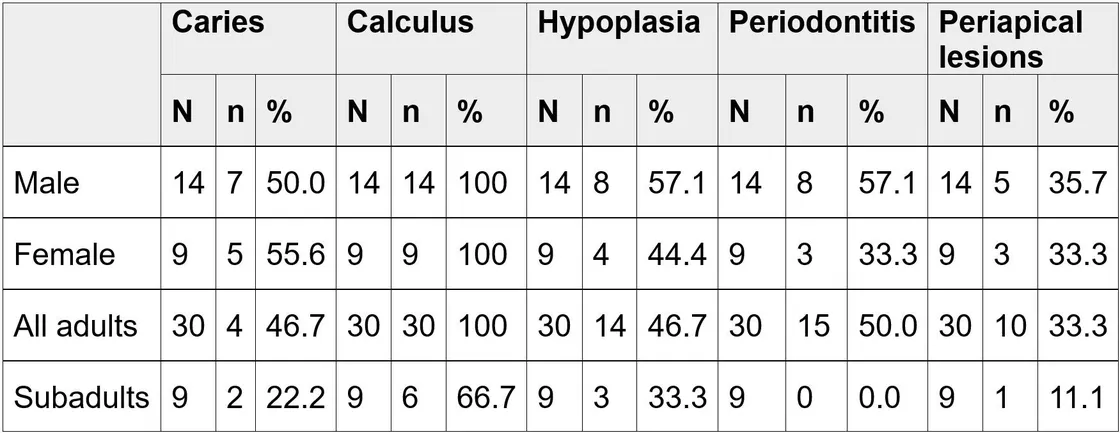
The dental health of the individuals in the friary cemetery from Table 6 were all markedly affected by calculus, with all adults affected to some degree and two-thirds of the subadults. Carious lesions were predominantly identified in the adult population with females and males affected similarly. Hypoplasia was not uncommon among the individuals but was higher in the males as was periodontal disease.
Table 6: Distribution of dental pathology in subadults and adults
Discussion
The individuals interred in the London Blackfriars medieval cemetery are an interesting, if relatively small, assemblage and documentary sources show that local merchants and tradesmen were buried here.
The time period for the burials encompassed the Great Famine (1315–1317) and the catastrophic effects of the Great Pestilence (1348–1350), which may perhaps be reflected in the presence of the mass grave. No ancient DNA analysis has been undertaken on these remains.
Downloadable documents
XLSX: 12.0 KB
This downloadable MS Excel file contains photographs of the skeletal human remains excavated at the Dominican Friary site.
XLSX: 11.1 KB
This downloadable MS Excel file contains all data of the human remains excavated at the Dominican Friary site.
Site references
Filer, J. 1991. Excavation round-up 1988, part1: City of London. London Archaeologist 6.10, 272–278, https://doi.org/10.5284/1070799
Gaimster, DRM, Margeson, S and Barry, T. 1991. Medieval Britain and Ireland in 1988. Medieval Archaeology 33.1, 161–241, https://doi.org/10.1080/00766097.1989.11735524
Heathcote, J. 1989. Excavation round-up 1988, part1: City of London. London Archaeologist 6.2, 46–53, https://doi.org/10.5284/1070825
Watson, B. 1987. The excavation of the Dominican friary cemetery in Carter Lane, EC4: assessment. Unpublished assessment report.
Watson, B. 1987. The excavation of the Dominican friary cemetery in Carter Lane, EC4: assessment. Unpublished assessment report.
Site location
56–66 Carter Lane, 1–3 Pilgrim Street, 29–33 Ludgate Hill, EC4
Site code: PIC87
Last updated: 2025
More medieval sites
-
Guildhall Art Gallery, Guildhall Yard cemetery
What the analysis of the human remains of 68 individuals tells us about health concerns of medieval Londoners
-

Spital Square burials
Data from the 126 human remains recovered from the excavations in the precinct of St Mary Spital
-

St Benet Sherehog cemetery
Excavations found 270 burials from an 11th-century church destroyed in Great Fire of London