Doctoral studies
PhD research partnerships guide our museum work and public engagement.
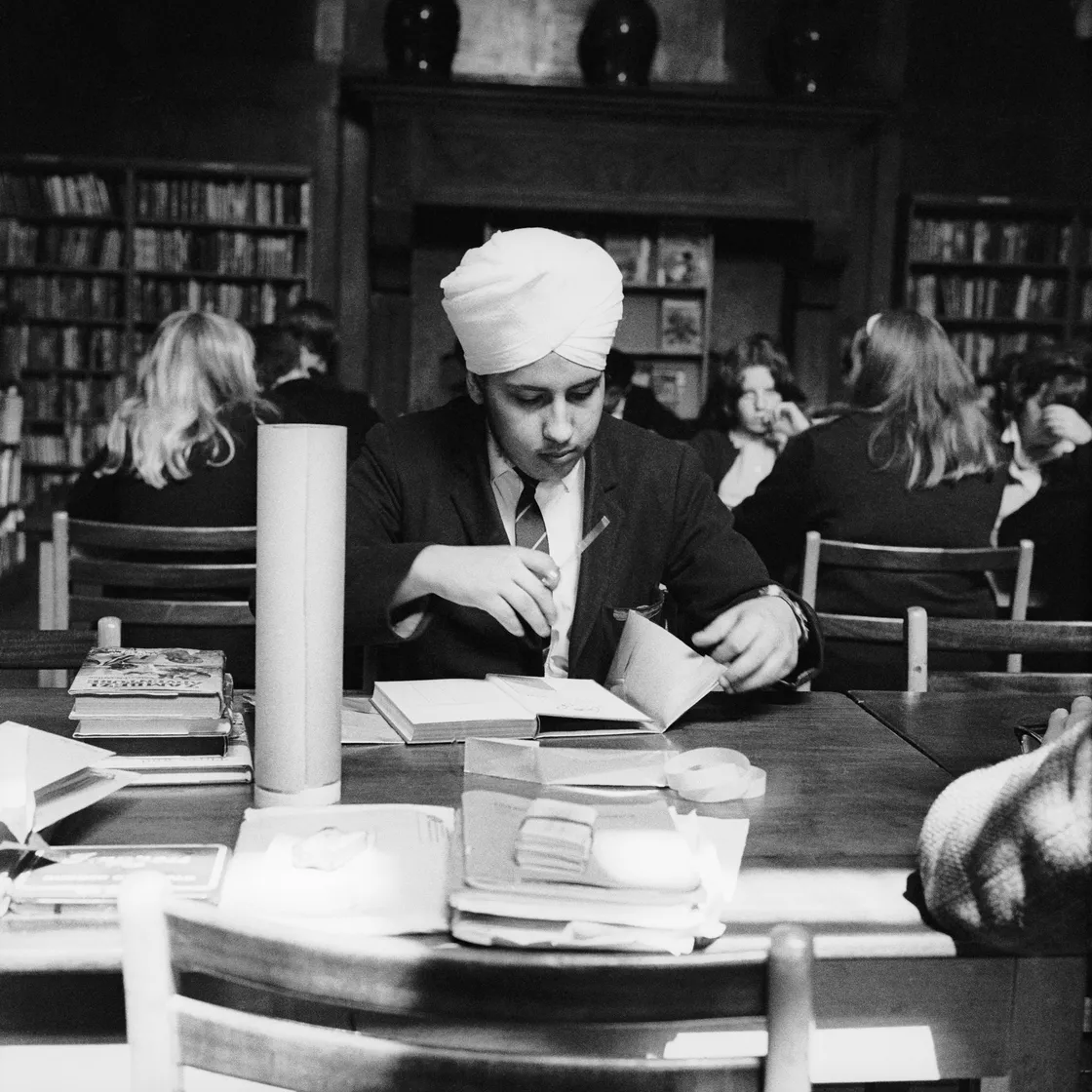
A young student in a library.
We host a range of collaborative doctoral students who we co-supervise with university partners. These projects span a wide range of subjects across our collections and practice, all closely aligned with our Research Strategy.
Doctoral researchers have received funding through major UK research councils, including the Engineering and Physical Sciences Research Council (EPSRC) and the Arts and Humanities Research Council (AHRC), via the London Arts and Humanities Partnership (LAHP), Techne and the Consortium for the Humanities and the Arts South-east England (CHASE).
The working-class museum: Exploring the lived experiences of 21st century working-class Londoners
By Lucy-Ellen Bateman
Ongoing
Supervisors: Dr Domenico Sergi, London Museum
Dr Serena Iervolino, King’s College London
This PhD project examines how socioeconomic differences and working-class experiences can be more meaningfully represented within UK museums. Using London Museum as a case study, it explores the analytic category of “working class” through the lived experiences of low-paid Londoners and considers how these narratives can be better incorporated into museum practice. The research aims to develop approaches that support more inclusive collecting, interpretation and engagement, ensuring that working-class histories and perspectives are reflected with greater depth and visibility across the museum sector.
The Place of Meat: Imperial Food Systems, Public Anxieties, and the Narration of London at Smithfield Market, 1868–1993
By Dr Jack Tyler-Hanlon
Completed: March 2025
Supervisors: Alex Werner and Dr Domenico Sergi, London Museum;
Prof Alastair Owens, Dr Regan Koch and Dr William Monteith, Queen Mary University of London, Geography
This thesis traced the history of London’s wholesale meat market from its opening in 1868 to its renovation in 1993, combining archival research with cultural analysis. It reconstructed the labour, anxieties and experiences of those who imported, stored, traded, regulated and transported London’s meat, treating Smithfield as a contested site of cultural meaning and public value.
Across six thematic chapters, the research examined representations of the market in administrative records, government inquiries, novels, newsreels, radio, sculpture, photography and oral histories, highlighting how these practices shaped the functioning and perception of the marketplace. The study explored Smithfield’s globalisation within an imperial food system, its post-imperial economic and cultural decline, and its enduring place in London’s imagination through the concept of ‘gendered nostalgia’, reflecting idealised memories of the male workforce.
Conducted in collaboration with London Museum ahead of its 2026 opening in a derelict wing of Smithfield, the research will inform a series of site-specific installations showcasing original findings.
Changing Places: Examining the Socio-Cultural Impact and Experiential Change of the new London Museum in Smithfield
By Dr Tom Butler
Completed: November 2024
Supervisors: Lauren Parker, London Museum;
Prof Monica Degen, Brunel University
This research examined the social identity and experience of Smithfield, a historic working district in London, in the context of London Museum’s relocation to the area in 2026. Conducted as a Collaborative Doctoral Award between 2020 and 2024, the study used a grounded theory approach and mixed methods, including document analysis, ethnographic observation, walking interviews and participatory workshops, to explore how accelerated culture-led development shapes local ‘sense of place’.
The thesis showed that local identity and experience are mediated through material, sensory and imagined cues, reflecting both the effects of urban change and the strategies of municipal and institutional actors. Drawing on sociology, urban studies, and museum studies, the research offered methodological, theoretical and practical contributions: adapting rhythmanalysis through a process-oriented understanding of place, theorising accommodation within senses of place, and developing a strategic blueprint for museums to engage equitably with new local contexts, disseminated via an online resource for professionals.
Staging Fashion, Imagining the City: Fashion Exhibitions and Urban Modernity at London Museum and Beyond, 1973–2026
By Dr Jihane Dyer
Completed: July 2024
Supervisors: Beatrice Behlen, London Museum;
Prof David Gilbert, Royal Holloway University of London
This thesis investigates the uses of fashion and clothing in the curation of urban history, with London Museum as its principal case study. Using archival materials and methods, the thesis examines three fashion exhibitions and displays at the museum between 1973 and 2018 in relation to shifting notions of urban modernity and key moments of institutional change.
With a view to London Museum’s move to a new venue and the potential to rethink how such objects may be used there, it also looks to contemporary curatorial precedents elsewhere in the UK and internationally, including other city museums, to pinpoint new themes and practices for interpreting cities through dress.
The Shrine and the Marketplace: Religious Materiality in London during the Long Fifteenth Century (1370–1530)
By Dr Eliot Benbow
Completed: March 2024
Supervisors: Meriel Jeater, London Museum;
Prof Miri Rubin, Dr Eyal Polegand Virginia Davis, Queen Mary University of London
This thesis examined the production, trade and use of devotional objects in London during the long fifteenth century (1370–1530), a period marked by vibrant developments in lay religious practice. Drawing on London Museum’s extensive collections including one of the world’s largest holdings of pilgrim badges, as well as carvings, tiles, beads, rings and inkpots – alongside documentary sources such as London customs and civic records, the research reconstructed the networks of production and trade that supplied devotional objects to the city. It identified key actors, including London haberdashers and their foreign counterparts, and considered the wide range of objects associated with pilgrimage and daily devotional use.
The thesis also examined how these objects were employed in parish churches, using churchwardens’ accounts to highlight varied forms of participation by parishioners, craftspeople and merchants. Concluding with the impact of the Reformation, the research demonstrated both profound changes and notable continuities in London’s material culture of devotion.
Curatorial Interruption: Critical analysis of sources of decision-making bias in dress/fashion curators […]
By Dr Cyana Madsen
Completed: July 2023
Supervisors: Dr Lucie Whitmore, London Museum;
Dr Jeffrey Horsley, University of the Arts London, London College of Fashion
This research explored an underexamined area in dress and fashion curatorship: how curatorial bias affects the interpretation of wearer and object biography.
Responding to the growing emphasis on object biography and underrepresented histories, the study focused on the practitioners responsible for analysing, interpreting and documenting garments. Drawing on ethnography, neuroscience, phenomenology, new materialist approaches, and material culture studies, it examined practitioner experiences when engaging with worn clothing objects.
The concept of ‘curatorial interruption’ was developed to identify the impact of bias on object biography during analysis.
A foundational survey established a dataset detailing the demographics and working environments of UK-based curators handling garments, complemented by an in-depth study of curatorial practices to pinpoint individual and discipline-wide influences on decision-making.
By integrating methodologies from anthropology, textile conservation, and cognitive and forensic science, the research proposed practical strategies for analysing worn garments that mitigate curatorial bias and enhance the retention of object and wearer biography.
Cellulose Acetate in Museums: A Study of Polymer-water-plasticiser Interactions and Physical Degradation Using a System Dynamics Approach
By Dr Isabella del Gaudio
Completed: January 2022
Supervisors: Abby Moore, London Museum;
Prof Ivan Parkin, Dr Katherine Curran and Dr John Duncan, University College London
This project examined the challenges posed by the conservation of plastics in museum collections, focusing particularly on the degradation of cellulose acetate (CA), a historic plastic used in textiles and a range of manufactured objects.
The research surveyed collections at London Museum and Tate to identify the types of plastics present, their condition and the factors contributing to their deterioration. Using non-invasive analytical techniques, including External Reflectance FTIR and Near-Infrared spectroscopy, the study documented the complexity of decay mechanisms in plastics, showing how different forms of damage relate to material composition, storage conditions and chemical change.
The thesis also investigated the relationship between CA, plasticisers and relative humidity through methods such as Dynamic Vapour Sorption and accelerated ageing, clarifying how water interactions and plasticiser loss influence stability. The findings offered a new approach for assessing the vulnerability of CA to relative humidity fluctuations, supporting more informed decisions about storage and display within museum environments.
Private Epigraphy in Late Medieval London: Metal Letters on Personal Possessions
By Dr Olivia Croyle
Completed: June 2022
Supervisors: Dr Glyn Davies, London Museum;
Prof Sandy Heslop and Dr Jack Hartnell, University of East Anglia
This thesis examined the role of text in the material culture of medieval London, focusing on small-scale, private inscriptions on objects such as jewellery, seal matrices, pilgrim souvenirs, spoons, purses, mirror cases and whistles.
By analysing inscriptions affixed to clothing or hidden in pockets, the research explored how these objects expressed identity, performed social relationships and demonstrated material playfulness. While many of these artefacts have been considered by art historians, their inscriptions have often been overlooked as repetitive or illegible.
Drawing on a large corpus of small metal objects, the study revealed previously unrecognised sculptural epigraphic traditions and demonstrated how letters circulated beyond the manuscript page. The thesis argued that these private inscriptions offer new insights into literacy, access and exclusion in medieval London, challenging conventional distinctions between the ‘literate’ and ‘illiterate’.
More in Research
-

Osteological Database
A database of human remains from dozens of archaeological sites across London
-
Projects & publications
Making our research accessible to everyone
-
Collections access & enquiries
We’d love to hear from you if you’d like to enquire about our collections